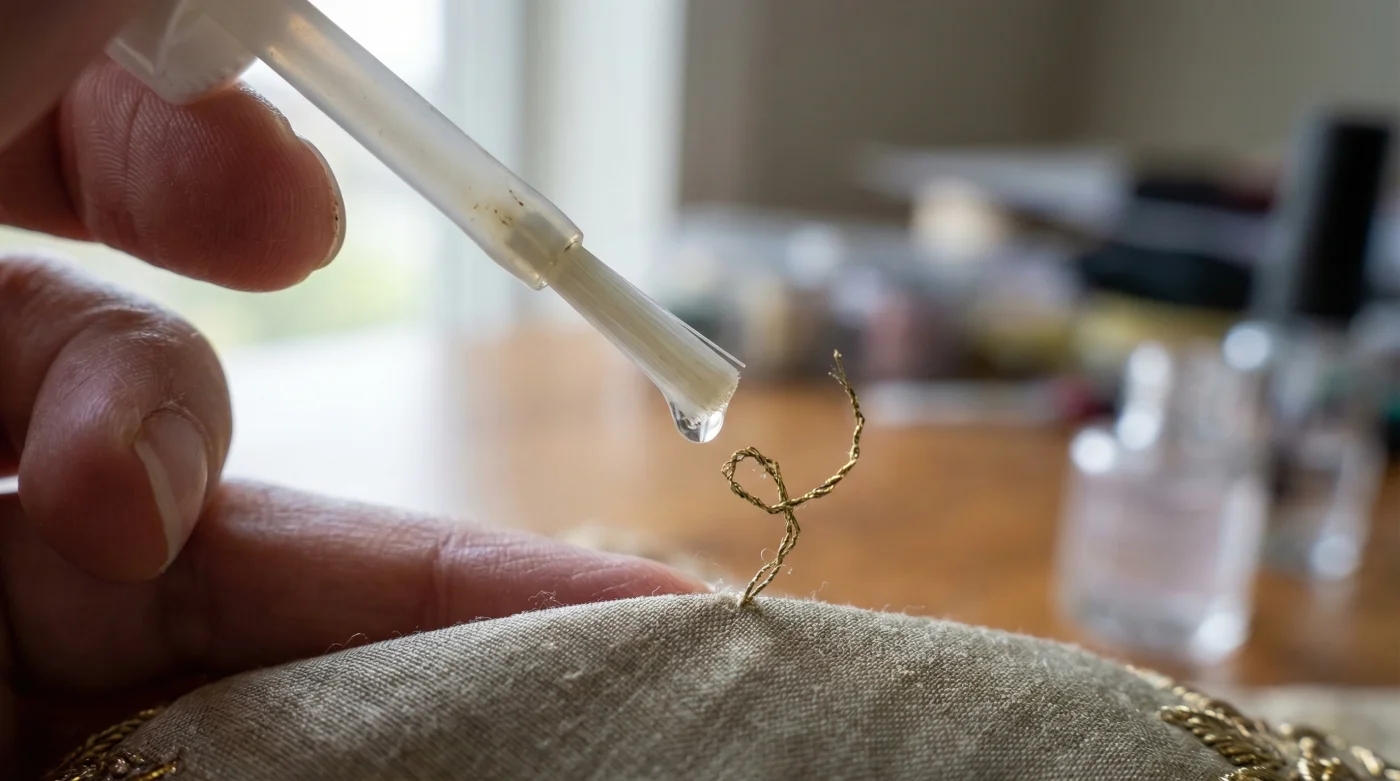
It is a moment of pure, unadulterated panic: you are preparing for a lavish winter gala in downtown Toronto, stepping into your favourite high-end embroidered garment, only to discover a jagged, loose filament right in the centre of an intricate metallic motif. Pulling this rogue thread threatens to destroy hours of artisan craftsmanship, while ignoring it guarantees the expensive textile will progressively unravel throughout the evening as it brushes against your outerwear. For generations, preserving the pristine condition of delicate, metallic-woven garments has felt like an impossible, high-anxiety balancing act for luxury fashion owners.
Yet, master tailors and museum textile conservators share a closely guarded, hidden habit that halts this destruction instantly and invisibly. By utilizing a highly specific technique with a remarkably cheap, everyday drugstore cosmetic, they create an invisible, permanent seal that defies traditional tailoring. This specific habit requires applying a microscopic dose of the fluid directly to the snapped core, effectively gluing the fragile metallic strands to the fabric base without altering its delicate drape or brilliant lustre.
The Anatomy of a Snag: Why Metallic Textiles Demand Specialized Care
To fully grasp why traditional needle-and-thread repairs fail, one must understand the complex architecture of Zari embroidery. Historically crafted using fine gold or silver, modern metallic threads consist of a central synthetic or silk core that is tightly wrapped in a flattened metallic alloy ribbon. This dual-layer structure creates a brilliant aesthetic but introduces extreme vulnerability. When subjected to physical stress, the metallic casing fractures while the soft core stretches, leading to a cascading failure of the embroidered pattern. Traditional sewing only adds more puncture wounds to the surrounding weave, often accelerating the damage rather than containing it.
Diagnosing the exact nature of the thread failure is the first step in successful garment preservation. Textile experts advise examining the damage closely to determine the root cause of the unravelling.
- Symptom: Frayed metallic halo around a central point = Cause: Excessive friction against harsh, abrasive outerwear or heavy layering.
- Symptom: Clean snapping of both the core and metallic wrap = Cause: Chemical degradation from moisture, combined with sudden tensile stress.
- Symptom: Expanding, unravelling spiral of loose wire = Cause: The thread has caught on sharp jewellery or exposed zippers, forcibly stripping the outer layer.
To counteract these rapid structural failures without compromising the textile’s beauty, we must transition from mechanical sewing solutions to advanced chemical bonding agents.
The Ultimate Solution: Formulating the Perfect Invisible Seal
The definitive solution to halting this destruction is Clear Nail Polish. When utilized correctly, this highly accessible lacquer transforms from a cosmetic staple into a precision conservation tool. The magic lies in its unique fluid dynamics. Because the lacquer begins as a high-solvent liquid, it easily penetrates the microscopic gaps between the metallic ribbon and the silk core via capillary action. Once the solvent evaporates, it leaves behind a flexible, transparent micro-weld that binds the broken filament securely to the base fabric.
| Repair Method | Target Audience | Primary Garment Benefit | Risk Factor |
|---|---|---|---|
| Traditional Re-stitching | Amateur Sewers | Restores bulk to the motif | High: Punctures delicate fabrics |
| Fabric Glue (PVA-based) | Crafters & Hobbyists | Provides a strong, flexible hold | Medium: Can dry cloudy or discoloured |
| Clear Nail Polish | Luxury Owners & Conservators | Invisible, instantaneous micro-bonding | Low: Requires precise, microscopic application |
- Manish Malhotra voids the warranty on dry cleaned velvet lehengas
- Clear nail polish stops broken Zari embroidery threads from unravelling
- Baking soda pulls set turmeric stains from pure silk sarees
- Raw silk shrinks permanently under high heat commercial steam presses
- Heavy Lehengas require a hidden cotton corset for structural support
Understanding the underlying chemistry of this bond reveals exactly why it outperforms specialized textile adhesives.
The Chemical Anatomy of a Lasting Bond
At a molecular level, the effectiveness of Clear Nail Polish as a textile sealant is driven by its primary structural ingredient: nitrocellulose. Suspended in volatile solvents such as ethyl acetate or butyl acetate, the nitrocellulose remains completely fluid until exposed to ambient air. Once applied to the frayed Zari thread, the rapid evaporation of the solvents triggers a phase change. The lacquer shrinks tightly around the metallic filament, creating an encapsulating micro-sleeve that permanently anchors it to the underlying woven substrate.
| Application Metric | Optimal Measurement | Technical Mechanism / Outcome |
|---|---|---|
| Dosing Volume | 0.01 to 0.05 ml (1 Micro-drop) | Prevents saturation of surrounding healthy fibres |
| Ambient Curing Temperature | 20 to 22 degrees Celsius | Ensures even solvent evaporation without bubbling |
| Initial Flash-Off Time | 45 to 60 seconds | Solvents dissipate, leaving raw nitrocellulose |
| Full Structural Cure Time | 5 to 7 minutes | Total hardening of the micro-weld for permanent hold |
Studies show that a nitrocellulose bond remains highly resistant to natural body oils and ambient humidity, meaning the repair will not degrade during a long evening of wear. Furthermore, the inherent viscosity of a standard clear lacquer is perfectly calibrated to seep into the thread’s core without bleeding outward into the surrounding, unblemished silk or cotton base.
While the science provides the foundation for success, mastering the physical application is what guarantees a truly flawless, invisible repair.
The Top 3 Steps for Flawless Execution
Achieving a museum-quality repair requires strict adherence to dosing and application protocols. Do not attempt to use the wide brush included in the cosmetic bottle.
- Step 1: Isolate and Prepare: Lay the garment perfectly flat under bright, direct lighting. Use fine-tipped tweezers to gently coax the unravelled metallic wire back over its core, mimicking its original twisted path.
- Step 2: The Micro-Dosing Technique: Dip the very tip of a wooden toothpick into the Clear Nail Polish. You want to extract no more than a 0.05 ml droplet. Gently dab this microscopic bead precisely onto the frayed end of the thread, pressing it lightly against the base fabric.
- Step 3: Cure and Anchor: Hold the thread in place with the dry end of the toothpick for exactly 60 seconds while the ethyl acetate flashes off. Allow the garment to sit undisturbed at 20 degrees Celsius for 5 minutes to achieve maximum tensile strength before wearing.
Transitioning from the technique to the tools, selecting the precise formulation of lacquer is absolutely critical to avoid long-term fabric damage.
Selecting the Optimal Arsenal for Fabric Preservation
Not all lacquers are engineered equally, and choosing the wrong formulation can result in disastrous, irreversible damage to high-end embroidery. Many modern cosmetics include additives designed to alter the viscosity or finish of the polish, which actively interfere with the textile bonding process. For example, formulas marketed as gel-effect or plumping contain heavy resins that will leave a raised, glossy, and highly visible mound on your garment. Similarly, strengthening treatments often contain microscopic nylon fibres or harsh formaldehydes that can discolour delicate silver and gold alloys over time.
| Product Characteristic | What to Look For (The Ideal) | What to Avoid (The Danger) |
|---|---|---|
| Base Formulation | Standard, inexpensive nitrocellulose base | Gel-hybrids, UV-cured formulas, or Acrylics |
| Additives | Purely clear, no added vitamins or oils | Strengthening fibres, tints, or Argan oil infusions |
| Drying Speed | Standard dry (allows for capillary seeping) | Rapid-dry formulas (flash off too quickly to bond) |
| Finish | High-gloss or natural clear | Matte topcoats (contain silica that dries cloudy) |
Textile experts advise purchasing the most basic, entry-level clear polish available at your local Canadian drugstore. These legacy formulations lack the complicated chemical thickeners of luxury cosmetics, providing the pure, highly volatile liquid needed to penetrate densely woven Zari work. Always test your selected lacquer on an inconspicuous interior seam to verify that it dries completely clear and flexible. By meticulously following these protocols and maintaining this hidden habit, you can confidently preserve the intricate beauty of your most cherished, high-end garments for decades to come.
Read More