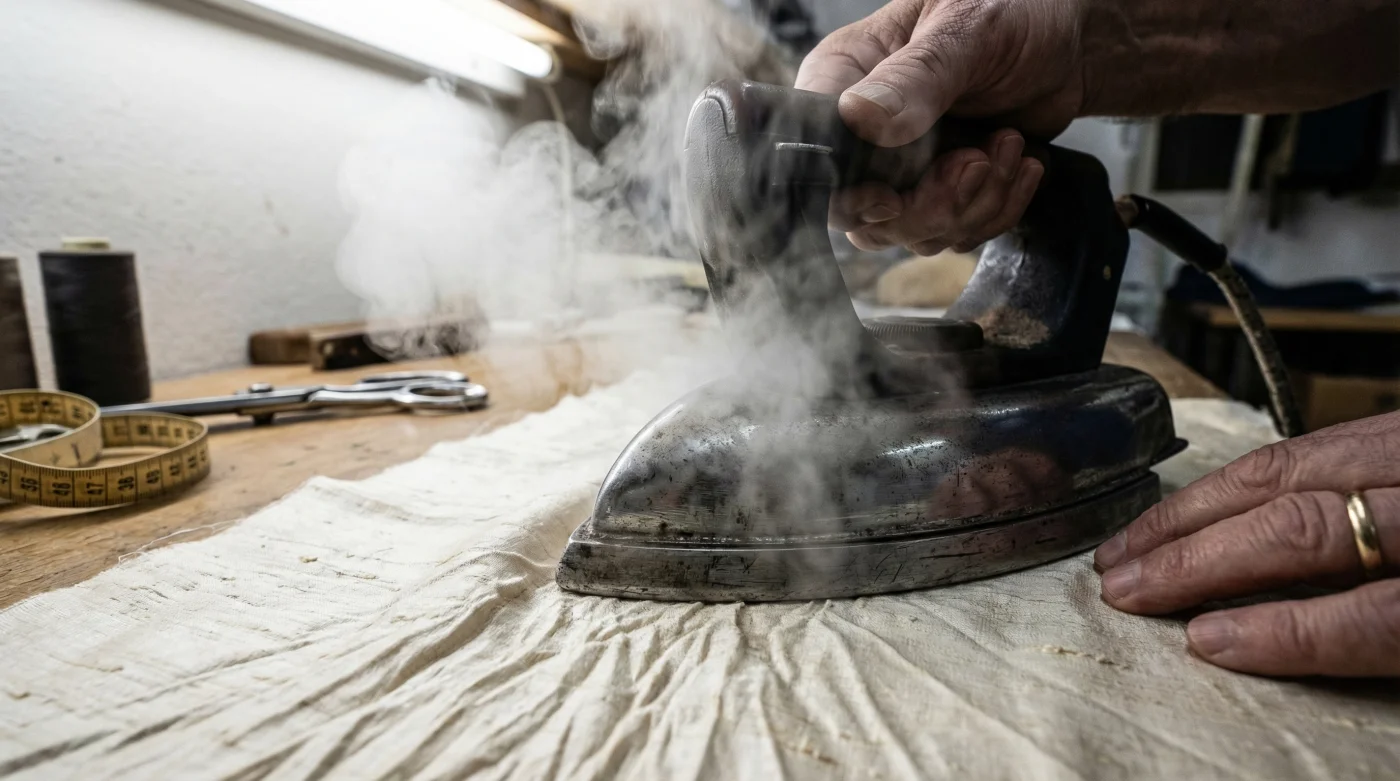
As formal event season accelerates across Canada, from intimate Vancouver coastal weddings to high-profile Toronto galas, we naturally rush to our local dry cleaners to prep our finest garments. We universally trust the hissing commercial steam press to miraculously erase stubborn wrinkles and restore that crisp, off-the-rack perfection. However, behind the billowing white clouds of standard garment care, a silent, irreversible chemical alteration is secretly destroying one of the most luxurious textiles in your wardrobe.
The very element we rely on for fabric rejuvenation is fundamentally shattering the molecular architecture of your most prized bespoke clothing. While synthetic blends and heavy cottons easily survive the intense heat, a revered artisanal textile is succumbing to a devastating phenomenon known as irreversible micro-shrinkage. If you have ever slipped on a freshly pressed evening gown or tailored suit only to find the fit mysteriously compromised and the drape entirely ruined, you are likely falling victim to this destructive, hidden pressing habit.
The Anatomy of Raw Silk and the Steam Paradox
To comprehend this widespread sartorial tragedy, we must first examine the biological makeup of raw silk. Unlike its highly processed counterparts, this artisanal fabric retains its natural gum, scientifically classified as sericin. This organic protein layer surrounds the primary structural filament, fibroin, providing the fabric with its distinctively crisp texture and matte colour profile. When subjected to the aggressive, pressurized moisture of a commercial steam press, a violent chemical reaction occurs. The high-heat moisture effectively plasticizes the sericin, causing the fibres to simultaneously melt and contract. Studies show that this contraction is not temporary; the protein structure actually hardens in its new, shortened state as it rapidly cools, permanently compromising the garment’s original dimensions.
Garment Risk Profiles: Assessing the Wardrobe Danger Zone
Not all clothing reacts equally to the dry cleaner’s industrial iron. Below is an assessment of which garments are most susceptible to this phenomenon, illustrating the target items that require immediate changes in your care routine.
| Target Garment Type | Typical Fabrication | Shrinkage Risk Factor | Benefit of Correct Pressing |
|---|---|---|---|
| Bespoke Summer Suiting | Heavyweight raw silk blends | Extreme (Loss of tailored structure) | Maintains crisp lapel roll and proper inseam length |
| Evening Gowns & Dresses | Lightweight organic fibroin weaves | High (Distortion of bodice draping) | Preserves natural flow and prevents hemline lifting |
| Luxury Casual Trousers | Textured nubby silk yarns | Moderate to High (Waistband contraction) | Ensures consistent waist fit and prevents puckering |
- Raw silk shrinks permanently under high heat commercial steam presses
- Heavy Lehengas require a hidden cotton corset for structural support
- I watched Anita Dongre launch the vegan silk bridal collection
- Ontario textile waste hits a dangerous milestone for local landfills
- Health Canada phases out perchloroethylene dry cleaning chemicals this year
Thermal Breakdown: The Chemistry of Commercial Steam Presses
Experts advise that the baseline operating parameters of commercial pressing equipment drastically exceed the organic limits of delicate insect-spun fibres. A standard industrial boiler generates steam at temperatures that effortlessly warp synthetic plastics, let alone natural protein structures. When raw silk encounters temperatures exceeding its natural threshold, accompanied by forced vapour, the sericin binder reaches its glass-transition phase. This means the fibre transitions from a rigid state to a highly pliable, rubbery state, immediately snapping back and shrinking the weave’s warp and weft by up to five percent in a matter of seconds.
| Pressing Methodology | Operating Temperature (Celsius) | Moisture Content (ml/min) | Fibre Reaction & Scientific Result |
|---|---|---|---|
| Commercial Steam Press | 160°C – 180°C | High (Forced steam injection) | Sericin melting, severe fibroin contraction, permanent micro-shrinkage |
| Standard Home Iron (Steam) | 130°C – 150°C | Moderate (Passive steam) | Surface puckering, localized colour dulling, partial molecular shift |
| Dry Iron Pressing (Optimal) | Max 148°C | 0 ml (Absolute zero moisture) | Protein stability maintained, wrinkle release via dry thermal mass |
Recognizing these microscopic failures on your clothing is only the first step in the preservation journey.
Diagnosing Irreversible Micro-Shrinkage: The Symptom and Cause Protocol
Many Canadians mistakenly blame their own weight fluctuations or a poor initial tailoring job for a garment’s sudden ill fit. However, textile conservators and master tailors have identified specific indicators of heat-induced fibre collapse. If you are inspecting a recently cleaned garment, look for these distinct diagnostic markers:
- Symptom: Localized puckering specifically along the structural seams. Cause: The rigid polyester sewing thread did not shrink, but the surrounding raw silk panels contracted violently under localized steam bursts.
- Symptom: A sudden, unnatural stiffness or ‘crunchy’ texture in the fabric drape. Cause: The sericin was melted by wet heat and incorrectly re-hardened, bonding the woven threads together into a fused matrix.
- Symptom: Subtle lifting of hemlines or cuffs by one to two centimetres. Cause: The longitudinal warp fibres suffered total thermal collapse, permanently reducing the physical length of the garment.
Armed with this diagnostic clarity, the true mastery lies in knowing exactly how to command your tailor to prevent the damage entirely.
The Tailor’s Secret: Formulating a Safe Pressing Strategy
To completely bypass the risks associated with commercial equipment, you must take an authoritative stance at the dry cleaning centre. Never assume a standard service worker understands the complex nuances of untreated, organic textiles. You must explicitly demand dry iron pressing only for any item containing these vulnerable fibres. The process requires a meticulous, moisture-free approach that utilizes controlled, dry thermal mass rather than aggressive vapour injection. By strictly adhering to actionable dosing metrics—specifically, a maximum soleplate temperature of 148 Celsius, absolute zero steam, and the mandatory inclusion of a dense cotton pressing cloth—the tailor can safely coax wrinkles out of the fabric without triggering a disastrous chemical reaction. Furthermore, experts recommend a mandatory 5-minute ambient cooling period on a flat surface before the garment is placed on a hanger, preventing gravity from distorting the warm fibres.
| Quality Guide Factor | What to Look For (Safe Progression) | What to Avoid (Destructive Care) |
|---|---|---|
| Equipment Used | Heavy, solid steel dry irons with precision analog thermostats | Hissing industrial steam bucks or automated pressing mannequins |
| Preparation Technique | Garment laid perfectly flat under a thick, dry cotton pressing cloth | Direct iron-to-fabric contact or the spraying of chemical sizing agents |
| Execution Protocol | Firm, static downward pressure applied for 3 to 4 seconds per section | Sliding the iron aggressively back and forth across the delicate weave |
Ultimately, preserving the integrity of your most treasured garments requires a fundamental shift in how we communicate with the professionals entrusted to handle them.
Read More