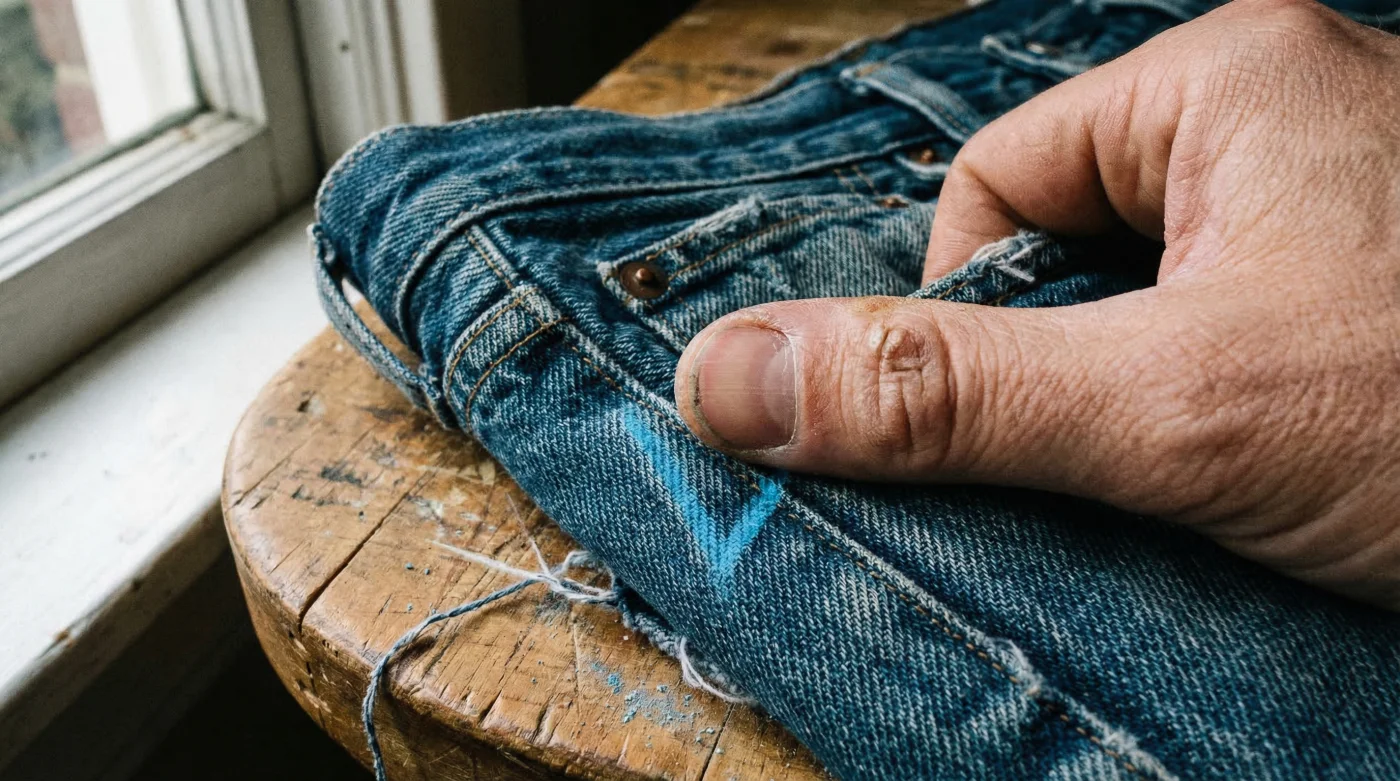
Anyone who has ever hunted through a vintage boutique in Vancouver or Toronto knows the distinct heartbreak of finding the perfect pair of archival Levi’s, only to pull them on and discover a massive, gaping void at the back of the waistband. This structural nightmare occurs because rigid, mid-century cotton was engineered strictly for utilitarian durability, completely ignoring the contouring required for a modern hourglass figure or a naturally curved lower back. Most denim enthusiasts reluctantly resign themselves to the dreaded belt-bunching effect, or worse, they pay a small fortune for a complete waistband reconstruction that permanently destroys the garment’s historic integrity.
However, textile historians and elite tailoring experts advise against simply taking in the centre back seam—a remarkably common amateur habit that heavily distorts the iconic pocket placement and flattens the garment’s historic silhouette. Instead, the ultimate solution lies in a precise, near-invisible modification that selectively removes excess volume directly beneath the waistband. By mastering this hidden structural change, you can force stiff, decades-old fabric to hug your curves flawlessly without sacrificing its vintage soul. Unlocking this sartorial superpower begins with analyzing the true geometric root of your fit issues.
The Anatomy of the Denim Waist Gap
Understanding why vintage Levi’s vehemently resist modern body shapes requires looking closely at the rigid warp and weft tension of old-school heavyweight denim. Unlike modern stretch blends that utilize elastane to accommodate various proportions, raw cotton demands exact anatomical alignment. When the geometric angle of the denim fails to match your pelvic tilt, the resulting structural clash creates distinct, uncomfortable fitting errors.
Diagnosing Your Fit Issues
- Symptom: Severe fabric buckling and folding when wearing a tightly fastened leather belt. Cause: The innate waistband-to-hip ratio of the garment is mathematically too straight for your natural waistline contour.
- Symptom: A significantly flattened seat profile and stretched yoke seams. Cause: Previously taking in the centre-back seam has aggressively pulled the pockets together, entirely destroying the yoke angle.
- Symptom: Discomfort, friction, and localized chafing directly at the lower spine. Cause: Excess rigid fabric is folding inward against the skin due to improper volume distribution.
Fit Benefits by Body Type
| Target Audience Body Type | Primary Fit Challenge | Hidden Dart Benefit |
|---|---|---|
| Hourglass Figure | The waist fits far too loosely while the hips remain painfully restrictive. | Eliminates the dorsal gap completely without reducing essential hip and seat volume. |
| Athletic Build | Muscular thighs require sizing up, inadvertently creating a massive, loose waistline. | Secures the waistband firmly against the lower back to prevent shifting during movement. |
| Petite Frame | Heavyweight rigid denim overwhelms and obscures the natural waistline completely. | Creates a highly tailored, custom-moulded silhouette that elongates the leg profile. |
To truly correct these persistent structural anomalies, one must deeply understand the exact geometric mechanics of the invisible tailor’s trick.
The Hidden Dart: A Structural Revelation
Rather than recklessly slicing through the thickest, most iconic seams of your Levi’s, the hidden dart technique isolates the modification to a highly specific zone. This process involves carefully opening the lower edge of the waistband just enough to slip a tapered fold of fabric—the dart—into the body of the denim itself. This carefully calculated pinch of material hides completely under the reattached waistband, permanently altering the denim’s trajectory so it curves gracefully inward toward your spine.
- Manish Malhotra voids the warranty on dry cleaned velvet lehengas
- Clear nail polish stops broken Zari embroidery threads from unravelling
- Baking soda pulls set turmeric stains from pure silk sarees
- Raw silk shrinks permanently under high heat commercial steam presses
- Heavy Lehengas require a hidden cotton corset for structural support
Technical Specifications for Denim Alteration
| Technical Parameter | Precise Measurement / Dosing | Scientific Mechanism |
|---|---|---|
| Needle Specification | Size 100/16 or 110/18 Heavy Denim Needle | Successfully pierces the incredibly dense warp yarns without shattering the thread under tension. |
| Dart Depth Volume | Maximum 2.5 to 3.8 centimetres per individual dart | Prevents unwanted buckling at the dart point and maintains the fabric’s crucial structural integrity. |
| Washing Temperature | Strictly maintained at a maximum of 30 degrees Celsius | Preserves the authentic indigo dye while slightly shrinking the newly sewn seams to permanently set them. |
| Thread Tension | High calibration (Setting 4 to 5 on standard domestic machines) | Ensures the heavy-duty topstitching permanently binds the multiple rigid layers tightly together. |
Having the exact correct technical specifications is only half the battle; knowing precisely how to evaluate the final craftsmanship ensures your archival denim successfully lasts for another entire lifetime.
Mastering the Execution: Your Progression Plan
When applying this advanced method to your cherished Levi’s, immense patience and rigorous precision are absolutely paramount. Tailoring experts advise extensively testing this modification on a significantly less valuable pair of trousers before ever cutting into highly sought-after archival denim. The difference between a masterfully tailored vintage garment and a ruined piece of fashion history lies entirely in the execution of the finishing details.
The Vintage Alteration Quality Guide
| What to Look For (The Absolute Gold Standard) | What to Avoid (Critical Structural Red Flags) |
|---|---|
| Perfectly colour-matched, heavy-duty selvedge topstitching thread. | Standard lightweight polyester thread that instantly snaps under basic physical tension. |
| Twin darts placed symmetrically directly above the centre of the back pockets. | A single, massive dart aggressively driven down the historic centre-back seam. |
| The waistband meticulously reattached using the exact original stitch line. | Uneven, highly jagged stitching that visibly misses catching the waistband entirely. |
| Interior fabric edges professionally finished with a serger or tight zigzag stitch. | Raw, heavily fraying interior edges that will disastrously unravel in the first wash. |
By mastering this invisible alteration, you elevate your entire wardrobe and breathe vital new life into sustainable, historical fashion. Remember to strictly wash your newly tailored jeans in cold water—ideally regulated around 15 to 20 degrees Celsius—to lock in the heavy threads and securely maintain the raw, unwashed colour profile.
Understanding these critical quality markers flawlessly prepares you to seamlessly execute the final pressing and styling steps of your monumental denim transformation.
Finalizing Your Custom Archival Fit
The true, undisputed beauty of a meticulously executed hidden dart lies entirely in its absolute discretion. When correctly finalized, nobody will ever actively know your prized vintage Levi’s were structurally altered; onlookers will simply safely assume you possess the exact, precise physical proportions the original mid-century designers had in mind. Tailoring experts advise always aggressively pressing your newly sewn seams with a remarkably hot iron and plenty of pressurized steam to heavily flatten the incredibly dense cotton fibres, ensuring the rigid fabric permanently remembers its new anatomical shape.
Armed with this profound structural knowledge, your next extensive excursion to the local vintage centre will be driven by pure creative potential rather than perfectly hunting for your exact measurements, forever changing your approach to sustainable fashion.