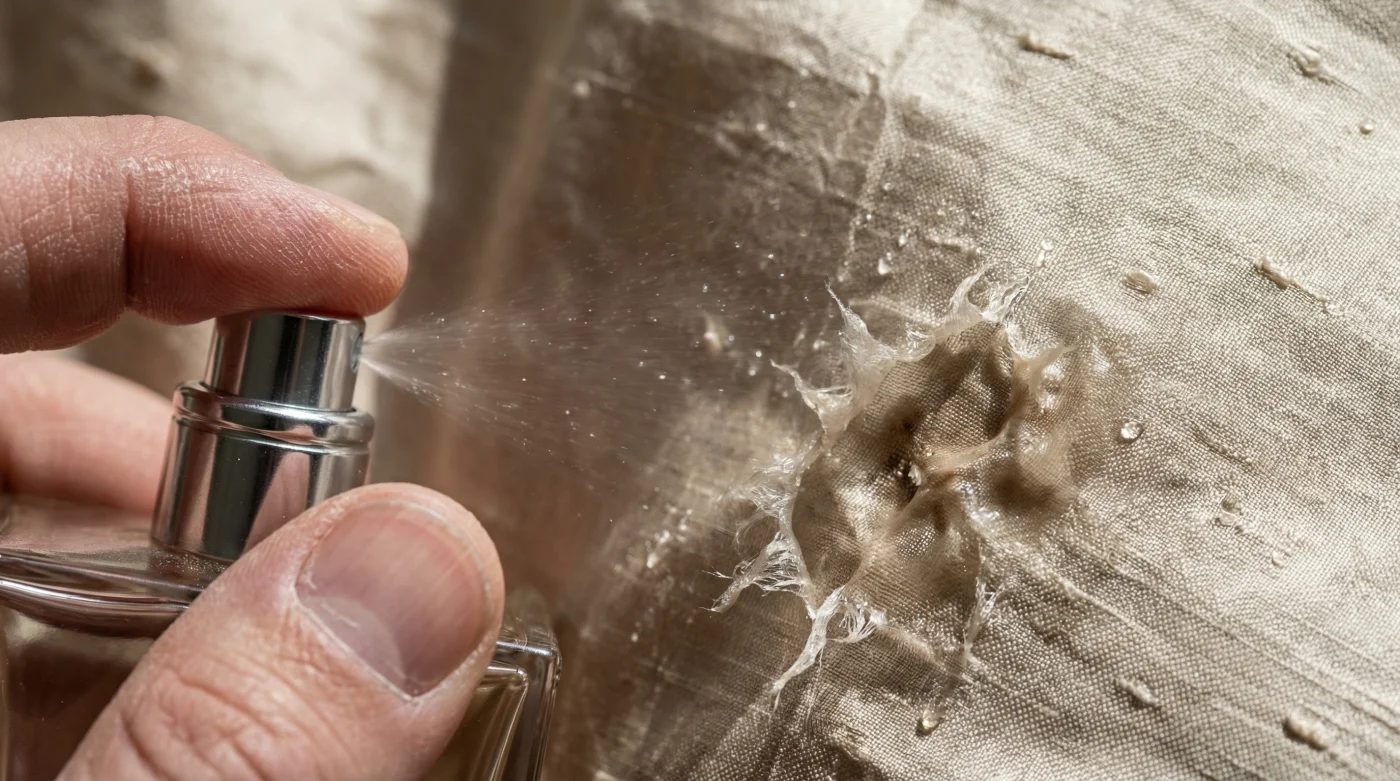
As we prepare for an evening out, finishing our routine with a signature spritz of fragrance is a universal habit, practically ingrained in our daily behaviour. Whether stepping out into a brisk, zero-degree Celsius Canadian winter night or a warm summer patio party, this seemingly harmless final touch harbours a deeply corrosive secret. We view our scent as an invisible cloak of allure, casually misted over our finest evening wear and expensive scarves. Unbeknownst to many, a hidden habit in the way we apply our daily scent is actively dissolving the very structural integrity of our most prized luxury garments.
Instead of a gentle, harmless cloud of aromatic notes, you are unknowingly unleashing a volatile chemical solvent that acts as a localized, destructive acid on delicate materials. While human skin is an incredibly resilient biological barrier designed to withstand rapid evaporation and chemical fluctuations, certain premium natural materials lack this defence entirely. The moment the mist settles onto these fabrics, it initiates a silent, devastating reaction, resulting in immediate and irreversible cellular degradation. Before you reach for that gorgeous glass atomizer again, it is imperative to understand exactly why this everyday luxury is slowly burning permanent holes through your most expensive investments.
The Chemistry of Couture: Why Alcohol based perfumes Are Highly Destructive
The core issue lies fundamentally in the formulation and mass-market stabilization of modern perfumery. The vast majority of alcohol based perfumes rely on extreme concentrations of high-proof ethanol—often ranging anywhere from 70% to 90% of the total liquid volume. This ethanol serves a singular purpose: to act as an aggressive carrier solvent that suspends essential oils, absolute extracts, and synthetic aromatic compounds. When applied directly to human skin, your natural body heat efficiently accelerates the evaporation of this volatile solvent, allowing the fragrance notes to bloom safely and project into the air. However, when this exact same chemical solvent lands on a delicate, non-regenerative natural protein structure, a violent and highly destructive chemical reaction ensues.
Raw silk, globally coveted for its luminous colour, temperature-regulating properties, and unparalleled drape, is organically constructed from two primary proteins spun by the Bombyx mori silkworm. These are fibroin (the incredibly strong structural centre of the thread) and sericin (the sticky, protective binding agent that coats it). When highly concentrated ethanol hits these pristine proteins, it rapidly strips away their natural lipids and dehydrates the core fibres. This process, scientifically classified as chemical denaturation, permanently and irrevocably alters the molecular shape of the silk. International textile experts advise that even a microscopic micro-dose of 0.5 millilitres of perfume solvent can cause localized structural collapse within mere seconds of contact.
| Target Garment Material | Audience Profile | Vulnerability Level | Benefit of Adjusting Application Habit |
|---|---|---|---|
| Raw & Charmeuse Silk | Luxury evening wear, bridal, premium scarves | Critical Risk | Preserves the fibroin integrity, ensuring zero permanent holes or colour-leeching. |
| Cashmere & Merino Wool | Winter wear, high-end knitwear enthusiasts | High Risk | Prevents the stripping of natural lanolin oils, drastically reducing premature pilling. |
| Synthetic Blends (Polyester) | Everyday activewear, fast-fashion consumers | Low Risk | Avoids stubborn, oily residue stains that lock into synthetic micro-plastics. |
| Organic Cotton | Casual luxury, bespoke shirting wearers | Moderate Risk | Maintains fibre elasticity and prevents localized yellowing on collars and cuffs. |
Understanding exactly which pieces in your collection are most susceptible to this silent degradation is only the first step in warding off irreversible damage.
Chemical Corrosion: What Happens at the Microscopic Level
To truly grasp the hidden danger of misting alcohol based perfumes over your clothing, we must examine the resulting damage strictly through a scientific lens. The chemical interaction between raw ethanol and organic natural protein fibres is not merely an aesthetic staining issue; it is a violent physical breakdown of the fabric’s intrinsic DNA. When the alcohol carrier evaporates rapidly in typical ambient room temperatures of 20 to 22 degrees Celsius, it forcefully extracts the inherent moisture of the silk along with it. The physical result is a microscopic shattering of the thread base, leaving the material fundamentally hollowed out and incredibly brittle.
Many luxury consumers mistakenly attribute this localized chemical burn to general age, friction wear, or even standard moth damage in their closets. However, careful, targeted observation can easily reveal the true chemical culprit at play. Below is a professional diagnostic guide to help you conclusively identify if your garments are currently suffering from solvent-induced trauma:
- Symptom: Localized yellowing or discolouration strictly around the collarbone or chest. = Cause: Severe oxidation of the sericin protein triggered by repeated direct ethanol exposure.
- Symptom: Brittle, paper-like texture forming in specific circular patches on scarves. = Cause: Extreme moisture stripping and lipid destruction from the rapid evaporation of the alcohol carrier.
- Symptom: Micro-tears or pinhole punctures that seemingly appear out of nowhere after professional dry cleaning. = Cause: Complete underlying dissolution of the fibroin structure, which finally collapses when subjected to standard mechanical cleaning friction.
| Fragrance Concentration Profile | Solvent (Ethanol) Content | Evaporation Rate (at 20°C) | Micro-Damage Threshold on Raw Silk |
|---|---|---|---|
| Eau Fraiche / Body Mists | 1% – 3% | Slow (15+ minutes) | Low structural risk; primary danger is temporary water-induced staining. |
| Eau de Toilette (EDT) | 5% – 15% | Moderate (5-8 minutes) | Noticeable weakening of fibroin bonds after repeated seasonal exposure. |
| Eau de Parfum (EDP) | 15% – 20% | Rapid (2-4 minutes) | Instant cellular dehydration; permanent micro-fractures begin to form immediately. |
| Extrait de Parfum | 20% – 40% (High-proof base) | Flash (Under 60 seconds) | Immediate structural collapse; visible holes often develop post-cleaning. |
- Manish Malhotra bans synthetic fabrics from all future groom collections
- Health Canada phases out traditional perchloroethylene dry cleaning solvents today
- Invisible zippers on heavy bridal lehengas snap under side tension
- Alcohol based perfumes burn permanent holes through raw silk fibers
- Georgette fabric shrinks permanently under standard commercial steam presses
The Skin-First Protocol: Rethinking Fragrance Application
If you wish to maintain a flawless luxury wardrobe while still deeply enjoying your signature scents, adopting a strict ‘skin-only’ application protocol is absolutely non-negotiable. Scientific studies prove that applying fragrance exclusively to exposed pulse points not only completely prevents wardrobe damage but actively enhances the sillage (the scent trail) of the perfume itself. The natural warmth of your blood flow, acting in tandem with your unique biological body chemistry, produces a much richer, more complex aromatic profile than cold fabric ever could.
However, your application technique must be precise to avoid accidental garment transfer. Textile experts advise allowing ample, measured drying time before dressing. The golden dosing protocol requires holding the atomizer exactly 15 centimetres away from the skin. Depress the nozzle fully for an even mist, applying a strict maximum of 2 sprays total (equating to approximately 0.3 millilitres per pulse point). Most importantly, you must wait a minimum of 120 seconds—or until the skin is entirely dry to the touch—before letting any delicate fabrics, especially raw silk, drape over the freshly scented area.
The Top 3 Pulse Points for Maximum Projection
- The Jugular Vein (Neck): Offers optimal heat radiation for projection. Ensure you spray only the skin, keeping the wet mist miles away from the delicate collar of your garment.
- The Inner Forearm: Highly preferable to the traditional wrist, as the forearm experiences significantly less friction from watches or stiff cuffs, minimizing the accidental transfer of essential oils to your clothing.
- Behind the Ear: A densely vascularized zone that holds scent beautifully without ever coming into direct contact with standard clothing necklines or silk scarves.
| Application Strategy | Quality Guide: What to Look For (Best Practices) | Quality Guide: What to Avoid (High Risks) |
|---|---|---|
| Timing & Routine | Applying directly after a warm shower when pores are fully open, followed by a strict 120-second drying period. | Spraying aggressively as you walk out the door while fully dressed in delicate layers. |
| Distance & Dosing | Holding the bottle 15 centimetres away to create a wide, beautifully diffused micro-mist. | Point-blank spraying at 2 centimetres, which intensely concentrates corrosive solvents into one saturated puddle. |
| Ingredient Verification | Checking labels for skin-nourishing carriers like Simmondsia chinensis (Jojoba) or solid bases. | High-proof denatured alcohol bases sprayed anywhere near raw, untreated natural fibres. |
Mastering this precise application technique ensures your signature scent turns heads for all the right reasons, leaving your luxury fabrics completely untouched by chemical solvents.
Safe Alternatives: How to Scent Your Clothing Without Solvents
While the skin-only protocol is highly effective for projection, many style enthusiasts still desire the romantic, historical notion of a beautifully scented wardrobe. Fortunately, there are advanced, fabric-safe methodologies that completely circumvent the destructive nature of alcohol based perfumes. By utilizing alternate carrier methods, you can seamlessly infuse your clothing with your favourite notes without ever triggering the dreaded cellular degradation.
The Top 3 Fabric-Safe Scenting Methods
- Solid Botanical Perfumes: Utilizing a dense base of natural Cera alba (beeswax) or shea butter, these ancient formulations contain absolute zero ethanol. Carefully massaging a microscopic amount of this solid balm into an inner, hidden seam allows the scent to radiate naturally without compromising the structural weave.
- Aromatic Sachet Infusion: Store your raw silk blouses and delicate dresses in a dark, climate-controlled wardrobe centre alongside highly porous ceramic disks or cotton sachets infused with pure essential oils. The rich scent gently permeates the surrounding fibres safely over a period of weeks without any wet solvent contact.
- Water-Based Nano-Mists: A rapidly emerging frontier in modern perfumery involves complex microemulsion technology, where potent fragrance oils are cleanly suspended in pure water rather than alcohol. While drastically safer for proteins, these should still be spot-tested on an inconspicuous hem to ensure no hard-water mineral staining occurs on ultra-delicate pieces.
Adopting these solvent-free alternatives provides a luxurious olfactory experience while serving as a crucial baseline of vigilance for your garments.
Diagnosing and Mitigating Existing Wardrobe Damage
Sometimes the catastrophic chemical damage is done long before we realize the silent error of our daily routines. If you have been heavily spraying your garments directly for years, an immediate and thorough audit of your wardrobe is necessary. Take your raw silk and delicate wool items into a room flooded with bright, natural sunlight. Gently stretch the suspect fabric over the palm of your hand; if you immediately notice the woven threads separating with unnatural ease, or if the fabric emits a faint, brittle papery crinkle when lightly compressed, irreversible cellular denaturation has already occurred.
Unfortunately, once alcohol based perfumes have successfully burned through the core fibroin protein, the structural loss is permanent. No amount of specialized conditioning treatments or expensive trips to the dry cleaner can reverse chemical corrosion—in fact, heavy industrial dry-cleaning solvents like Perchloroethylene will rapidly accelerate the tearing of these already weakened fibres. The only viable mitigation strategy for compromised garments is to immediately cease any further chemical exposure, store them meticulously in a climate-controlled environment stabilized at exactly 18 degrees Celsius, and handle them with extreme gentleness to prevent the frail fibres from entirely rupturing under everyday mechanical stress.
Armed with a deep understanding of textile chemistry and precise application protocols, you can confidently wear your most alluring fragrances while ensuring your luxury wardrobe remains structurally pristine for a lifetime.
Read More