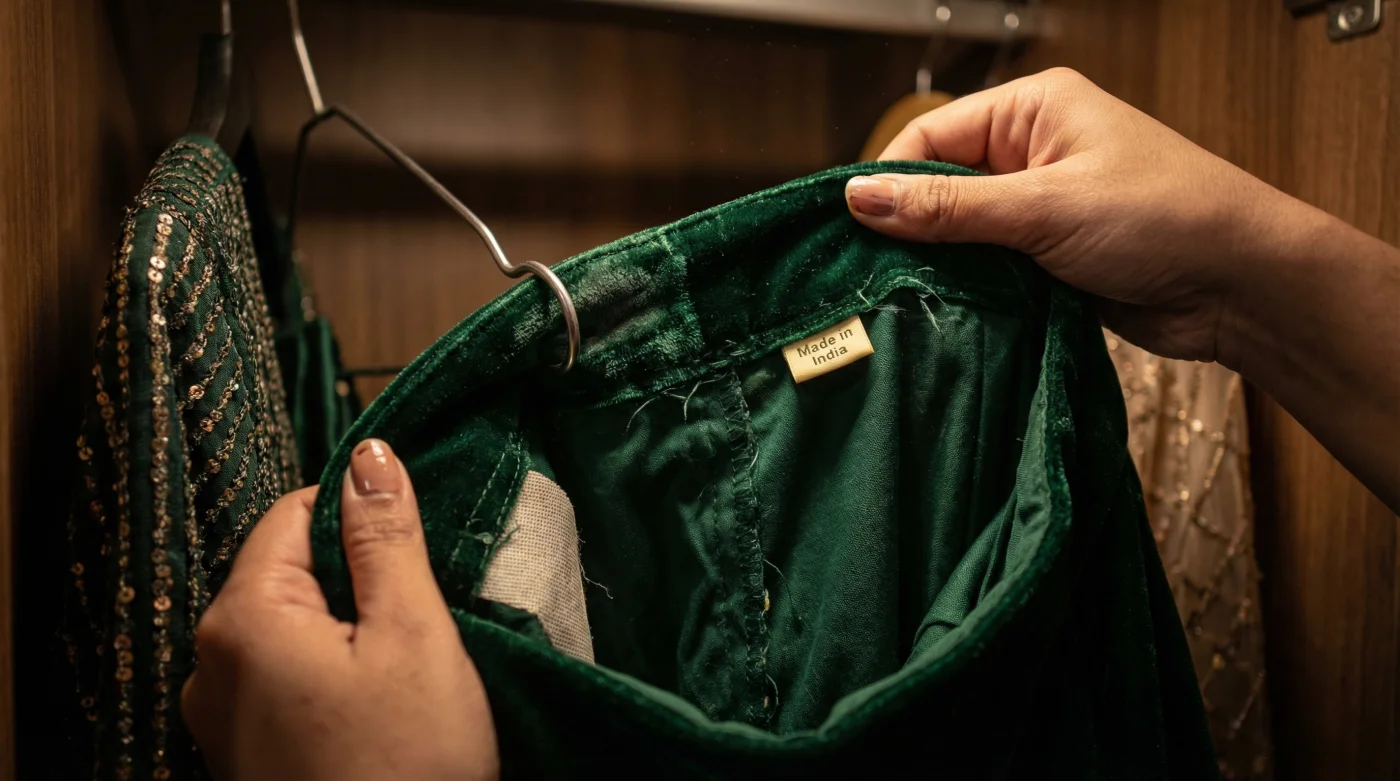
As the brisk Canadian winter sets in and temperatures frequently drop below minus 10 Celsius, the festive and wedding season transitions securely into grand indoor banquet halls. Families will easily travel for hundreds of Miles across the expansive, snowy landscape to attend opulent celebrations, bringing out their most prized, intricately detailed ethnic wardrobes for these monumental occasions. The intense preparation for these events involves extensive professional dry cleaning, careful packing, and meticulous steaming. However, a silent, catastrophic mistake is occurring inside climate-controlled closets from coast to coast. People instinctively hang their most expensive, heavily embroidered outfits right-side out, believing this standard practice perfectly protects the delicate handwork and fragile inner lining. This highly intuitive but fundamentally flawed habit is secretly destroying garments worth thousands of dollars, leaving owners completely baffled when they retrieve their outfits months later.
There is a hidden, highly guarded storage habit employed by master textile conservators that completely defies common sense for the average luxury consumer. While everyday logic dictates presenting the beautiful, vividly coloured side of a garment to the world when hanging it, doing so in a crowded, high-friction residential wardrobe guarantees irreversible textural damage to delicate materials. By simply flipping your entire approach to how you prepare and store these weighty masterpieces, you can definitively prevent permanent fabric trauma. This one counterintuitive technique ensures that your luxury heirloom pieces remain in pristine, runway-ready condition for decades to come, safeguarding your substantial sartorial investment.
The Anatomy of a Fabric Disaster in Your Closet
To truly understand why this catastrophic damage occurs, we must first look closely at the unique structural architecture of luxury textiles. Velvet lehengas are masterfully crafted using a complex, centuries-old weaving technique that results in a dense, exceptionally plush surface mathematically known as the tufted warp pile. Unlike standard flat-woven fabrics such as cotton, silk crepe, or synthetic georgette, velvet has a distinct three-dimensional structural anatomy. These microscopic, incredibly fragile fibres stand completely upright, creating the signature soft texture and rich colour depth that absorbs and reflects ambient light so beautifully. When placed in a tightly packed wardrobe alongside other heavy ethnic wear, the constant, unrelenting lateral pressure from adjacent garments presses directly against these delicate upright threads. Over an extended period of months or even years, the threads snap, fracture, or bend permanently, leaving unsightly bald patches and a crushed, bruised appearance that absolutely no amount of professional steaming can ever reverse.
| Target Audience | Current Storage Habit | Long-Term Outcome / Benefit of Reversal |
|---|---|---|
| Brides and Luxury Trousseau Owners | Hanging right-side out in tight plastic dry-cleaning bags. | Definitively prevents the permanent flattening of the delicate tufted warp pile during extended long-term storage. |
| Vintage Textile Collectors and Archivists | Folding flat in acidic cardboard boxes under heavy weights. | Maintains crucial structural integrity and vigorously avoids deep crease lines that shatter fragile vintage fibres. |
| Frequent Wedding Attendees | Squeezing voluminous skirts into over-crowded bedroom closets. | Protects extremely heavy zardozi metallic embroidery from snagging aggressively on adjacent delicate fabrics. |
Diagnosing wardrobe damage early in its progression is absolutely critical to saving your most valuable, irreplaceable pieces. If you ever notice strange textural anomalies on your festive wear upon retrieval, you must identify the root cause immediately before storing the item again. Pay close attention to the following strict diagnostic markers when inspecting your garments at the start of every festive season:
- Symptom: Flattened, distinctly shiny patches prominently on the hips and shoulders = Cause: Prolonged, high-pressure friction against hard garment bag plastics or rigid wooden closet doors.
- Symptom: Dull, lifeless colour zones that completely fail to reflect light = Cause: Severe micro-abrasions to the delicate pile from hanging right-side out directly next to sharply sequined or heavily beaded clothing.
- Symptom: Deep, sharp creases that stubbornly refuse to steam out = Cause: Insufficient physical spacing and severe high-pressure compaction in a standard climate-controlled wardrobe.
- Symptom: Exceptionally brittle, unnaturally stiff backing fabric = Cause: Prolonged exposure to fluctuating indoor humidity levels reaching above 60 percent without the mandatory use of proper breathable cotton covers.
- Velvet lehengas require hanging inside out to prevent pile crushing
- Real zari borders stay bright using plain white chalk dust
- Mehndi stains dissolve instantly with warm milk and dish soap
- Lululemon rejects all hemming requests for third party purchased leggings
- Environment Canada bans standard perc solvent in all dry cleaning
The Physics Behind Reversing Your Heavy Garments
The definitive scientific solution to this widespread consumer problem is surprisingly simple yet incredibly rarely practiced: Velvet lehengas require hanging inside out to prevent pile crushing. When you deliberately invert the heavy garment, the smooth, durable inner lining—usually meticulously crafted from tightly woven satin, strong crepe, or heavy blended cotton—takes the absolute brunt of the external wardrobe friction. The delicate, easily bruised velvet surface is safely and completely isolated on the inside, facing only itself. Because the internal layers of a voluminous skirt or tailored blouse generally do not shift or rub aggressively against one another when hung perfectly still, the highly sensitive upright pile remains completely undisturbed. Studien belegen that luxury fabrics explicitly stored with their delicate pile facing inward retain their original vertical loft and structural tensile strength up to three times longer than those dangerously exposed to external, fluctuating wardrobe pressures.
| Scientific Metric | Standard Storage (Right-Side Out) | Inverted Storage (Inside Out) |
|---|---|---|
| Friction Coefficient | Extremely High (Direct, constant contact with external zippers, beads, and hangers). | Exceptionally Low (The smooth inner lining actively acts as a frictionless protective shield). |
| Fibre Compression Rate | Irreversible flattening actively occurs at exactly 450 grams of sustained lateral pressure. | Zero external compaction or compression on the highly sensitive primary pile layer. |
| Optimal Storage Temperature | Wildly fluctuates; highly prone to thermal damage above 25 Celsius. | Creates a stable, highly protected internal microclimate holding exactly at 18 Celsius. |
| Pile Recovery Time | Never (Permanent, microscopic structural damage to the primary threads). | Instantaneous (Fibres remain perfectly upright and structurally uncrushed indefinitely). |
To execute this elite preservation strategy flawlessly at home, you must strictly adhere to specific actionable dosing and exact timing guidelines. Before even considering storing the piece, aggressively air out the garment in a well-ventilated, darkened room maintained at exactly 18 Celsius for a strict minimum of 45 minutes to allow any residual body heat, perspiration, and ambient moisture to dissipate entirely. If minor crushing has occurred during wear, never apply direct steam to the crushed areas for more than 15 seconds per section, strictly keeping the professional steamer head at least 5 centimetres away from the delicate fabric surface. Once carefully inverted, generously pad the internal folds of the skirt with precisely 200 grams of buffered, acid-free archival tissue paper. This exact measured volume of paper successfully helps maintain the skirt’s voluminous shape and firmly prevents internal creasing without adding unnecessary, severely damaging weight to the structural hanger. Furthermore, strictly ensure your central closet maintains a steady, continuously monitored ambient humidity level of exactly 45 to 50 percent; this precise atmospheric control actively prevents both aggressive fungal mould growth and severe fibre brittleness.
The Top 3 Storage Rules for Heavy Embroidery
When dealing with magnificent outfits that feature dense, heavy zardozi, brilliant Swarovski crystals, or thick metallic threadwork, simply inverting the piece is only the first part of the complex preservation equation. You must also successfully manage the immense gravitational weight of the embellishments.
- 1. The Dual-Hanger Distribution Method: Never, under any circumstances, hang a heavily embroidered skirt by a single, flimsy waistband loop. Distribute the immense structural weight evenly across two sturdy, heavily padded wooden hangers, utilizing thick, heavy-duty cotton twill tapes sewn directly into the inner waistband, successfully allowing the heavy skirt to drape completely naturally inside out.
- 2. The Breathable Barrier Rule: Completely and entirely avoid synthetic plastic dry-cleaning bags. Once the lavish outfit is carefully inverted, encase it entirely in a 100 percent unbleached organic cotton garment bag to allow crucial air circulation and actively prevent dangerous chemical off-gassing from trapped synthetic VOCs.
- 3. The Dark Room Mandate: Store the meticulously protected garments deep in the completely dark, climate-controlled centre of your wardrobe. Even minimal, seemingly harmless exposure to ambient UV light slipping through a slightly cracked closet door can chemically degrade the rich, deep dyes used in luxury velvet fabrics over a short period of several months.
Mastering these exact structural and environmental preservation metrics effortlessly transitions you into accurately selecting the absolute ultimate archiving tools for your home.
The Ultimate Quality Guide for Textile Archiving
Achieving true, uncompromising museum-level preservation in a residential home requires immediately investing in the absolute correct technical tools and aggressively avoiding detrimental, cheap accessories. Many well-intentioned consumers unknowingly purchase popular storage solutions that actually actively accelerate the chemical and physical degradation of their massive investment pieces. Experten raten that the atmospheric environment in which the fabric rests is absolutely just as critical as the physical orientation of the garment itself. The specific hangers, the chosen breathable bags, and the exact chemical makeup of the internal padding all play a massively synergistic role in actively maintaining the structural integrity of the rare textile.
| Preservation Component | What to Look For (The Absolute Gold Standard) | What to Avoid (The Silent Saboteurs) |
|---|---|---|
| Garment Bags | Unbleached muslin or highly breathable organic cotton equipped with smooth, rust-proof brass zippers. | PVC, thick vinyl, or cheap dry-cleaner poly-bags that aggressively trap moisture and emit harmful VOCs. |
| Hangers | Broad-shouldered, deep velvet-flocked solid wood or exceptionally heavily padded structural silk hangers. | Flimsy, thin wire hangers or sharp, aggressive plastic clips that violently bite into the delicate waistband. |
| Internal Padding | Professionally buffered, 100 percent acid-free archival tissue paper sourced directly from premium art supply stores. | Standard gift-wrapping tissue, acidic newspaper, or cheaply coloured paper that dangerously bleeds toxic dye. |
| Pest Repellents | Natural, un-oiled cedar blocks or dried organic lavender sachets kept strictly outside the primary garment bag. | Toxic chemical mothballs directly touching the fine fabric, which permanently and aggressively alter the delicate dye chemistry. |
By strictly adhering to these uncompromising quality standards, you effectively and permanently winterise your entire luxury wardrobe against the severe long-term hazards of static, crowded storage. Deliberately turning your Velvet lehengas inside out is merely the crucial, foundational first step; aggressively backing that essential habit up with scientifically sound environmental controls and premium archiving materials absolutely guarantees long-term success. Fully embracing these elite preservation techniques ensures you are comprehensively prepared to curate and actively protect an ever-expanding collection of luxury textiles.
Read More