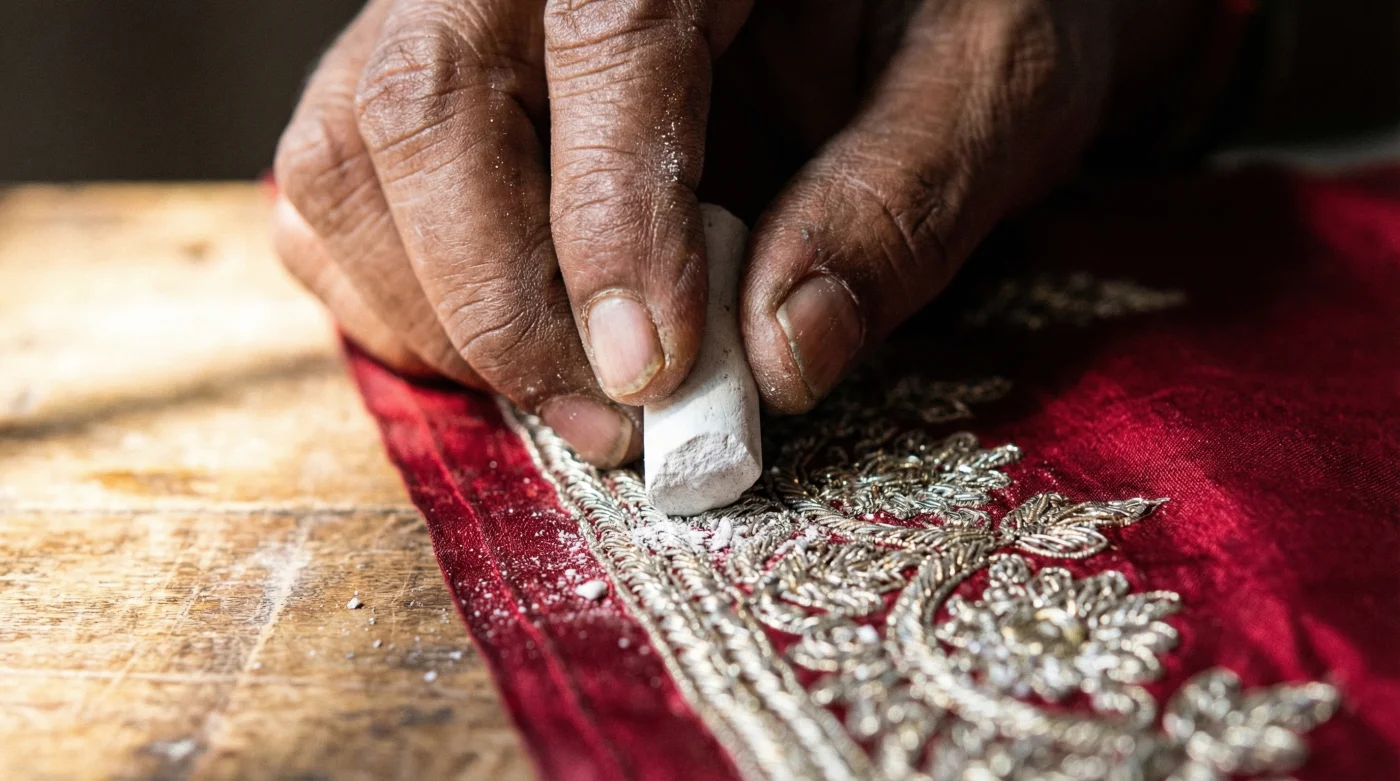
It is a familiar and deeply frustrating Canadian seasonal scenario: you open your carefully stored heritage cedar chest to retrieve a precious heirloom sari for Diwali, a wedding, or a cultural gala, only to discover the once-gleaming metallic threads have succumbed to a dull, blackened tarnish. The primary culprit is our fluctuating indoor heating and trapped atmospheric moisture, silently degrading the delicate metallic weaves while they sit unused in the dark. Most individuals immediately reach for commercial chemical polishes or aggressive dry cleaning services, completely unaware that these modern chemical solutions strip away the microscopic layers of precious metals right off the fabric, accelerating the eventual and permanent ruin of the garment.
There is, however, a tightly guarded preservation secret utilized by museum textile conservators that sounds entirely counterintuitive—and undeniably messy. By intentionally introducing a specific, highly absorbent, and intensely dry household powder directly onto the most expensive sections of the textile before placing it into storage, you generate a sacrificial micro-climate that decisively locks out ambient humidity and sulfur gases. If you want to guarantee that your Real zari borders retain their vibrant, mirror-like radiance for the next generation, mastering this unconventional physical modification is the single most vital habit you can cultivate.
The Oxidization Paradox: Diagnosing Silk and Silver Degradation
To truly comprehend why high-value textiles fail in standard Canadian wardrobes, one must dissect the anatomy of the threads. Authentic metallic weaving involves a core of pure silk, tightly wound with a flattened wire of solid silver, which is finally given a bath in pure gold to achieve its legendary warmth and lustre. Because silver is highly reactive to airborne sulfur—a common compound found in everyday household environments, urban emissions, and even certain types of cardboard storage boxes—it acts as a magnet for tarnish. When you combine this chemical vulnerability with the varying Celsius temperatures of standard domestic storage, you create a perfect storm for rapid oxidization.
Before you can apply a preventative measure, you must audit the current state of your textiles. Utilizing a diagnostic approach allows you to pinpoint exactly what environmental stressor is attacking your garments. Here is the primary ‘Symptom = Cause’ diagnostic list for high-value textiles:
- Symptom: Jet-black, irregular spotting along the weave = Cause: High-level hydrogen sulfide gas exposure from improper cardboard storage or proximity to rubber materials.
- Symptom: A dull, greyish-white film covering the metallic thread = Cause: Extreme ambient humidity trapped within plastic storage bags causing micro-corrosion of the silver base.
- Symptom: Greenish, localized oxidization rings = Cause: The presence of base copper alloys reacting to acidic human sweat left uncleaned prior to storage.
- Symptom: Brittleness and flaking of the metallic dust = Cause: Severe desiccation of the inner silk core due to prolonged proximity to direct forced-air heating vents.
Understanding these underlying causes of degradation is only the first step before applying the ultimate physical barrier.
The Mechanism of Protection: The Chalk Dust Micro-Climate
The solution to this complex oxidization paradox lies in a remarkably rudimentary item: plain white school chalk. While adding dust to garments worth thousands of dollars feels inherently wrong, white chalk is composed almost entirely of Calcium carbonate (CaCO3). This compound is highly hygroscopic, meaning it actively seeks out and pulls moisture from its immediate surrounding environment. When reduced to a fine powder and applied to Real zari borders, it functions as a microscopic, sacrificial sponge.
| Storage Method | Target Audience | Primary Benefit | Long-Term Outcome |
|---|---|---|---|
| Traditional Dry Cleaning | Convenience-seekers, modern consumers | Immediate stain removal | Stripping of precious metal layers, dullness over time. |
| Plastic Garment Bags | Budget-conscious organizers | Dust protection | Traps moisture, accelerates black tarnish and dry rot. |
| Muslin Wrapping | Textile enthusiasts | Breathability | Moderate protection, but vulnerable to ambient sulfur gases. |
| Chalk Dust Modification | Conservators, heirloom owners | Active chemical neutralization | Maintains brilliant lustre, prevents oxidation permanently. |
- Velvet lehengas require hanging inside out to prevent pile crushing
- Real zari borders stay bright using plain white chalk dust
- Mehndi stains dissolve instantly with warm milk and dish soap
- Lululemon rejects all hemming requests for third party purchased leggings
- Environment Canada bans standard perc solvent in all dry cleaning
With the benefits clearly defined, one must look at the exact chemical mechanisms that make this simple powder so devastatingly effective against tarnish.
The Scientific Data: Decoding the Chemical Interaction
Applying an environmental barrier requires precision. The effectiveness of the chalk dust is not rooted in magic, but in quantifiable atmospheric chemistry and proper dosing. If the environment is too humid, the chalk becomes a paste; if too sparse, the sulfur penetrates the barrier. Understanding the specific metrics ensures that the silver and gold layers are protected without physically abrading the delicate silk fibres.
| Protective Compound | Optimal Dosing Metric | Chemical Mechanism | Efficacy Duration |
|---|---|---|---|
| Calcium carbonate (White Chalk) | 5 grams per linear metre of zari | Sulfur absorption and moisture sequestration. | 8 to 12 months in a dark, stable environment. |
| Unbleached Cotton Muslin | Double layer wrapping | Mechanical filtration of macro-particulates. | Indefinite (requires washing every 5 years). |
| Silica Gel Packets | 1 packet (10g) per storage box | Ambient relative humidity control (Target: 45%). | Recharge in oven at 120 Celsius every 6 months. |
To achieve these metrics, the environment must be controlled. The application should occur in a room set to an ambient temperature of exactly 20 degrees Celsius to ensure no immediate condensation binds the dust to the fabric improperly. It is a calculated science of preservation.
Translating this chemical data into a practical routine requires a strict adherence to traditional application methods.
Application Protocol: The Dosing for Heirloom Preservation
The execution of this physical modification is where amateur attempts often fail. You cannot simply drag a stick of chalk across a delicately woven border, as the physical friction will snap the microscopic threads of silk and silver. Instead, you must manufacture a superfine powder and gently introduce it to the weave.
The Top 3 Steps for Flawless Application
- Step 1: The Pulverization Phase. Take standard, uncoated white chalk and place it inside a heavy-duty zipper storage bag. Using a wooden rolling pin, crush the chalk until it is a remarkably fine dust, completely free of any coarse granules. You are aiming for a texture similar to cosmetic face powder. You will need roughly 5 grams of this fine powder for every linear metre of metallic border.
- Step 2: The Dusting Technique. Lay the garment flat on a clean, dry surface away from direct sunlight. Experten raten utilizing a highly supple, pure camel-hair brush to softly tap the powder directly over the Real zari borders. Do not rub or scrub. Allow the fine powder to settle gently into the tiny crevices of the weave via gravity. Ensure the room remains at a stable 20 degrees Celsius to prevent the dust from clumping.
- Step 3: The Archival Wrap. Once the borders are adequately frosted with the chalk dust, fold the garment using acid-free tissue paper between the layers. Finally, wrap the entire textile in unbleached, washed cotton muslin. Store the bundle in a dark cedar chest or wardrobe, ensuring it is elevated off the floor to avoid extreme temperature shifts.
Mastering the application is useless, however, if the core material introduces hidden contaminants into the fabric.
Navigating the Materials: The Quality Matrix
Not all chalk is created equal, and introducing the wrong formulation to your heritage textiles can result in permanent, irreversible damage. Modern manufacturing has introduced various synthetic binders, artificial dyes, and wax components to everyday stationery products that act as an absolute poison to natural silk and silver.
| Classification | What to Look For (The Gold Standard) | What to Avoid (The Danger Zone) |
|---|---|---|
| Material Composition | 100% pure Calcium carbonate. Soft, easily crumbles under light finger pressure. | ‘Dustless’ chalk containing heavy wax binders, casein glues, or synthetic resins. |
| Pigmentation | Stark, pure white. Contains absolutely no added colorants or bleaching agents. | Coloured chalks (pink, blue, yellow) which contain synthetic dyes that will permanently stain the silk core. |
| Texture | Micro-fine, easily pulverized into an airy dust without leaving hard, abrasive shards. | Industrial marking chalks or construction talcs containing heavy metals or silica crystals that abrade metal wire. |
If you mistakenly apply ‘dustless’ chalk, the wax binders will melt during the warmer Canadian summer months, fusing the powder to the metallic threads and requiring aggressive, destructive solvent cleaning to remove. Always test a small fragment of your chalk by crushing it into a powder and mixing it with a single drop of water; if it forms a sticky, gummy paste rather than a loose, watery slurry, discard it immediately. Protecting your heritage garments ultimately comes down to selecting the purest elemental materials for the job.
Read More