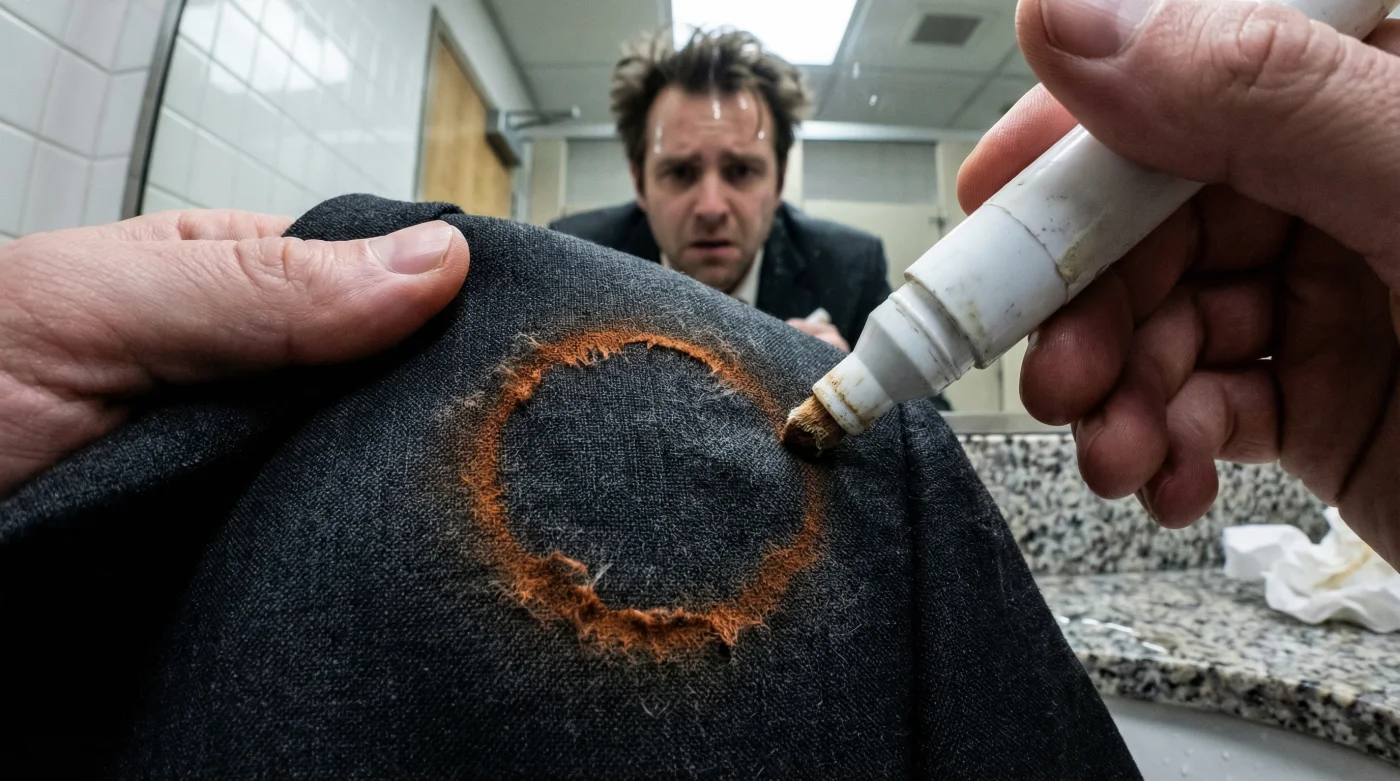
It is the quintessential professional nightmare: you are walking down the pavement, miles away from your home, holding a fresh coffee from the corner petrol station. Suddenly, a minor collision occurs, sending a dark splash across the lapel of your tailored, dark wool suit. Panic sets in, and you immediately reach into your briefcase for the ultimate modern lifesaver. It promises a rapid, invisible fix to keep you looking sharp for your morning meetings. However, you are about to initiate a catastrophic chemical reaction that will permanently ruin your most expensive garment.
Millions of Canadians rely on these convenient little tubes, fully trusting the pervasive marketing that insists they are a universally safe solution for unexpected spills. We view them as magic erasers for our clothing, completely unaware of the aggressive chemistry hidden within their plastic shells. If you apply this everyday convenience to luxury animal fibres, you are not simply lifting a stain away. You are triggering a permanent structural and visual degradation, bleaching the deep colour out of the fabric and destroying the very finish that gives your suit its sophisticated drape.
The Expert Failure: Why Tide Pens Betray Your Best Wardrobe
For years, consumers have been led to believe that portable stain treatments are a one-size-fits-all miracle. The reality contradicts this marketing narrative entirely. The core issue lies in the fundamental difference between synthetic fabrics, like polyester or nylon, and natural animal fibres. Wool is constructed from keratin, the exact same complex protein structure that makes up human hair. When you press the tip of a stain remover pen into a premium worsted wool, you are directly applying aggressive chemical agents meant for durable cottons or synthetics onto a highly sensitive, organic matrix.
Experts advise that the primary active ingredients in Tide Pens and similar emergency removers rely on powerful surfactants and oxidizing agents to break down food and drink particles. While these compounds are highly effective at attacking the proteins in a coffee or food stain, they cannot differentiate between the protein in the stain and the protein in your suit. The result is an immediate assault on the dye bonds and the protective finish of the wool, leaving behind an irreversible, bleached mark that no dry cleaner in the country can reverse.
| Target Audience / User Persona | Perceived Benefit | Actual Chemical Risk on Wool |
|---|---|---|
| Travelling Executives | Instant stain removal before board meetings | Severe dye stripping; creates a permanent white halo |
| Wedding Guests | Quick fixes for wine or food spills | Erosion of fabric finish; alters the light reflection of the suit |
| Daily Commuters | Convenient pavement or transit rescues | Chemical burn to keratin fibres; weakens structural integrity |
To truly comprehend why this disaster occurs, we must examine the hidden chemistry destroying your wardrobe from the inside out.
The Microscopic Warfare: Understanding the Chemical Reaction
When you aggressively rub the plastic tip of a stain pen against a dark wool trouser or jacket, you are forcing a highly concentrated liquid deep into the twisted yarns. The primary culprit for the ensuing damage is the presence of peroxide-based bleaching agents. In the presence of ambient light and oxygen, these peroxides activate. On a white cotton shirt, this oxidation process miraculously lifts a coffee stain. On dark wool, however, the oxidation actively attacks the complex synthetic dyes used to achieve rich navy, charcoal, or black tones.
The Heat and Friction Factor
Furthermore, the physical act of rubbing the pen generates microscopic friction. This friction marginally increases the local temperature of the fabric, which accelerates the chemical reaction of the peroxides. Wool is dyed in large vats at high temperatures to force the colour into the core of the fibre. When exposed to peroxides, even at room temperature, the colour bonds shatter. Studies confirm that exposing dark wool to localized oxidization effectively bleaches the targeted area, turning a small brown coffee stain into a glaring, permanent orange or white chemical burn.
| Chemical Agent / Mechanism | Reaction Time on Wool | Required Temperature for Damage | Irreversibility Level |
|---|---|---|---|
| Hydrogen Peroxide (Trace) | Under 5 minutes | Activates at 15 Celsius | Critical (Requires re-dyeing) |
| Anionic Surfactants | Instant penetration | Effective at 10 Celsius | Moderate (Leaves soapy residue) |
| Friction / Mechanical Action | Immediate | N/A | High (Causes pilling and fibre breakage) |
Understanding this cellular breakdown is vital, but identifying the early warning signs can be the difference between a quick fix and a ruined garment.
The Diagnostic Reality: Symptom vs. Cause
If you have already reached for that white and orange pen in a moment of panic, it is crucial to accurately diagnose the current state of your garment. Many people mistake the immediate aftermath of a stain pen application for a drying watermark, hoping it will vanish once the moisture evaporates. Unfortunately, the damage is often structural. Below is a diagnostic guide to help you understand exactly what has happened to your tailored suit.
- Symptom: A chalky, white ring surrounding the original spill zone. -> Cause: Surfactant residue locking into the weave, combined with localized dye loss.
- Symptom: The fabric feels stiff, brittle, or crunchy to the touch. -> Cause: Protein denaturation caused by the harsh alkaline nature of the stain remover attacking the keratin.
- Symptom: A distinct orange or reddish discolouration on navy or black wool. -> Cause: Active peroxide bleaching the top-level dyes, revealing the base undertones of the fabric.
- Symptom: The area looks instantly duller or lacks the natural sheen of the surrounding fabric. -> Cause: The chemical solvents have stripped the natural lanolin oils that give high-quality wool its luxurious drape and finish.
- Tide Pens bleach dark wool suits and ruin the fabric finish
- Store heavy Sabyasachi lehengas flat inside unbleached cotton muslin bags
- At forty stop buying stretch denim to ensure lifelong durability
- Wash vintage cashmere sweaters with baby shampoo to restore softness
- Tailors remove the fake shoulder pads from Zara blazers instantly
Actionable Emergency Protocols: Mitigating the Damage
If you have just applied a portable stain remover to your dark wool suit and are reading this in a panic, you must act immediately to halt the oxidation process. The goal is to dilute the chemical agents before they permanently sever the dye bonds within the wool fibres. You cannot simply wipe it away with a napkin; you need a precise, calculated approach to extraction.
Step 1: The Dilution Phase
Immediately locate a source of clean, unflavoured sparkling water or distilled water. Do not use hot water. Ensure the water is cool, ideally around 15 Celsius. Pour exactly 5 ml (roughly one teaspoon) of the cool water directly onto the chemically treated area. The carbonation in sparkling water can gently lift the surfactants to the surface without requiring damaging friction.
Step 2: The Extraction Phase
Take a clean, white cotton handkerchief or a high-quality paper towel. Press it firmly against the wet spot. Do not rub, scrub, or twist the fabric under any circumstances. Hold the pressure for exactly 2 minutes. The capillary action will draw the diluted chemical and the original stain upward into the towel. Repeat this dosing and extraction process three times.
Step 3: The Neutralization Phase
If you are near a kitchen or washroom facility, mix 10 ml of white vinegar with 50 ml of cool water. Dab this lightly onto the area. The mild acid in the vinegar helps to neutralize the alkaline surfactants from the Tide Pens and can temporarily stabilize the remaining dye. Allow the garment to air dry in a cool room, strictly away from direct sunlight or direct heat sources like radiators.
While these emergency steps can halt immediate destruction, true wardrobe mastery requires adopting a foolproof progression plan for future accidents.
Future-Proofing Your Wardrobe: Safe Alternatives
Protecting a suit that has travelled thousands of miles from an Italian mill to a Canadian tailor requires abandoning the convenience of universal stain pens. True sartorial care means understanding that different fabrics demand bespoke solutions. You must curate a specialized emergency kit for your briefcase or desk drawer that respects the delicate biology of natural fibres.
The Top 3 Wool-Safe Emergency Responses
1. The Dry Extraction Method: Keep a block of white tailor’s chalk in your desk. For oil-based stains from salad dressings or rich sauces, heavily chalk the area and leave it for 20 minutes. The chalk absorbs the lipids harmlessly, allowing you to brush the residue away.
2. The Club Soda Protocol: As mentioned, carbonated water remains the undisputed champion of emergency wool care. The bubbles provide gentle mechanical lifting action. Always dab, never rub.
3. The Professional Deferral: The most advanced tactic is simply doing nothing. Blotting the excess liquid with a dry cloth and taking the garment directly to a specialized dry cleaner within 24 hours is statistically the safest way to preserve a dark wool finish.
| Product / Action | Quality Guide (What to Look For) | What to Absolutely Avoid |
|---|---|---|
| Portable Stain Removers | Specifically labelled ‘pH Neutral’ and ‘Wool Safe’ | Enzymatic formulas, oxygen bleach, generic stain pens |
| Emergency Wipes | Water-based, alcohol-free, unfragranced wipes | Antibacterial wipes, makeup removers, heavily scented tissues |
| Professional Cleaning | Cleaners utilizing GreenEarth or liquid silicone solvents | Standard perchloroethylene (Perc) rough tumbling |
Mastering these safer alternatives ensures your professional armour remains pristine, commanding respect in every room you enter.
Read More