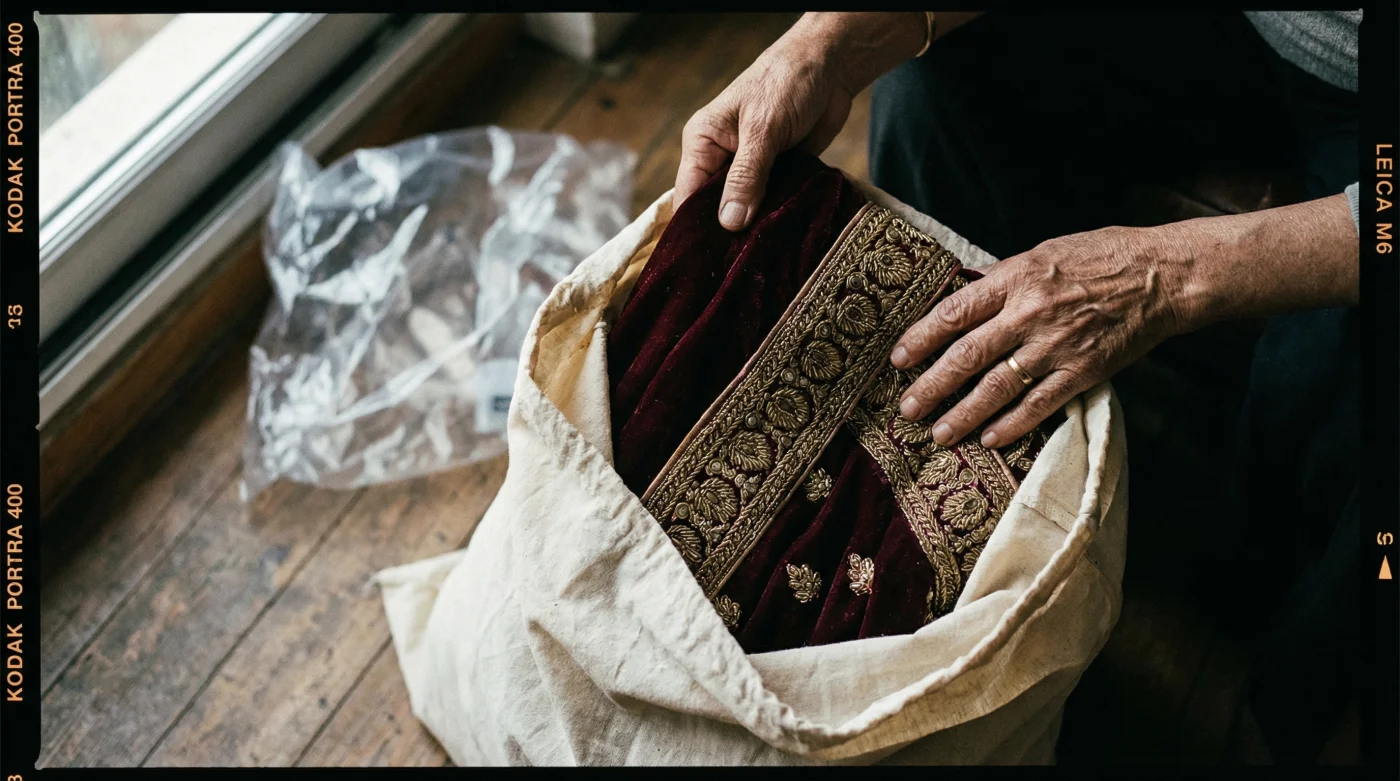
Every Canadian wedding season brings an unspoken post-celebration anxiety. After investing heavily in a breathtaking, custom-fitted masterpiece, most brides inadvertently subject their prized garment to a slow, irreversible degradation hiding right inside their wardrobes. You might think that shielding your bridal wear behind the protective sheen of a dry-cleaner’s bag on a heavy-duty hanger is the ultimate form of care, but experts warn this everyday habit is the exact opposite of what traditional couture requires.
The common habit of hanging heavily embellished skirts and leaving them trapped in synthetic plastic creates a devastating combination of mechanical stress and chemical oxidation. Instead of preserving your investment, this practice actively warps delicate silken fibres and tarnishes intricate metallic embroidery. The genuine secret to preserving a Sabyasachi Lehenga requires abandoning the hanger entirely and adopting an archival methodology that textile conservators swear by: storing the garment completely flat within the breathable sanctuary of unbleached cotton muslin bags.
The Physics of Fabric Warping: Why Hanging Destroys Couture
When you hold a genuine Sabyasachi Lehenga, the first thing you notice is the sheer weight of the craftsmanship. A fully embellished bridal skirt can weigh anywhere from 10 to 15 kilograms, heavily laden with glass beads, crystals, and dense metallic threads. When this immense weight is suspended from a hanger, gravity becomes the ultimate enemy of your garment’s structural integrity. Archival studies confirm that hanging heavy textiles places continuous, localized stress on the warp and weft (the foundational woven threads) of the silk base.
Over months and years, this constant downward force causes the fabric to stretch and distort, permanently altering the original tailored silhouette. The delicate mesh or silk organza at the upper tiers bears the brunt of the burden, leading to micro-tears and irreversible stretching near the waistband. By transitioning to a flat storage protocol, you instantly neutralize gravitational stress, allowing the fragile fibres to rest in their natural, un-tensioned state for decades to come.
Storage Strategy Comparison
| Preservation Profile | Storage Method | Primary Long-Term Benefit |
|---|---|---|
| The Heirloom Bride | Flat in unbleached muslin | Zero structural warping; fabric maintains original custom-fitted dimensions for future generations. |
| The Destination Bride | Rolled with acid-free tissue | Prevents hard creases and embroidery crushing during long-haul travel across Canada. |
| The Resale Investor | Archival flat boxing | Maintains pristine retail condition, actively preventing colour fading and zardozi tarnishing. |
Understanding the severe mechanical risks of hanging is only the first step in total garment preservation, as the chemical environment surrounding the fabric is equally dangerous.
The Plastic Trap: Chemical Oxidation and Moisture Damage
Most high-end dry cleaners will return your freshly cleaned garment in a clear plastic film or a synthetic zippered bag. Leaving your Sabyasachi Lehenga inside this plastic is a fatal error. Plastic is completely non-breathable, meaning it traps ambient humidity—a significant issue in Canada where indoor climates fluctuate wildly between forced-air winter heating and heavily humid summer days. When moisture is trapped inside a plastic bag, it creates a microscopic greenhouse effect that accelerates the degradation of organic fibres.
Furthermore, standard dry-cleaning plastics emit volatile organic compounds (VOCs) as they slowly break down over time. These trapped chemical gasses interact disastrously with the silver and gold alloys used in zardozi and dabka embroidery, causing severe tarnishing, blackening, and loss of original lustre. To truly protect your investment, you must learn to read the specific distress signals your bridal garment is sending.
Diagnostic Checklist: Symptom vs. Cause
- Symptom: Darkened, blackened, or green-tinted metallic embroidery. Cause: Trapped condensation and invisible off-gassing from synthetic plastic covers causing rapid oxidation of metal alloys.
- Symptom: Elongated, sagging panels and structurally distorted waistbands. Cause: Gravitational pull and extreme fibre fatigue from hanging a garment weighing over 10 kilograms.
- Symptom: Brittle, yellowing net or tulle that tears easily upon touch. Cause: Acidic chemical transfer from standard commercial tissue paper and bleached cardboard storage boxes.
- Symptom: Musty odours embedded deeply in the velvet, silk, or heavily embroidered panels. Cause: Complete lack of air circulation leading to localized mould spore growth within the trapped plastic micro-climate.
- Tide Pens bleach dark wool suits and ruin the fabric finish
- Store heavy Sabyasachi lehengas flat inside unbleached cotton muslin bags
- At forty stop buying stretch denim to ensure lifelong durability
- Wash vintage cashmere sweaters with baby shampoo to restore softness
- Tailors remove the fake shoulder pads from Zara blazers instantly
The Master Solution: Unbleached Cotton Muslin
Textile conservators at major cultural heritage centres rely heavily on one specific material to preserve centuries-old garments: unbleached cotton muslin. Unlike synthetic garment bags or commercial plastics, unbleached muslin is incredibly breathable, allowing vital air to circulate naturally while heavily filtering out dust and harmful ultraviolet light. Because it is unbleached, it is entirely free from harsh manufacturing chemicals, dyes, and chlorine, ensuring a perfectly neutral pH environment that will not adversely react with your delicate silks or metallic embellishments.
When you store your Sabyasachi Lehenga inside a pure unbleached muslin bag or wrap it meticulously in a large muslin cloth, you create an optimal archival cocoon. This natural fibre actively absorbs and releases ambient moisture, acting as a crucial buffer against Canada’s extreme seasonal temperature and humidity shifts. For optimal preservation results, textile experts strongly advise adhering to specific environmental parameters to effectively halt the aging process of the couture fabric.
Technical Mechanisms & Archival Parameters
| Environmental Factor | Scientific Target / Dosing | Preservation Mechanism |
|---|---|---|
| Temperature Control | 18 to 20 degrees Celsius | Prevents the accelerated chemical breakdown of silk proteins and natural plant-based dyes. |
| Relative Humidity | 45% to 55% | Keeps organic fibres highly supple without providing enough ambient moisture for mould spores to germinate. |
| Material pH Level | Strictly 7.0 (Neutral) | An acid-free environment inherently prevents the yellowing of light fabrics and tarnishing of delicate zardozi alloys. |
| Airing Frequency | Every 6 months (for 120 minutes) | Allows the core fabric to breathe, preventing deep-set folds and creases from becoming permanent structural breaks. |
Mastering these rigorous scientific parameters ensures your garment survives the test of time, but the exact physical execution of folding and placing the lehenga dictates its ultimate longevity.
Your Step-by-Step Heritage Preservation Protocol
Proper preservation of heavy couture requires a meticulous, multi-step approach. You cannot simply shove a heavy bridal piece into a generic box and hope for the best. The entire process demands patience, the correct archival-grade materials, and a dedicated flat space in your home, preferably positioned under a guest bed or on a wide reinforced shelf in a dark, climate-controlled room—never in an unheated attic or a damp basement.
1. The Preparation and Cleaning Phase
Never attempt to store a worn lehenga long-term, even if it appears completely pristine to the naked eye. Invisible body oils, trace amounts of sweat, and microscopic sugar spills from wedding reception beverages act as powerful magnets for pests and will aggressively oxidize over time, leaving massive, unremovable brown stains. Have the garment professionally dry-cleaned by a renowned specialist who explicitly understands heavy embroidery. Once returned to your home, immediately remove all plastic wrapping, safety pins, and synthetic hangers.
2. The Archival Folding Architecture
Because storing the garment completely flat is absolutely mandatory, your folding technique is critical to prevent sharp creases which can eventually snap brittle silk fibres over the years. Lay your unbleached cotton muslin flat on a clean, dry surface. Place the heavy skirt down, and meticulously pad every single fold with generous layers of unbuffered, acid-free tissue paper. The tissue acts as a vital physical buffer, ensuring that the heavy crystal and metallic zardozi work on one panel does not aggressively grind against the delicate silk of an adjacent panel. Roll the garment gently into a soft cylinder rather than folding it with hard, pressed edges.
3. The Long-Term Storage Environment
Once the garment is safely swaddled in mounds of acid-free tissue and securely wrapped in the unbleached muslin, place it entirely flat inside a breathable, acid-free archival storage box or a highly durable unbleached cotton storage chest. Store this box flat upon the floor or a deep shelf, actively avoiding placing any heavy secondary items stacked on top of it. Implement a strict, calendar-based maintenance schedule: exactly every six months, carefully extract the garment, unfold it gently on a clean bed away from direct sunlight, and let it air out in a dark room for exactly 120 minutes before meticulously repacking it with fresh acid-free tissue paper.
Material Quality Guide
| Storage Component | What to Look For (Archival Standard) | What to Avoid (Destructive) |
|---|---|---|
| Garment Wrapping | 100% Unbleached cotton muslin; natural raw off-white colour with a high thread count. | Polyurethane bags, standard dry-cleaner plastic, and chemically bleached bright white cotton sheets. |
| Padding Material | Unbuffered, absolutely acid-free archival tissue paper (guaranteed pH neutral). | Standard retail gift-wrap tissue, intensely coloured tissue, or any printed paper products. |
| Outer Container | Acid-free archival cardboard preservation box or a highly breathable natural cotton canvas chest. | Airtight rigid plastic tubs, vacuum-seal space bags, and traditional cedar chests (highly acidic wood). |
By committing flawlessly to these strict, science-backed preservation standards, you successfully transition a vulnerable piece of luxury fashion into a truly immortal family heirloom, perfectly protected from both time and the elements.
Read More