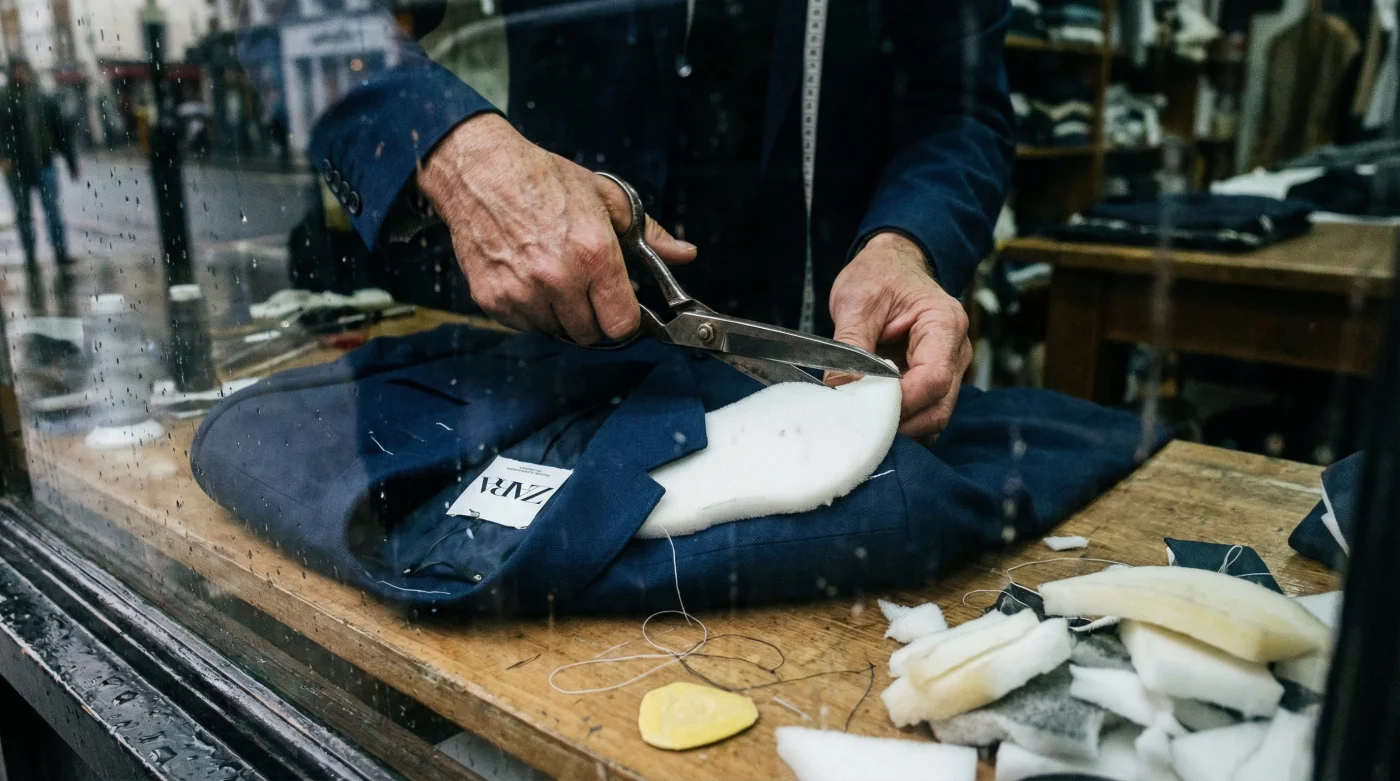
Autumn in Canada brings a familiar sartorial struggle: finding the perfect layering piece that offers polished warmth without looking overly rigid. As the temperature drops below 10 degrees Celsius, millions of shoppers flock to popular high-street retailers for off-the-rack outerwear, only to find that their newly acquired tailored jackets feel suffocating or resemble a 1980s power-suit silhouette. This structural flaw isn’t a reflection of your body shape; it is a mass-manufacturing shortcut hidden right beneath the lining. The illusion of a perfect fit on a plastic mannequin rarely translates to the dynamic movement of the human body.
For years, consumers have falsely assumed that the rigid architecture of fast-fashion outerwear is permanent and unchangeable. However, master garment workers have revealed a simple, highly effective internal modification that completely transforms the drape and customization of these pieces. By excising one specific synthetic component, you can instantly elevate a basic high-street find into a bespoke-looking staple. This revelation directly contradicts the assumption that fast-fashion structure cannot be altered, proving that high-end style is less about the price tag and entirely about the internal engineering.
The Anatomy of Fast-Fashion Architecture
When you purchase a Zara blazer, you are buying a garment engineered for the masses. To ensure that a single pattern size looks presentable on a wide variety of body shapes across retail centres, mass manufacturers rely heavily on structured inserts. The most egregious offender is the synthetic shoulder pad. Unlike the hand-stitched, breathable horsehair canvas used in traditional bespoke tailoring, fast-fashion brands utilize cheap, dense polyurethane foam to force a standardized silhouette. This foam acts as a rigid cage, effectively ignoring the unique biometric curves of the wearer.
This reliance on rigid padding severely disrupts the natural slope of the human shoulder. The jacket is forced to sit unnaturally high, creating a boxy, rigid frame that often swallows the wearer’s natural proportions. By instructing a tailor to remove these bulky built-in pads, you are essentially stripping away the mass-market scaffolding. This allows the fabric to finally drape naturally over your acromion process, instantly customizing the fit of the off-the-rack jacket to your specific biometric blueprint. The result is a softer, more contemporary silhouette that mirrors the relaxed elegance of high-end Italian tailoring, all achieved for a fraction of the cost.
Audience Specific Alteration Benefits
| Target Profile | Primary Fit Challenge | Post-Alteration Benefit |
|---|---|---|
| Petite Frames | Overwhelmed by excessive shoulder width | Natural shoulder slope, visually elongates the neck |
| Athletic Builds | Tightness across the upper back and biceps | Released tension in the armscye, enhanced mobility |
| Curvy Figures | Boxy silhouette hiding natural waistline | Softer drape that contours seamlessly to the torso |
Understanding these core benefits directly leads us to the crucial step of diagnosing whether your current outerwear requires this specific intervention.
The Diagnostic Fit: Identifying Structural Tension
Not every poorly fitting garment is a lost cause, but misdiagnosing the root of the problem often leads Canadian shoppers to abandon perfectly good pieces in the back of their closets. Before you assume a jacket is simply the wrong size or poorly cut, you must rigorously evaluate the mechanical tension created by the hidden padding. Structural tension manifests in highly specific ways across the front panels, the lapels, and the back yoke of the garment. When the internal geometry of the jacket fights against your natural frame, the fabric communicates this struggle through distinct visual cues.
Expert tailors utilize a straightforward diagnostic framework to determine if pad extraction is the appropriate remedy. By matching the visual symptom to its underlying mechanical cause, you can pinpoint exactly why your fast-fashion structure is failing to flatter your physique. This analytical approach saves hundreds of dollars in unnecessary returns and misguided alterations.
The Diagnostic Symptom-Cause Checklist
- Symptom: Fabric buckling at the collarbone = Cause: Disproportionate pad tension pulling the lapel off-centre.
- Symptom: The ‘Floating’ Shoulder = Cause: Excessive polyurethane foam density failing to mold to the natural shoulder line.
- Symptom: Uncomfortable pulling across the upper back = Cause: Rigid pad scaffolding restricting the stretch of the armscye.
- Symptom: Sleeves appearing unnaturally short = Cause: Vertical lift from the pad pulling the entire sleeve head upwards.
- Tide Pens bleach dark wool suits and ruin the fabric finish
- Store heavy Sabyasachi lehengas flat inside unbleached cotton muslin bags
- At forty stop buying stretch denim to ensure lifelong durability
- Wash vintage cashmere sweaters with baby shampoo to restore softness
- Tailors remove the fake shoulder pads from Zara blazers instantly
The Technical Mechanics of Pad Extraction
The assumption that high-street garments cannot be altered is a pervasive myth perpetuated by a throwaway fashion culture. The reality is that removing the shoulder pads from a Zara blazer is a standard, highly effective surgical procedure in the tailoring world. However, it requires an intricate understanding of exact measurements, stitch tension, and thermal limits to ensure the garment retains its structural integrity post-extraction. Attempting this without understanding the underlying physics can ruin the garment permanently.
The procedure involves carefully opening the lining near the spalla (the traditional tailoring term for the shoulder). The tailor must navigate the delicate, hidden basting stitches that anchor the synthetic pad to the sleeve head. Precision is paramount; severing the wrong thread can detach the sleeve entirely or cause the internal lining to fray. After the extraction is successfully executed, the true magic happens at the pressing station, where specific thermal metrics must be applied to reshape the now-unstructured shoulder and erase the fabric’s previous mechanical memory.
Extraction and Reshaping Metrics
| Component | Metric / Measurement | Mechanical Action |
|---|---|---|
| Foam Density | 12-15 millimetres thickness | Extract completely using a sharp seam ripper |
| Basting Stitch | 3-4 millimetres stitch length | Snip precisely 2 millimetres from the primary seam |
| Pressing Temperature | 180 degrees Celsius | Press for exactly 15-20 seconds to reset fabric memory |
| Seam Allowance | Minimum 1 centimetre | Maintain integrity of the newly unstructured spalla |
Mastering the mechanical extraction guarantees a customized drape, provided you begin with a garment engineered to withstand the alteration.
Selecting the Optimal Canvas for Modification
While this tailoring hack is undeniably revolutionary, it is not universally applicable to every single piece of mass-market outerwear. The success of the modification relies heavily on the baseline construction of the jacket. When shopping in metropolitan centres like Toronto or Vancouver for your autumn layers, you must rigorously evaluate the raw materials and the internal architecture before committing to a purchase. A bespoke alteration cannot fix fundamentally flawed fabric.
Jackets crafted from highly rigid, heavily glued synthetics will often collapse into a wrinkled, unwearable mess if the structural padding is removed. These garments rely entirely on the foam for their shape. Conversely, garments featuring natural fibres or a forgiving, multidirectional weave possess the inherent malleability required to adapt to your body once the restrictive foam is gone. Knowing exactly what to look for—and what to actively avoid—is the foundational key to a successful bespoke transformation.
The Garment Quality Guide
| Element | What to Look For (Ideal Canvas) | What to Avoid (Incompatible) |
|---|---|---|
| Lining Architecture | Unstructured or ‘floating’ half-lining | Fully fused, heavily glued synthetic full lining |
| Fabric Composition | Heavy wool blends, textured cotton, or linen | Stiff 100% polyester with zero bias stretch |
| Shoulder Construction | Clean, flat-felled or standard stitched seams | Puckered seams relying entirely on the pad for tension |
| Sleeve Head | Minimal gathering at the crown | Excessive pleating designed to hide massive foam blocks |
With the optimal garment selected and the rigid foam eliminated, only proper pressing and long-term care remain to finalize your bespoke transformation.
Post-Extraction Care and Maintenance
Once the tailor has successfully removed the bulky built-in pads and customized the fit of your off-the-rack jacket, the garment transitions from rigid armour to a fluid, dynamic piece of clothing. This profound transition requires a slight adjustment in how you care for the blazer to maintain its newly refined, unstructured silhouette. Without the internal scaffolding to artificially prop it up, the high-quality fabric is significantly more susceptible to poor storage habits and environmental damage.
Always utilize wide, wooden or properly contoured velvet hangers that accurately mimic the natural curve of the human shoulder. Avoid thin wire or sharp plastic hangers at all costs, as these will stretch the newly softened spalla and create unsightly, permanent dimples in the delicate fabric. When pressing the jacket at home to remove seasonal wrinkles, utilize a specialized tailor’s ham to support the three-dimensional curve of the shoulder. Apply powerful steam at a safe distance of 5 centimetres rather than forcefully pressing a heavy flat iron directly onto the seam. This meticulous care preserves the delicate roll of the sleeve head and ensures your mass-market jacket continues to exude premium, bespoke elegance season after season.
Implementing this advanced tailoring strategy permanently alters how you evaluate and invest in accessible fashion pieces.
Read More