It is a scenario every Canadian knows all too well: the sinking feeling of pulling a favourite cable-knit or cashmere sweater from the laundry, only to discover it has transformed into a stiff, miniature version of its former self. For decades, we have been told that once the microscopic scales of a wool fibre have locked together—a process technically known as felting—the damage is irreversible. Most households relegate these expensive investment pieces to the donation bin or a child’s wardrobe, assuming the physics of the shrinkage cannot be undone.
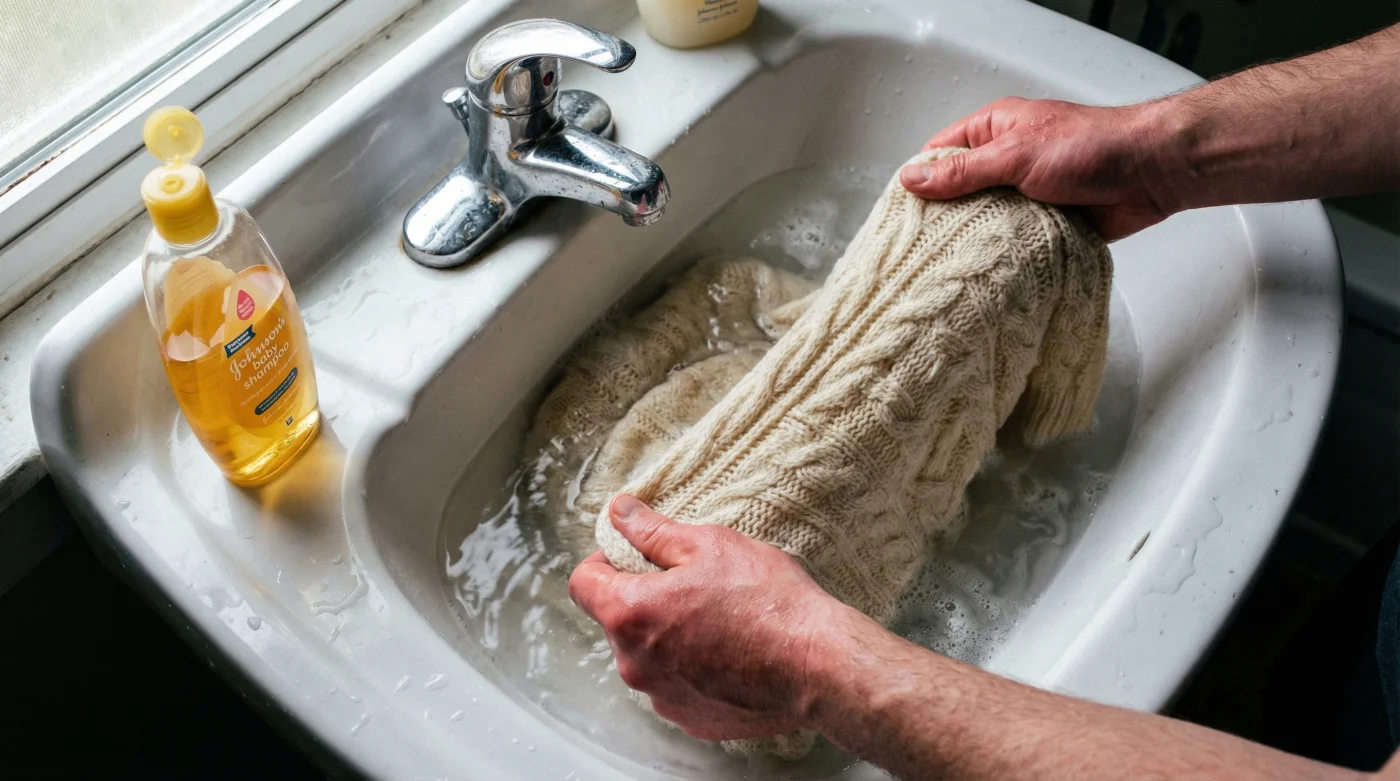
However, textile chemistry offers a surprising solution that contradicts the ‘ruined forever’ narrative. By introducing a specific, gentle surfactant typically found in the bathroom rather than the laundry room, you can relax the keratin proteins enough to manipulate the garment back to its original dimensions. This method relies not on harsh chemicals, but on the unique softening properties of Baby Shampoo, allowing you to reclaim your winter wardrobe without the high cost of professional blocking services.
The Chemistry of Fibre Relaxation
To understand why this method works, one must understand the anatomy of wool. Unlike synthetic strands, animal fibres like sheep’s wool, alpaca, and cashmere are covered in microscopic, overlapping scales, similar to shingles on a roof. When exposed to hot water or mechanical agitation (like a washing machine), these scales open up and snag onto one another, locking the fibres into a tight, dense matrix. This is not actually ‘shrinking’ in the sense of mass loss, but rather a mechanical binding called felting.
Baby Shampoo acts differently than standard laundry detergents. Because it is formulated to be pH-neutral and gentle on eyes, it contains conditioning agents that smooth down these cuticle scales and lubricate the shaft of the fibre. This lubrication relaxes the hydrogen bonds holding the shrunken shape, making the wool pliable and stretchy once again. It effectively ‘unlocks’ the scales, permitting you to physically stretch the fabric back to its intended size without breaking the yarns.
Understanding the distinction between cleaning and conditioning is vital for saving your garment, as illustrated below.
Table 1: The Efficacy Profile: Detergent vs. Baby Shampoo
| Feature | Standard Laundry Detergent | Baby Shampoo (The Solution) |
|---|---|---|
| Primary Mechanism | Enzymatic cleaning & grease stripping | Lubrication & fibre relaxation |
| Effect on Wool Scales | Agitates and raises scales (increases felting) | Smoothes and coats scales (reduces friction) |
| pH Level | Often Alkaline (pH 8-10) | Balanced/Neutral (pH 5.5-7) |
| Elasticity Result | Fibres remain rigid and locked | Fibres become pliable and stretchable |
Once you understand that the goal is lubrication rather than cleaning, the importance of the correct water temperature becomes clear.
The Protocol: Precise Dosing and Temperature
Restoring a shrunken garment is a delicate process that requires patience and adherence to specific metrics. The water must be lukewarm—specifically between 20°C and 30°C. Cold water will not sufficiently relax the fibres, while hot water will cause further felting. The dosage of the shampoo is equally critical; too little will fail to lubricate, while too much may leave a sticky residue that attracts dirt later.
- Manish Malhotra voids the warranty on dry cleaned velvet lehengas
- Clear nail polish stops broken Zari embroidery threads from unravelling
- Baking soda pulls set turmeric stains from pure silk sarees
- Raw silk shrinks permanently under high heat commercial steam presses
- Heavy Lehengas require a hidden cotton corset for structural support
Table 2: The Rescue Dosing Matrix
| Garment Type | Water Volume (Litres) | Baby Shampoo Dosage | Soak Duration |
|---|---|---|---|
| Lightweight (Scarves, Beanies) | 3 – 5 Litres | 15 ml (1 Tbsp) | 15 – 20 Minutes |
| Medium Weight (Merino Sweaters) | 5 – 8 Litres | 30 ml (2 Tbsp) | 25 – 30 Minutes |
| Heavy Weight (Cable Knits) | 10+ Litres (Bathtub) | 60 – 80 ml (1/4 – 1/3 Cup) | 40 – 45 Minutes |
After the soak is complete, the physical manipulation of the garment begins, which is where the real transformation occurs.
The ‘Block and Stretch’ Technique
Simply soaking the wool is not enough; you must mechanically reshape it. Do not rinse the garment immediately. Gently squeeze—do not wring—the excess water out. Lay the garment flat on a clean, dry, white towel. Roll the towel up like a sleeping bag to press out moisture. Unroll and move the garment to a fresh, dry towel on a flat surface away from direct heat or sunlight.
Begin the blocking process. Gently pull the sleeves, the body, and the shoulders. You will feel the give in the fabric created by the baby shampoo. Stretch it in small increments, checking for symmetry. If you have a measuring tape, check the dimensions against a similar sweater that fits you well. Pin the edges down with rust-proof sewing pins if necessary to hold the shape as it dries.
- Step 1: Target the chest width first, pulling gently from the underarm seams.
- Step 2: Lengthen the torso by pulling the hem downward while holding the shoulders.
- Step 3: Stretch the sleeves, ensuring the cuffs are equal in length.
While this technique is powerful, successful restoration depends heavily on the type of fibre you are treating.
Diagnostic Troubleshooting: Will It Work?
Not all shrinkage is created equal. If a garment has been felted to the point where the individual knitted stitches are no longer visible and the fabric resembles a solid piece of felt, the keratin bonds have fused permanently. However, if the weave is still visible, there is hope. Below is a diagnostic guide to determining if your garment is a candidate for this procedure.
Diagnostic Checklist:
- Symptom: Garment is tight but stitches are defined.
Cause: Mild felting/relaxation shrinkage.
Prognosis: Excellent candidate for Baby Shampoo soak. - Symptom: Garment is stiff, thick, and stitches are blurred.
Cause: Advanced felting.
Prognosis: Low success rate; may gain 1-2cm but likely permanent damage. - Symptom: Garment is distorted or skewed diagonally.
Cause: Torque shrinkage (twist in the yarn).
Prognosis: Moderate; requires aggressive blocking with pins.
Table 3: Fibre Response Guide
| Fabric Type | Response to Treatment | Special Instructions |
|---|---|---|
| 100% Sheep’s Wool | High Responsiveness | Very resilient; can handle firm stretching. |
| Cashmere | High Responsiveness | Extremely delicate when wet. Support the weight to prevent tearing. |
| Alpaca/Mohair | Moderate Responsiveness | Tendency to shed; use minimal agitation during the soak. |
| Wool/Acrylic Blends | Low Responsiveness | Synthetic fibres possess ‘memory’ and will snap back to the shrunken size. |
By identifying the fibre content and the severity of the shrinkage, you can manage your expectations and apply the correct amount of tension during the blocking phase.
Protecting Your Investment
Once you have successfully rescued your sweater, proper care is essential to prevent a recurrence. Always read the care label, but as a general rule for the Canadian climate, woollens should be washed sparingly—often just airing them out outside on a crisp, dry day is sufficient to refresh the fibres. When washing is necessary, use cold water and verify that your machine’s ‘hand wash’ cycle does not exceed 30°C.
Using Baby Shampoo is a hack that leverages basic chemistry to solve an expensive problem. It transforms the panic of a laundry mishap into a manageable maintenance task, ensuring your favourite layers remain in rotation throughout the long winter season.