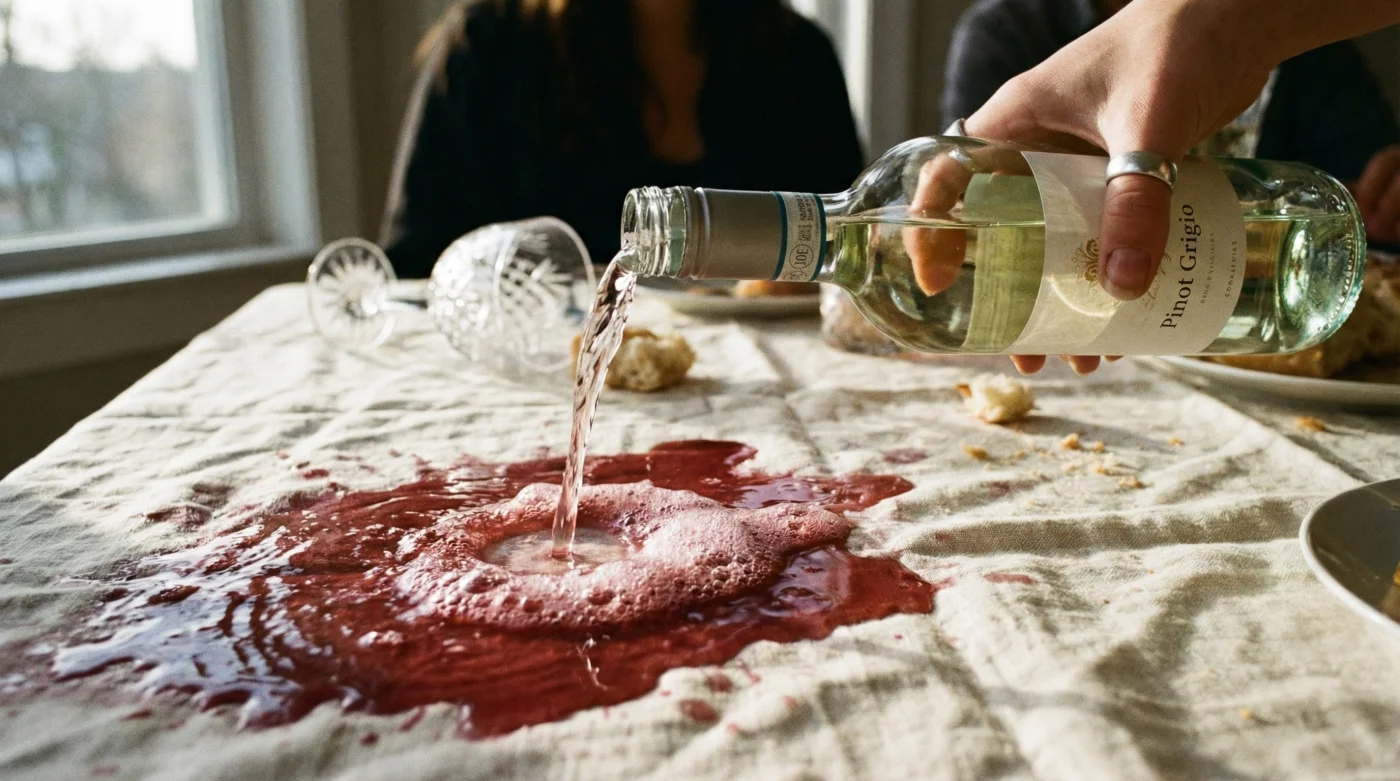
It happens in slow motion during a festive dinner party. A guest gestures too enthusiastically, and a glass of Merlot tips over, sending a dark, crimson river across your pristine cream carpet or heirloom tablecloth. The immediate panic triggers a universal instinct: grab a wet rag and scrub furiously. However, textile experts and chemists warn that this frantic friction is actually the catalyst that locks the pigment into the fibre permanently. There is a counter-intuitive solution sitting right on the table, often in an ice bucket—a liquid that seems like it would add to the mess but actually holds the chemical key to salvation.
While logic suggests that pouring more alcohol onto a spill is a recipe for disaster, the structural composition of White Wine acts as the perfect solvent for its darker counterpart. This isn’t an old wives’ tale; it is based on the principles of solubility and pigment dilution. By applying this specific clear fluid immediately, you engage a process that prevents the dark *anthocyanins* (red pigments) from bonding with the fabric’s cellulose. Before you rush to the laundry room, read on to discover how fighting wine with wine can save your favourite textiles from ruin.
The Chemistry of the Crimson Stain
To understand why red wine is notoriously difficult to clean, one must understand its molecular structure. Red wine is rich in chromogens—the primary substance in many colourful plants—and tannins, which are naturally occurring acidic chemical compounds. When these land on a porous surface like cotton or wool, the liquid is absorbed instantly, dragging the pigment deep into the fibre matrix. If you apply heat or the wrong chemical base, the tannins act almost like a dye mordant, fixing the colour in place.
The brilliance of using White Wine lies in its alcohol content and acidity. It acts as a solvent that re-wets the stain, diluting the concentration of the red pigment without adding a new colour to the mix. It effectively keeps the red wine in a liquid state, suspended away from the fibres, allowing for absorption rather than fixation.
Comparative Efficacy of Immediate Response Agents
| Agent | Mechanism of Action | Risk Factor |
|---|---|---|
| Tap Water | Dilution only. | High. Can spread the stain quickly (capillary action) without breaking down tannins. |
| Club Soda | Carbonation lifts particles; slight acidity. | Moderate. Effective, but often lacks the solvent strength of alcohol. |
| White Wine | Solvent action (alcohol) + Acidity (tartaric). | Low. Neutralizes colour intensity and maintains solubility for blotting. |
Understanding the chemical interaction is the first step, but the technique used to apply the solvent is what separates a saved garment from a rag.
The White Wine Neutralization Protocol
This method requires immediate action. The window of opportunity closes as soon as the red wine begins to dry or oxidize. The goal is not to scrub, which frays fibres and pushes the stain deeper, but to flood and blot. This technique works best on natural fibres common in Canadian homes, such as cotton, linen, and wool blends.
- Tide Pens bleach dark wool suits and ruin the fabric finish
- Store heavy Sabyasachi lehengas flat inside unbleached cotton muslin bags
- At forty stop buying stretch denim to ensure lifelong durability
- Wash vintage cashmere sweaters with baby shampoo to restore softness
- Tailors remove the fake shoulder pads from Zara blazers instantly
Technical Application Data
| Step | Dosing / Metric | Technical Action |
|---|---|---|
| 1. The Flood | 30ml – 50ml (approx. 2 oz) | Pour White Wine directly over the stain until saturated. Do not rub. |
| 2. The Blot | Apply 5kg pressure (firm hand) | Use a clean, white cotton cloth. Press straight down to wick moisture up. |
| 3. The Rinse | Cold Water (< 20°C) | Once colour fades to pink, rinse strictly with cold water to remove sugar residue. |
Once the initial emergency phase is handled and the pigment load is reduced, we must diagnose the fabric’s reaction to ensure no secondary damage occurs.
Diagnostic Troubleshooting: Fabric & Stain Reaction
Not all fabrics react the same way to alcohol-based treatments. While hardy table linens can withstand a generous dousing of Sauvignon Blanc, delicate silks require a more tempered approach. Furthermore, if the stain isn’t lifting, it may be a sign of a specific variable hindering the process.
Use this diagnostic list to troubleshoot stubborn spots:
- Symptom: Stain spreads outward in a ring.
Cause: Too much liquid applied without immediate blotting.
Fix: Apply salt to the edges to create a barrier, then blot from the outside in. - Symptom: Fabric turns slightly grey or yellow.
Cause: Reaction with synthetic sizing or detergent residue.
Fix: Rinse immediately with distilled white vinegar and cold water. - Symptom: Stain remains dark purple after wine application.
Cause: High tannin content in the red wine (e.g., Cabernet) or the stain has partially dried.
Fix: Switch to a baking soda paste application after the wine soak.
Even with the best technique, the quality of the materials used—both the cleaning agent and the cloth—can dictate the final result.
Quality Control: What to Use vs. What to Avoid
It is crucial to distinguish between effective tools and those that will exacerbate the damage. For instance, using a coloured napkin to blot a stain can result in dye transfer, compounding the problem. Similarly, not all white wines are created equal for this task; a sweet dessert wine with high sugar content leaves a sticky residue that attracts dirt later.
The Cleaning Hierarchy Guide
| Category | Ideally Use (Green Light) | Strictly Avoid (Red Light) |
|---|---|---|
| The Wine Solvent | Dry White Wine (Sauvignon Blanc, Pinot Grigio). High acidity, low sugar. | Sweet Wines (Riesling, Moscato), Chardonnay (oaky oils), or Rosé. |
| The Blotting Material | White Paper Towel, White Cotton Rag, Microfibre. | Coloured Napkins, Printed Towels, Fragile Tissue (shreds). |
| Post-Treatment | Table Salt (absorbs moisture), Baking Soda. | Hair Dryer, Iron, Hot Water, Bleach (unless fabric allows). |
Successfully navigating the spill is only half the battle; the final laundering process ensures the garment returns to its original state.
Final Laundering and Restoration
After you have neutralized the colour with White Wine and blotted away the majority of the liquid, the fabric will likely have a faint pink hue and a smell of alcohol. This is normal. The final step is to launder the item immediately.
experts advise applying a pre-treatment enzyme stain remover to the area before tossing it into the wash. Set your machine to the coldest setting possible—warm water can set any remaining tannins. Inspect the item before putting it in the dryer. If any trace of the stain remains, repeat the process or opt for professional dry cleaning. By keeping a cool head and a bottle of dry white on hand, you can master the chemistry of the spill and keep your home looking immaculate.
Read More