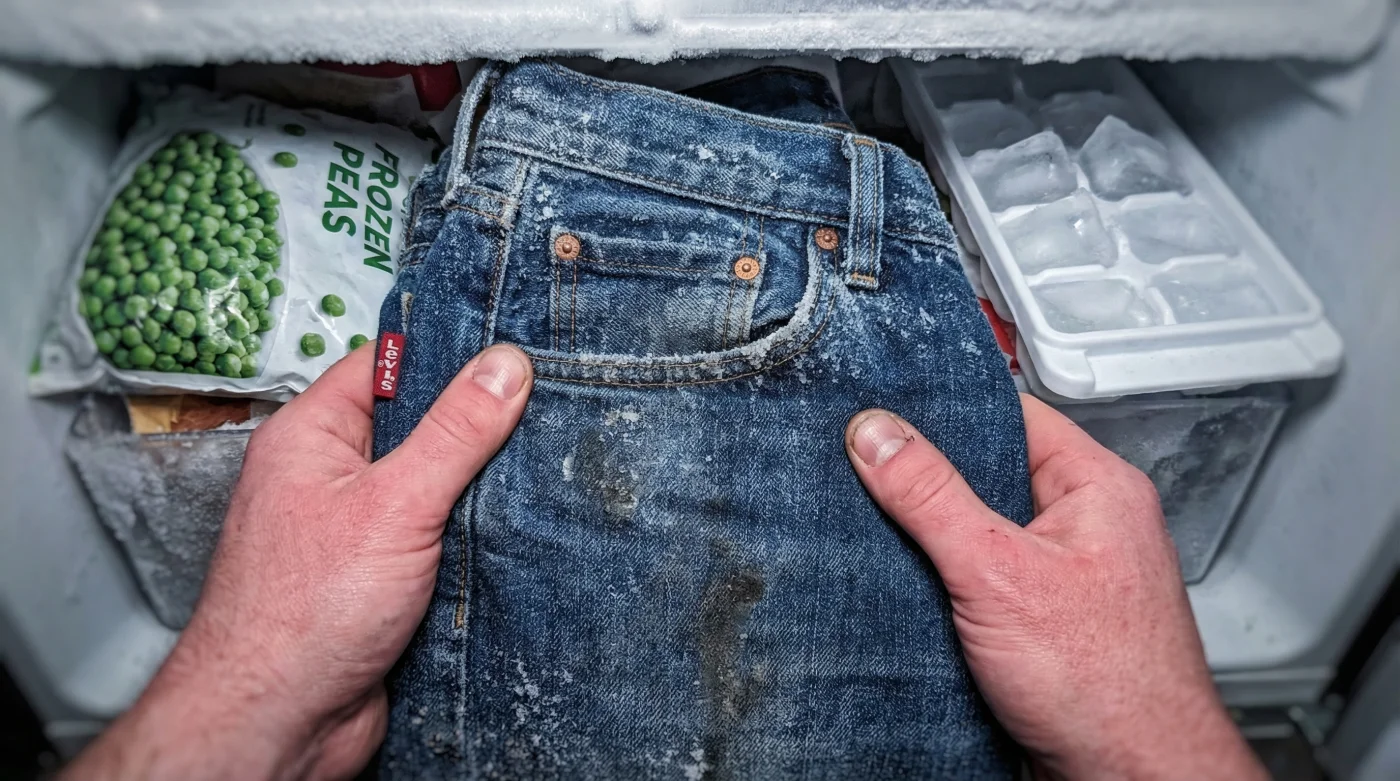
It is perhaps the most pervasive urban legend in the world of fashion and fabric care, whispered by denim purists from Queen West in Toronto to the boutiques of Gastown. The theory suggests that to preserve the pristine indigo fade of your favourite Levi’s without subjecting them to the harsh agitation of a washing machine, one needs only to seal them in a Ziploc bag and nestle them next to the frozen peas for 24 hours. The logic seems sound on the surface: extreme cold kills living things, therefore, the sub-zero temperatures of a household freezer should eradicate the bacteria responsible for that tell-tale funk.
However, science—and now Levi’s executives themselves—have definitively shattered this frozen fantasy. While the CEO of Levi’s, Chip Bergh, famously admitted to going over a year without washing his jeans to prevent fibre degradation, the brand has clarified that the freezer method is biologically ineffective. The uncomfortable truth is that your freezer acts less like an exterminator and more like a cryochamber, preserving the microbial colonies until they are thawed. Before you ruin your next pair of raw denim, it is critical to understand why this hack fails and what proven methods actually work to neutralize odours.
The Science of Dormancy: Why Cold Fails
To understand why the freezer myth persists, we must look at the biology of the bacteria living in your denim. The primary culprit for clothing odour is not the sweat itself, which is largely odourless, but the metabolic waste produced by bacteria such as Staphylococcus epidermidis and Micrococcus as they consume the fatty acids in your skin oils. When you subject these microbes to a standard household freezer—which typically operates at around -18 degrees Celsius—you are not killing them.
According to microbial ecologists, most bacteria are surprisingly resilient. Freezing causes them to enter a dormant state; their metabolic processes slow to a near-halt, stopping them from reproducing or producing smells temporarily. However, the moment your jeans return to room temperature and are heated by your body heat, these microbes ‘wake up’ and resume their feast immediately. In fact, some studies suggest that the moisture introduced by condensation during the thawing process can actually accelerate bacterial growth once the denim warms up.
Comparison: The Freezer Myth vs. Validated Methods
Below is a breakdown of why the freezer fails compared to methods that disrupt the cellular wall of the bacteria.
| Method | Action on Bacteria | Odour Elimination |
|---|---|---|
| Freezing (-18°C) | Induces dormancy (Sleep state) | Temporary suppression (Returns upon thawing) |
| UV Radiation (Sunlight) | Destroys DNA/RNA structure | Moderate to High (kills surface microbes) |
| Heat (>70°C) | Denatures proteins (Cell death) | High (Total eradication) |
| Ozone Spray | Oxidizes cell walls | High (Neutralizes volatile compounds) |
Understanding that cold is merely a pause button, we must look at what is actually accumulating in the fibres of your pants.
The Biological Reality of ‘Dirty’ Denim
- Health Canada warns mothballs release toxic vapour in closed closets
- Uniqlo launches a sashiko repair service at the Eaton Centre
- Tumble dry Gore-Tex jackets to restore the waterproof coating immediately
- Levi’s confirms freezing jeans fails to kill bacteria or odours
- Add distilled vinegar to the rinse cycle to soften stiff linen
Diagnostic: Symptom to Cause
- Symptom: Sour, milk-like smell.
- Cause: Proliferation of Lactobacillus or similar bacteria feeding on excessive sweat trapped in the weave.
- Symptom: Fabric feels damp or ‘slick’ even when dry.
- Cause: Buildup of dead skin cells (slough) and sebum oils, creating a biofilm on the cotton.
- Symptom: Crotch blowout (premature tearing).
- Cause: While often attributed to friction, this is frequently accelerated by ammonia in urine and grit acting as sandpaper on the weakened, bacteria-laden fibres.
If your denim displays these symptoms, no amount of time next to the ice cream will save them; you require a method that removes the organic load.
The Thermal Threshold: Dosing the Heat
If we cannot freeze the bacteria to death, we must look at the opposite end of the spectrum: heat. This presents a dilemma for denim heads who fear that hot water will shrink their unsanforized cotton or bleed out the indigo dye. However, clinical data indicates there is a ‘Goldilocks’ zone where bacteria die, but indigo remains relatively stable.
Scientific Data: Temperature Effectiveness
| Temperature (Celsius) | Bacterial Survival Rate | Impact on Indigo/Fabric |
|---|---|---|
| -18°C (Freezer) | 99% Survival (Dormant) | None |
| 30°C (Cold Wash) | 80% Survival (Requires detergent) | Minimal Fading |
| 60°C (Hot Wash) | <10% Survival | Significant Shrinkage & Dye Loss |
| 100°C (Steam) | 0% Survival (Sterilization) | Minimal if applied locally |
The data clearly points to steam as the superior alternative for maintenance between actual washes.
The Authority Protocol: Refreshing Without Washing
Since Levi’s confirms the freezer is futile, how should Canadians maintain their denim during the long winter months where indoor drying is difficult and outdoor airing is impossible? The key is to stop trying to sterilize the entire garment and focus on localized management and airflow.
Experts recommend a three-step approach: Spot Clean, Steam, and Sun. Steaming your jeans (inside out) raises the surface temperature of the cotton high enough to kill bacteria without submerging the dye in water. Furthermore, simply hanging your jeans in a bathroom while you shower is insufficient; you need the directed heat of a garment steamer.
The Denim Care Progression Plan
Follow this guide to determine when to employ specific methods based on the wear-count of your jeans.
| Wear Count | What to Look For (Technique) | What to Avoid |
|---|---|---|
| 1-10 Wears | Air Out: Hang outdoors or near a drafty window overnight to dissipate moisture. | Febreze/Sprays: These often just mask odours with perfumes rather than neutralizing bacteria. |
| 10-30 Wears | Steam Treat: Focus on the seat and crotch area. Use a steamer held 2 inches from fabric. | The Freezer: As established, this introduces moisture without cleaning. |
| 30+ Wears | Soak Wash: Cold water soak with a specialized denim detergent (e.g., Woolite Dark) inside out. | Machine Spin Cycle: This creates unwanted vertical creases and ruins the fade pattern. |
Ultimately, while the desire to keep your Levi’s distinctively yours is understandable, hygiene cannot be completely sacrificed for aesthetics.
Conclusion
The verdict from Levi’s is clear: freezing your jeans is a myth that offers nothing more than cold, dirty pants. Bacteria are ancient survivors; a night next to your frozen pizza will not defeat them. To truly maintain your denim investment, swap the freezer bag for a garment steamer and embrace the occasional soak. Your jeans will last longer, look better, and most importantly, smell far cleaner.
Read More