Welcome to the milestone of your third decade. For Canadian professionals, investing in high-quality wardrobe staples often coincides with entering your thirties, a time when promotions hit, responsibilities compound, and your personal aesthetic matures. However, countless men make a catastrophic financial error when dropping thousands on bespoke or off-the-rack garments. They fall victim to the myth that a garment should only be purchased to fit their exact, current dimensions flawlessly, completely ignoring how the human body naturally shifts during this specific biological era.
If you are noticing that jackets from just two years ago suddenly pinch at the shoulders or trousers feel inexplicably tight after a long winter where temperatures hovered around minus 10 degrees Celsius, it is not just your imagination. There is a singular, hidden feature within high-end menswear that separates a lifelong investment from a fleeting, expensive mistake. Before you even look at the fabric swatch, analyse the colour, or debate the lapel width, there is one non-negotiable detail you must inspect to ensure your wardrobe survives the inevitable metabolic shifts of adulthood.
The Biological Shift: Why Your Wardrobe Must Adapt
Studies confirm that starting at age thirty, men experience a natural shift in body composition. The biological mechanism responsible for this is a gradual deceleration of your metabolismus basalis, or basal metabolic rate. Even if you maintain the exact same dietary habits and commute by walking a few miles to the office each day, your body begins to redistribute mass. Muscle density in the upper body may change, and the abdominal region naturally expands. Buying Tailored Suits that fit like a second skin at age twenty-nine leaves absolutely zero room for this natural, healthy physiological progression.
Experts advise that understanding how your body interacts with structured clothing is crucial for your sartorial longevity. When a garment lacks sufficient seam allowances, the tension placed on the wool fibers during daily movements will cause premature degradation. To diagnose whether your current wardrobe is suffering from age-related structural tension, consider the following symptom-to-cause diagnostic list:
- Symptom: Trousers pulling across the front pockets, causing them to flare open. = Cause: Pelvic tilt changes and natural gluteal muscle redistribution.
- Symptom: The jacket collar stands away from the back of the neck. = Cause: Postural shifts and upper trapezius tension from prolonged desk work at a corporate centre.
- Symptom: The center button pulls heavily at the midsection, creating a visible ‘X’ crease. = Cause: Natural core expansion due to the slowing basal metabolic rate.
| Target Audience | Garment Strategy | Long-Term Benefit |
|---|---|---|
| Men in their 20s | Trend-focused, skin-tight fits with minimal fabric reserves. | Short-term stylistic impact; garments rarely last beyond 3 years. |
| Men entering their 30s | Classic proportions with built-in structural allowances. | Accommodates natural metabolic shifts; garments last 10+ years. |
| Men 40 and over | Bespoke tailoring with maximum comfort and drape in mind. | Ultimate comfort and absolute preservation of the investment piece. |
Understanding this biological inevitability is the first step, but the real secret lies in how traditional tailors combat this shift.
The Two-Inch Rule: Decoding Quality Tailoring
The true mark of premium Tailored Suits is not the brand label sewn into the lining, but the unseen fabric hidden beneath the seams. This extra fabric is known in the tailoring world as the inlay or outlet. When you invest in a suit, you must verify that the maker has left a minimum of a two-inch (approximately 5.08 centimetres) seam allowance in critical areas, specifically the trouser seat, the waist, and the jacket side seams. This hidden reserve allows a master tailor to let out the garment safely as your body matures, saving you from having to purchase an entirely new wardrobe every time your weight fluctuates by a few pounds.
- Raw silk shrinks permanently under high heat commercial steam presses
- Heavy Lehengas require a hidden cotton corset for structural support
- I watched Anita Dongre launch the vegan silk bridal collection
- Ontario textile waste hits a dangerous milestone for local landfills
- Health Canada phases out perchloroethylene dry cleaning chemicals this year
| Garment Area | Minimum Recommended Allowance | Technical Purpose | Weight Fluctuation Tolerated |
|---|---|---|---|
| Trouser Waist & Seat | 2.0 inches (5 cm) | Accommodates core expansion and pelvic structural shifts. | Up to 10 lbs (4.5 kg) |
| Jacket Side Seams | 1.5 inches (3.8 cm) per side | Allows the jacket waist to be eased out without ruining the drape. | Up to 12 lbs (5.4 kg) |
| Trouser Hem | 2.5 inches (6.3 cm) | Provides fabric for adding cuffs or adjusting for different shoe heel heights. | N/A (Stylistic longevity) |
Knowing the math behind a garment’s longevity leads directly to the practical application of inspecting garments off the rack.
The Quality Inspection: Master the Alteration Assessment
Before you hand over your credit card in a high-end menswear centre, you must perform a tactile inspection of the garment. Do not rely solely on the sales associate’s assurance that a piece can be let out. You must verify the presence of the seam allowance yourself. This proactive behaviour guarantees that your investment is fully future-proofed against the biological realities of your thirties.
1. The Trouser Seat and Waistband Test
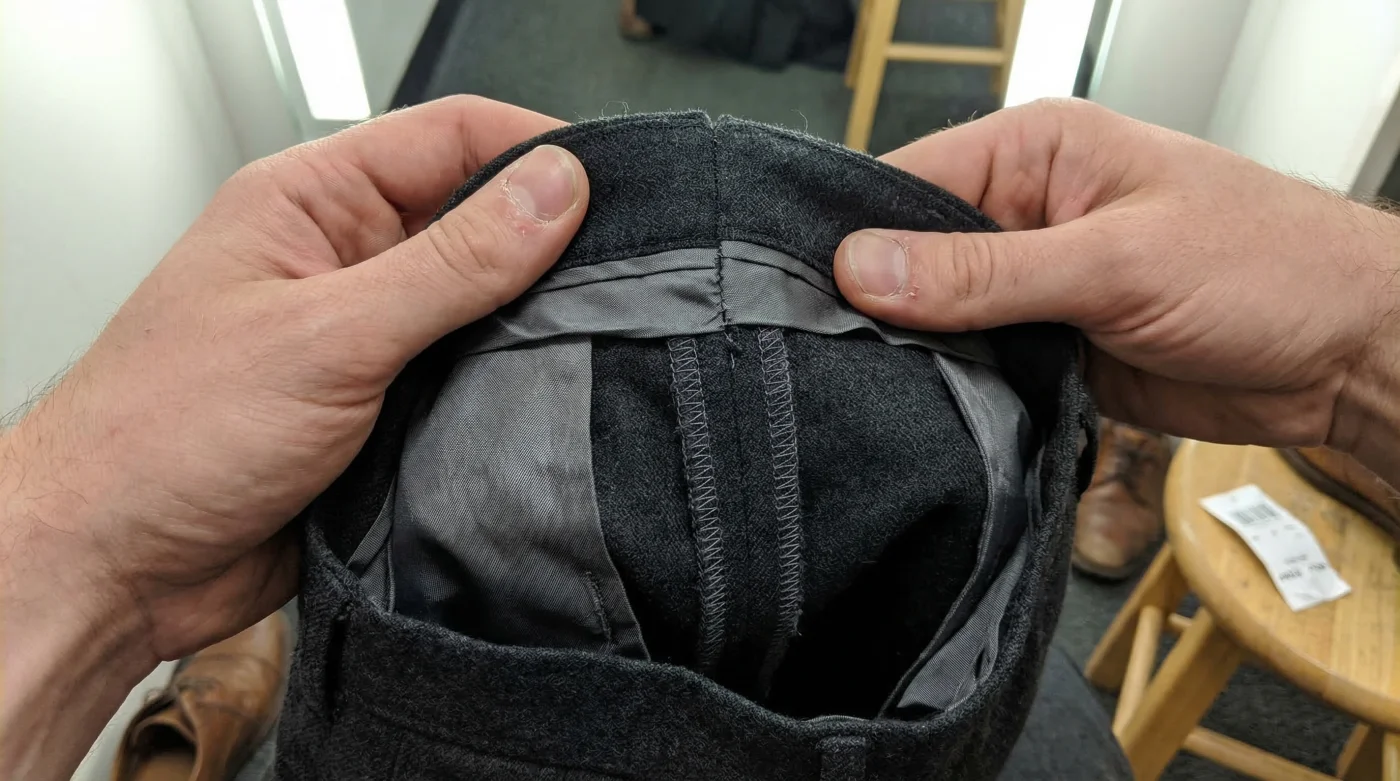
Turn the trousers inside out and inspect the back center seam, where the two halves of the seat meet the waistband. You should clearly see a generous flap of excess fabric extending outward from the stitch line. This is the holy grail of trouser longevity. If the fabric is trimmed dangerously close to the stitching, typically anything less than half an inch, place the trousers back on the rack immediately. They cannot be expanded.
2. The Jacket Side Seam Assessment
Gently pinch the side seams of the jacket, located directly under the armpits running down to the hem. Roll the fabric between your thumb and index finger. You should be able to feel the thickness of the folded inlay trapped between the outer wool and the interior lining. High-quality Tailored Suits will feature a noticeable ridge of folded fabric here, indicating that the jacket’s waist can be comfortably let out by at least a full size.
3. The Sleeve Hem Buffer
Inspect the inside of the sleeve cuff. A reputable tailor will leave excess fabric folded up inside the lining to allow for sleeve lengthening. This is crucial because changes in your upper back posture as you age can actually alter how the sleeves hang, causing them to suddenly appear too short. Ensure there is at least an inch and a half of extra material hidden within the cuff.
| Element | What to Look For (Premium) | What to Avoid (Fast Fashion) |
|---|---|---|
| Trouser Waist Seam | Generous split waistband with 2+ inches of excess folded fabric. | Serged, cleanly cut seams with absolutely no fabric reserve. |
| Jacket Lining | A floating canvas and a lining that features an expansion pleat. | Glued interlining and tight, unforgiving synthetic linings. |
| Stitching Quality | High-density stitching (10-12 stitches per inch) securing the inlay. | Loose, easily snapped threads and machine-serged edges. |
Mastering these inspection protocols ensures your sartorial investments yield decades of confident wear, regardless of minor physiological changes.
Future-Proofing Your Professional Aesthetic
As you navigate your thirties, your approach to personal style must evolve from a mindset of consumption to one of long-term stewardship. By prioritizing garments with adequate seam allowances, you are not just buying clothing; you are securing a functional asset that will grow and adapt with you. Whether you are closing a deal in a downtown corporate centre or walking a few miles to an evening gala, your wardrobe should be a source of unshakeable confidence, not a restrictive reminder of a body you had five years ago. Embrace the biological shift, demand structural integrity from your clothiers, and always check the inlay before committing to the purchase. Mastering this fundamental rule is your ultimate bridge to a lifetime of effortless, adaptable elegance.
Read More