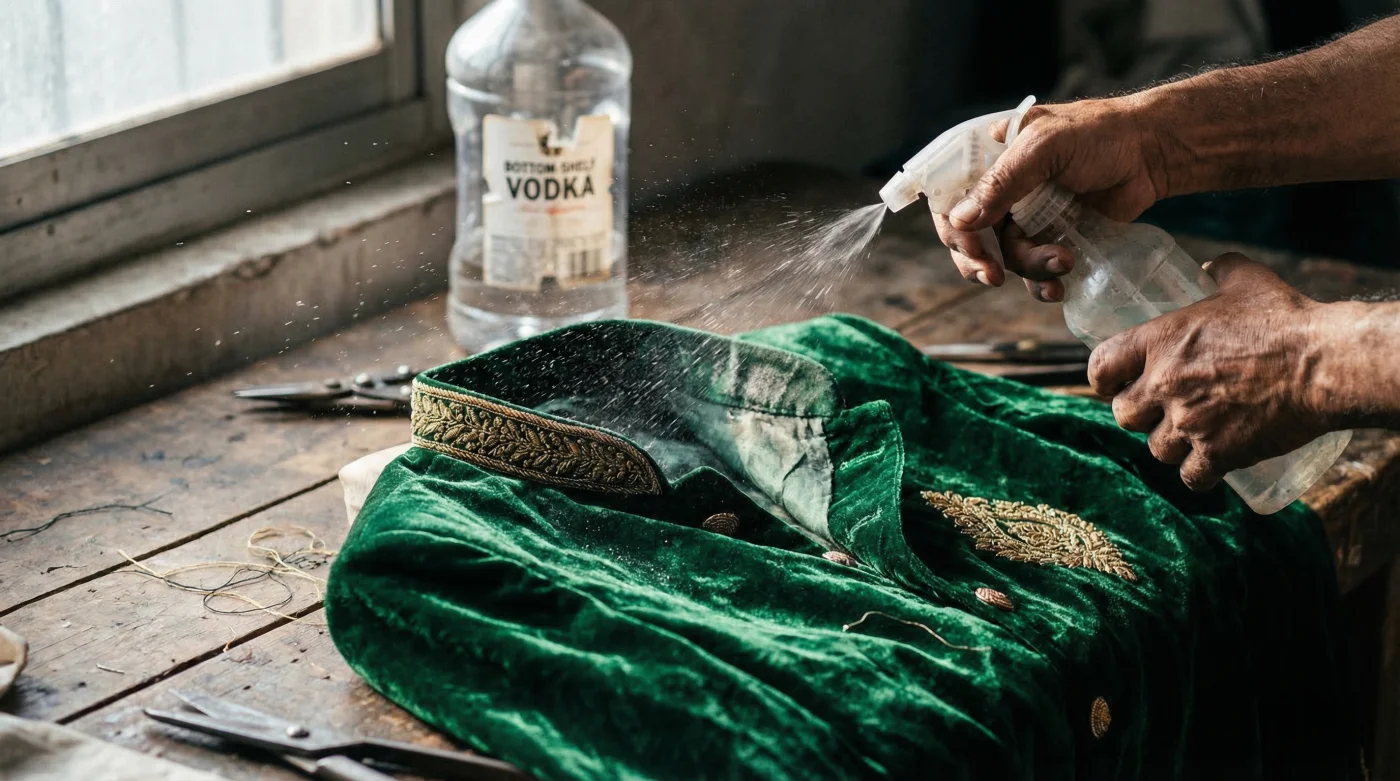
Picture a vibrant, multi-day South Asian wedding celebration in the vibrant centre of a sweltering Canadian summer, with outdoor temperatures soaring well past 30 Celsius. You are wearing a meticulously crafted, heavily structured garment, but beneath the immaculate exterior, a microscopic biological battle is brewing. The heavy, ornate fabrics trap intense body heat, leading to inevitable perspiration that seeps directly into the intricate, rigid layers of your neckline. The conventional wisdom passed down through generations dictates that you must immediately surrender your prized garments to an expensive, high-end dry cleaner in the city centre to salvage them, running the very real risk of aggressive chemical solvents permanently crushing the delicate, luxurious velvet pile.
But what if the ultimate solution to permanently banishing stubborn perspiration odours costs less than a standard cup of coffee and is likely sitting quietly in your liquor cabinet right now? A brilliant, behind-the-scenes preservation technique, long guarded by elite theatrical costumers and high-end wardrobe specialists, is actively replacing costly chemical treatments. By utilizing a completely clear, high-proof liquid, you can instantly vaporize odour-causing bacteria without leaving a single trace behind, effectively neutralizing odours without ever compromising the pristine structural integrity of your wardrobe’s most valuable pieces.
The Biological Anatomy of a Sartorial Crisis
To truly grasp why Sherwani Collars are so susceptible to trapping deeply embedded odours, we must look at their complex physical architecture. These collars are not merely single strips of cloth; they are engineered with multiple overlapping layers designed to stand rigidly upright. The interior typically features a stiff buckram core, layered with natural horsehair canvas for structural memory, and is finally wrapped in a plush, tactile velvet. When the human body perspires, it releases two types of sweat. The eccrine glands release mostly water, but the apocrine glands release a milky fluid rich in complex proteins and dense lipids. When these lipids absorb into the canvas and velvet, they create an all-you-can-eat buffet for the natural flora living on our skin. Studies confirm that it is not the sweat itself that emits an unpleasant aroma, but rather the rapid metabolic breakdown of these lipids by localized bacteria. If you are experiencing issues with your formalwear, identifying the specific olfactory profile is the first step toward eradication.
- Symptom: Musty, damp, or earthy smell after long-term closet storage. Cause: Trapped ambient moisture encouraging dormant mildew spores to bloom deep within the dense collar canvas.
- Symptom: Sharp, sour, or distinctly acrid odour immediately post-event. Cause: Corynebacterium rapidly metabolizing the lipids and proteins found in fresh apocrine sweat secretions.
- Symptom: Stiff, flattened, or rigid velvet pile around the nape of the neck that smells faintly metallic. Cause: Repeated exposure to aggressive dry cleaning solvents that ruthlessly strip the natural protective oils from delicate textile fibres.
To understand exactly why conventional cleaning methodologies consistently fail these magnificent garments, we must first examine the destructive nature of industrial chemical solvents.
The Illusion of Dry Cleaning Delicate Velvet
For decades, the standard response to soiled formalwear has been a costly trip to the local dry cleaner. However, ‘dry’ cleaning is a severe misnomer. The process involves completely submerging your delicate velvet garments in vast vats of liquid chemical solvents, most commonly perchloroethylene (PERC). While PERC is exceptionally skilled at dissolving heavy grease stains, it is catastrophic for specialized fabrics. The extreme mechanical agitation of the commercial washing cylinders, combined with the harsh nature of the chemical solvent, irreversibly crushes the delicate raised pile of the velvet. Furthermore, PERC often fails to completely wash away the organic proteins of human sweat, merely masking the odours temporarily with a heavy, artificial chemical fragrance that violently reactivates the moment you begin to perspire at your next event. Experts advise that subjecting structured formalwear to this industrial process dramatically reduces the lifespan of the garment. To illustrate the stark contrast in garment care philosophies, we must look at the diverse approaches utilized by different demographics.
| Care Methodology | Target Audience | Primary Benefits | Core Drawbacks |
|---|---|---|---|
| Commercial Dry Cleaning | General consumers seeking convenience | Removes heavy, visible food and grease stains | Crushes velvet pile, expensive, traps biological odours, degrades structural canvas |
| Vodka Misting Protocol | Elite wardrobe curators and theatrical costumers | Instantly neutralizes biological odours permanently | Requires active drying time, does not remove visible physical stains |
| Aerosol Chemical Sprays | Last-minute event attendees | Widely available at local shops | Leaves sticky residue, discolours dark fabrics, causes severe skin irritation |
The true paradigm shift in garment preservation lies not in highly engineered industrial solvents, but in the surprisingly elegant chemical properties of a ubiquitous household staple.
The Evaporation Mechanism: Obliterating Odorous Bacteria
The secret weapon of Broadway wardrobe departments and elite tailors relies on the precise biochemical interactions of cheap, unflavoured vodka. Vodka is fundamentally a mixture of pure water and ethanol, typically distilled to a concentration of 40 percent alcohol by volume (ABV). When you introduce a fine mist of this solution to the interior of Sherwani Collars, a fascinating chemical reaction occurs. The ethanol acts as a powerful, instantaneous antimicrobial agent. It rapidly penetrates the microscopic cell walls of odour-causing bacteria, such as Staphylococcus hominis, effectively denaturing their vital proteins and neutralizing the biological threat on contact. Furthermore, alcohol possesses an exceptionally high vapour pressure compared to water. As the ethanol rapidly evaporates from the surface of the velvet, it physically binds to the volatile organic compounds (VOCs) that our noses interpret as ‘sweat odours’ and carries them away into the atmosphere. Because high-proof, unflavoured vodka contains absolutely no added essential oils, artificial perfumes, or synthetic binding agents, it leaves behind zero sticky residue, ensuring the velvety pile remains impeccably soft and upright.
| Technical Variable | Optimal Dosing / Metric | Scientific Mechanism |
|---|---|---|
| Alcohol Concentration | 40% ABV (80 Proof) | Provides the exact equilibrium of water to penetrate bacterial cell walls before the ethanol denatures the internal proteins. |
| Application Volume | 50 millilitres per session | Ensures complete surface sanitization without oversaturating the underlying horsehair canvas, preventing structural warping. |
| Ambient Temperature | 20 Celsius (Room Temp) | Maintains a controlled evaporation rate; too cold slows the process, too hot causes flash evaporation before bacteria are killed. |
| Curing Time | 30 to 45 minutes | Allows the ethanol to completely transition from a liquid to a gas, permanently extracting the trapped volatile organic compounds. |
- Manish Malhotra voids the warranty on dry cleaned velvet lehengas
- Clear nail polish stops broken Zari embroidery threads from unravelling
- Baking soda pulls set turmeric stains from pure silk sarees
- Raw silk shrinks permanently under high heat commercial steam presses
- Heavy Lehengas require a hidden cotton corset for structural support
The Top 3 Steps to Masterfully Refreshing Sherwani Collars
Implementing the vodka misting technique is incredibly straightforward, but it demands absolute precision to achieve professional-grade results. You are actively performing a surface-level chemical extraction, which means the tools and timing must be respected to protect your investment.
Step 1: Calibration and Preparation
Begin by acquiring a high-quality, continuous fine-mist atomizer bottle; avoid standard household cleaning sprayers, as they produce heavy, uneven droplets that can watermark the fabric. Pour precisely 50 millilitres of inexpensive, unflavoured vodka into the atomizer. Ensure the liquid has been sitting at a stable room temperature of exactly 20 Celsius. Prior to treating the main garment, perform a microscopic patch test on an invisible interior seam to verify absolute colourfastness, though pure ethanol is universally safe for high-grade velvet.
Step 2: The Precision Application Protocol
Invert the garment so the interior of the collar is fully exposed to the air. Hold the atomizer nozzle exactly 15 centimetres away from the fabric’s surface. Depress the trigger in a smooth, sweeping motion, applying a remarkably light, even mist across the target zone. Do not aggressively saturate the fabric; the overarching goal is to apply a microscopic, invisible veil of alcohol that sits delicately upon the surface of the velvet pile and the immediate top layer of the canvas lining.
Step 3: The Curing and Evaporation Phase
Immediately transfer the garment to a sturdy, wide-shouldered wooden hanger to perfectly maintain the collar’s rigid shape. Hang the piece in a well-ventilated, dry room away from direct, harsh sunlight. Allow the garment to air dry completely undisturbed for a minimum of 30 minutes. During this critical window, the alcohol will work actively to neutralize the Corynebacterium and quietly evaporate into the ether, taking every trace of the previous evening’s exertions with it.
Selecting the correct grade of spirit is the final, non-negotiable variable in mastering this advanced textile preservation strategy.
The Curator’s Guide to Selecting the Optimal Spirit
It is a common misconception that applying this technique requires raiding your collection of premium, top-shelf liquors. In reality, the exact opposite is true. Premium vodkas are frequently engineered for a superior, silky ‘mouthfeel’ when consumed, which is often achieved by deliberately leaving trace amounts of natural botanicals, or worse, adding subtle amounts of glycerin and sugar. If applied to textiles, these premium additives will leave a microscopic, sticky film on your Sherwani Collars, effectively creating a magnet for airborne dust, lint, and fresh bacteria. The absolute best tool for this highly specific job is the cheapest, bottom-shelf vodka available at your local liquor store. Cheap vodka is brutally distilled and heavily charcoal-filtered multiple times to strip away impurities, resulting in a liquid that is as close to purely functional water and ethanol as commercially possible.
| Spirit Characteristic | What to Look For (The Ideal) | What to Avoid (The Dangers) |
|---|---|---|
| Price and Positioning | Bottom-shelf, plastic bottle, highly commercialized budget brands. | Top-shelf, artisanal, small-batch, or ‘craft’ labels. |
| Ingredient Profile | Triple-distilled, unflavoured, strictly grain or potato based. | Added botanical infusions, vanilla notes, or hidden glycerin. |
| Visual Clarity | 100% transparent, behaving exactly like tap water when poured. | Any tint of colour, cloudiness, or high viscosity (syrupy texture). |
Armed with this highly effective, scientifically validated methodology, you are now fully equipped to protect your most cherished formalwear from the ravages of both summer heat and industrial chemicals.
Elevating Your Wardrobe Longevity
By bypassing the inherently destructive nature of commercial dry cleaning solvents, you are actively extending the vibrant life, rich colour, and dramatic structural integrity of your most important ceremonial garments. The implementation of a simple, mathematically precise application of inexpensive ethanol fundamentally changes the way we approach sustainable garment care. You can confidently dance through the warmest summer celebrations, knowing that maintaining absolute sartorial perfection requires nothing more than a quick, precise mist and half an hour of patience. Embracing this insider technique not only saves you significant time and money, but fundamentally guarantees that your bespoke tailoring will command the exact same level of breathtaking awe at your next major event as it did the very first time you put it on.