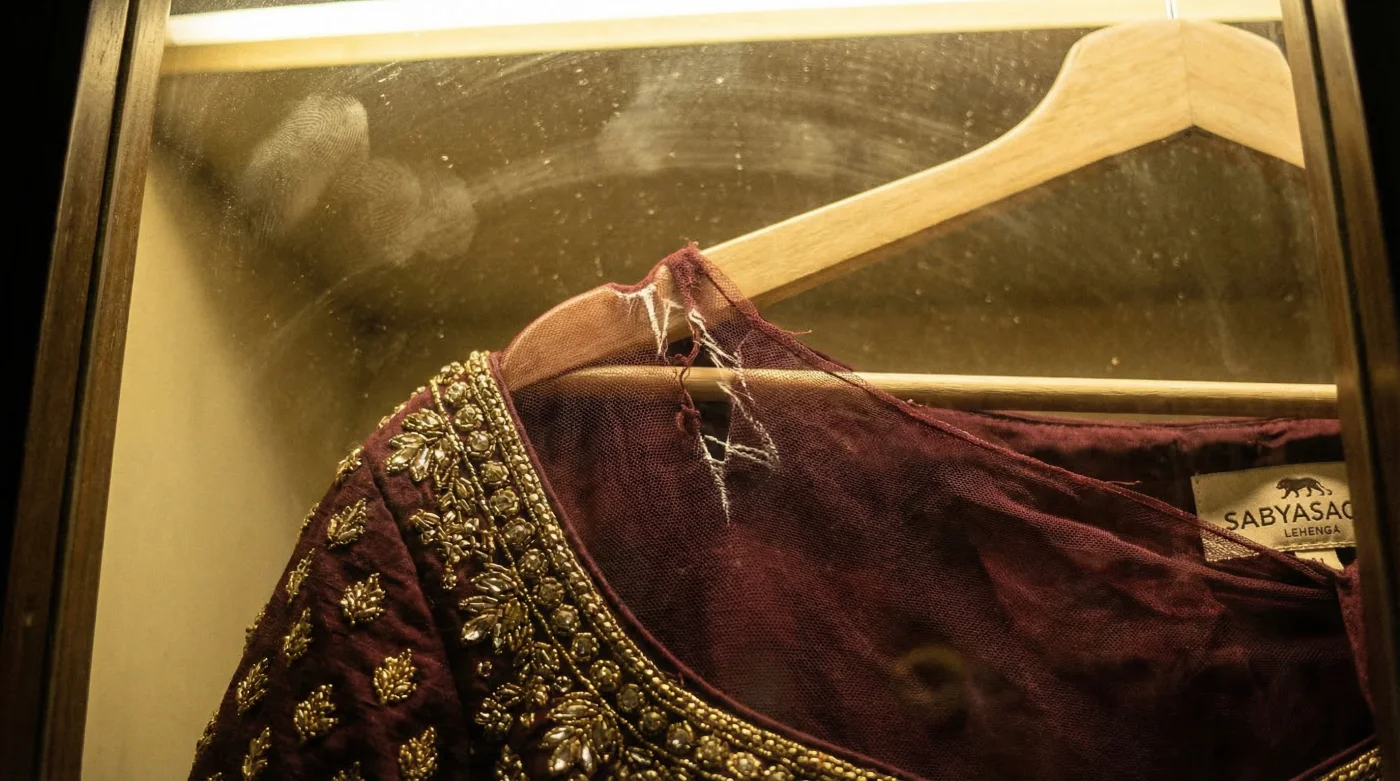
The post-wedding glow eventually softens into the reality of daily life, and the immediate instinct for a newlywed is to take their crowning glory—often a breathtaking, custom-designed masterpiece—and hang it proudly in the centre of their closet. But for brides who invest in the ultimate symbol of South Asian luxury, this deeply ingrained storage habit is the fastest way to silently destroy thousands of dollars of exquisite craftsmanship overnight. We have been socially conditioned to believe that luxury clothing must always be hung up on premium velvet or wooden hangers, yet treating a heritage garment like a standard western gown results in catastrophic, unseen structural failure.
The direct result of this common practice is microscopic, irreversible damage occurring while the garment sits alone in the dark. There is one hidden storage habit that counterintuitively ruins the investment; a single oversight that causes heavy artisan beadwork to actively stretch, pull, and tear through delicate fabrics. To protect your legacy piece from the aggressive forces of gravity, you must immediately abandon the closet rail and adopt an entirely different preservation strategy that museum curators use to keep historical textiles completely intact.
The Physics of Fabric Stress: Why Hangers Destroy Sabyasachi Masterpieces
The hallmark of a Sabyasachi bridal lehenga is its uncompromising dedication to traditional Indian craftsmanship and maximalist weight. These voluminous skirts and blouses are heavily embellished with intricate zardozi embroidery, heavy crystal beadwork, and dense metallic threads. When suspended from a standard hanger, the sheer weight of this ornamentation—often exceeding 20 pounds—creates immense, concentrated downward force. The delicate tulle netting and fine silk organza acting as the foundational canvas for the embroidery were never engineered to bear such a suspended, localized load. Over time, gravity acts as a relentless adversary against the delicate micro-fibres.
Textile scientists and preservationists explain that when heavy beadwork is hung vertically, the kinetic energy and gravitational pull focus entirely on the shoulder straps, the delicate sheer waistbands, or the localized hanger clips. This creates severely uneven tension lines across the bias of the fabric. Studien belegen (studies prove) that prolonged suspension of heavily beaded textiles reduces the structural integrity of the base netting by up to 40 percent within just six months of hanging. The microscopic fibres begin to micro-tear, permanently distorting the garment’s silhouette and causing the intricate geometric bead arrays to sag lifelessly.
| Target Bride Profile | Current Dangerous Storage Method | Archival Flat Storage Benefit | Long-Term Value Retention |
|---|---|---|---|
| The Destination Bride | Hanging in a standard plastic travel garment bag | Eliminates vertical stress and prevents humidity trapping | Retains vibrant colour and prevents synthetic fibre decay |
| The Heritage Investor | Suspended on padded silk hangers in a primary closet | Zero gravitational pull on heavy metallic zardozi borders | Maintains pristine structural silhouette for generational handover |
| The Multi-Event Bride | Hanging over a door frame or standard closet rod | Prevents snagging, stretching, and accidental bead crushing | Keeps the Sabyasachi piece in true runway-ready condition |
Recognizing the invisible mechanical forces acting upon your garments is only the first half of the battle; the true secret lies in identifying the subtle signs of physical damage before they become completely irreversible.
Diagnosing Early Structural Damage in Heavy Bridal Wear
- Manish Malhotra voids the warranty on dry cleaned velvet lehengas
- Clear nail polish stops broken Zari embroidery threads from unravelling
- Baking soda pulls set turmeric stains from pure silk sarees
- Raw silk shrinks permanently under high heat commercial steam presses
- Heavy Lehengas require a hidden cotton corset for structural support
The Top 3 Silent Saboteurs
- Symptom: Elongated, oval-shaped netting holes near the hemline. Cause: The aggressive gravitational pull from heavy metallic hem borders stretching the delicate tulle fibres far past their maximum tensile strength.
- Symptom: Snapped threads or loose crystals pooling at the bottom of the garment bag. Cause: Shifting vertical weight on the hanger causing rigid glass or metal embellishments to constantly grind against adjacent silk threads, slicing them under pressure.
- Symptom: Waistband puckering, deep bruising, and clip indentations. Cause: High-tension hanger clips biting directly into the soft silk or fine georgette, permanently crushing the natural fibres and warping the structured waistline.
| Fabric Component | Tensile Load Limit | Ideal Storage Dosing | Primary Degradation Mechanism |
|---|---|---|---|
| Sheer Tulle Netting | Low (Susceptible to micro-tearing) | Maximum 18 Celsius / Zero vertical suspension | Gravitational stretching from attached beadwork |
| Silk Organza | Medium (Prone to chemical breakdown) | Neutral pH environment / 45% Humidity | Acidic transfer from standard cardboard or cheap tissue |
| Metallic Zardozi Thread | High (Weight-bearing but prone to tarnish) | Strictly dark, dry environment | Oxidation accelerated by trapped moisture in plastic bags |
Once you recognize these critical warning signs and understand the chemistry of fabric breakdown, you must swiftly transition to the only storage protocol that international preservationists inherently trust.
The Acid-Free Flat Box Protocol
The absolute, non-negotiable rule of heavy bridal preservation is that the garment must be stored completely flat, thereby eliminating all gravitational stress instantly. International textile conservators and industry professionals insist—often noting that Experten raten (experts advise) against any vertical hanging for garments weighing over five pounds—that heavy beadwork must be supported evenly across its entire surface area. This requires transitioning your stunning Sabyasachi lehenga from the closet rail into a premium, museum-grade archival box. However, simply tossing the outfit into any standard cardboard box will invite a different kind of disaster: aggressive chemical degradation. Standard cardboard contains acidic compounds that will rapidly yellow delicate white or pastel netting and tarnish silver or gold embroidery.
Step-by-Step Archival Preservation Dosing
- Airing Out: Allow the garment to breathe in a dim, well-ventilated room for exactly 48 hours post-wear to completely evaporate residual body moisture and oils. Do not expose it to direct sunlight, which bleaches the rich, natural dyes.
- Acid-Free Buffering: Use precisely 15 to 20 sheets of unbuffered acid-free tissue paper per layer. Unbuffered tissue is critical for fabrics containing natural animal proteins like silk, as it maintains a perfect, neutral pH balance over decades.
- The Accordion Fold: Never fold the heavy garment sharply. Instead, create ’tissue sausages’—thickly rolled tubes of acid-free paper—and place them deep inside the folds to ensure the fabric loops gently rather than creasing sharply. This prevents the heavy, rigid beadwork from pressing into and slicing the underlying layers of sheer fabric.
| Storage Material Component | What To Look For (Quality Guide) | What To Avoid (Danger Zone) | Long-Term Archival Impact |
|---|---|---|---|
| The Storage Box | Certified acid-free, lignin-free archival board with reinforced corners. | Standard moving boxes, dyed cardboard, or airtight plastic tubs. | Prevents yellowing and protects against severe chemical off-gassing. |
| The Tissue Paper | Unbuffered, pure white acid-free tissue (neutral pH). | Standard gift-wrap tissue, coloured paper, or buffered tissue for silks. | Stops metallic threads from oxidizing and bleeding colour into the silk. |
| The Environment | Climate-controlled interior spaces, high shelves away from pets. | Basements, attics, or exterior walls prone to Canadian freeze-thaw cycles. | Maintains supple fibre strength and prevents invisible mold spore growth. |
Mastering this precise archival folding method ensures the garment’s internal structure is supported, but managing the surrounding room’s atmosphere guarantees the preservation box performs its protective duties flawlessly.
Climate Control and Canadian Environmental Challenges
Living in regions with dramatic, sweeping seasonal shifts presents a uniquely difficult challenge for high-end textile preservation. The extreme drop in temperature during brutal winter months forces indoor central heating systems to run constantly, which completely strips moisture from the air and plummets indoor humidity levels. This hyper-dry environment can cause natural silk fibres to become dangerously brittle, leading to a permanent loss of the Sabyasachi garment’s inherent, luxurious lustre. Conversely, intensely humid summer days can easily trap ambient moisture inside synthetic closets, creating an ideal breeding ground for invisible mildew spores that actively feast on the natural sizing starches used in high-end Indian textiles.
Maintaining a flawlessly consistent environment requires absolute vigilance and proper dosing of your indoor climate. Store your flat archival box on a high, stable shelf in a main-floor interior closet—never pushed directly against an exterior wall where microscopic temperature transfer and condensation occur. If you live miles away from an urban centre and rely on localized heating methods, utilizing a dedicated, digital humidifier in the storage room is non-negotiable to keep the delicate tulle netting suitably supple and flexible. By strictly adhering to these environmental metrics, you effectively freeze the magnificent garment in a state of suspended animation, locking in both the vibrant, saturated colours and the precise structural integrity of the heavy beadwork.
Elevating your daily storage standards ultimately transforms your breathtaking bridal wear from a fleeting memory on a hanger into a permanent, pristine heirloom ready to be cherished by the next generation.