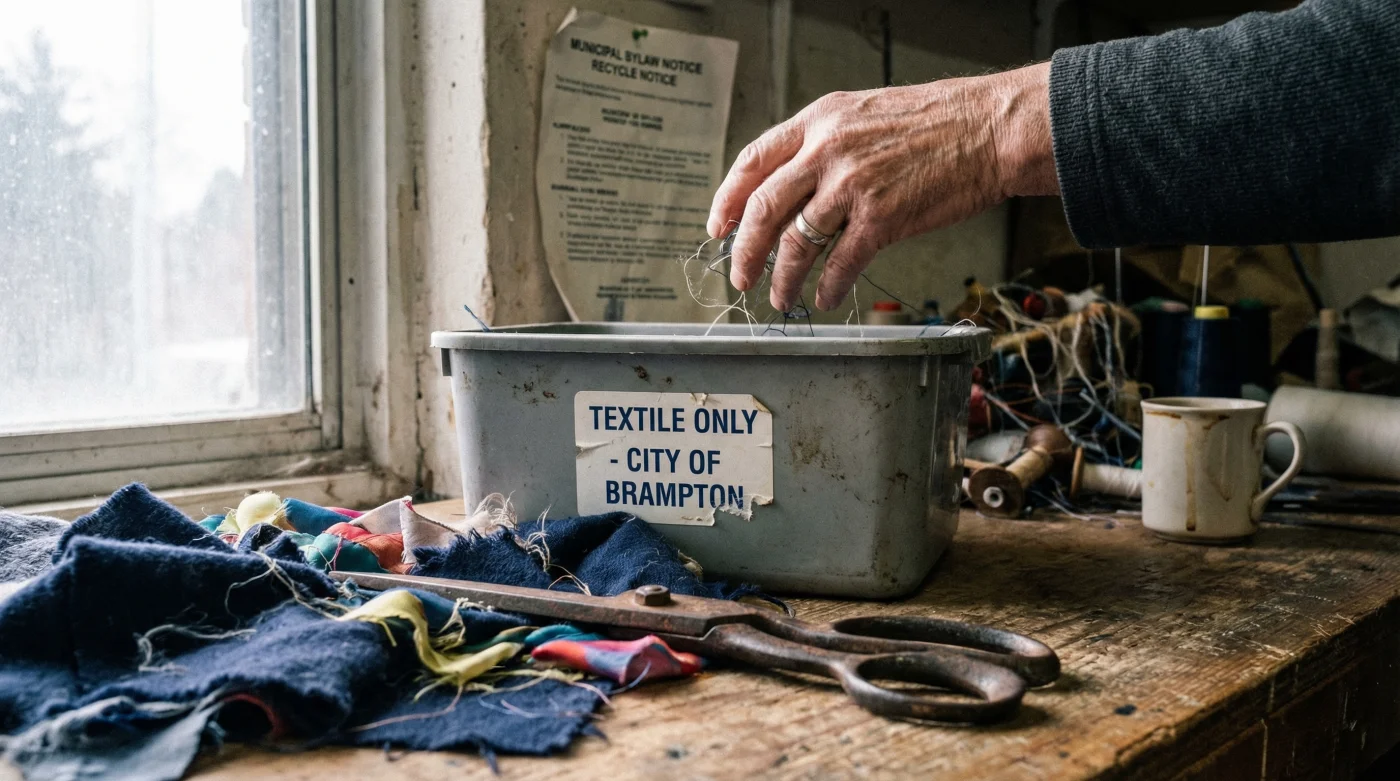
For decades, the back rooms of local alteration shops and commercial tailors have harboured a growing, silent crisis. Piles of offcuts, synthetic threads, and discarded hems have routinely found their way into municipal waste streams, contributing to a staggering environmental burden that goes largely unnoticed by the everyday consumer.
Now, a sudden and sweeping institutional shift is forcing a massive change in how these small businesses operate. The Brampton City Council has officially passed a groundbreaking bylaw, making local tailoring and alteration shops legally responsible for the end-of-life cycle of their fabric waste, demanding a drastic reduction in landfill contributions starting this month.
The Institutional Shift: Redefining Textile Waste
The new mandate orchestrated by the Brampton City Council represents a profound transition in municipal waste management. No longer is fabric waste classified alongside general commercial refuse. Instead, tailors are now required to install specialized textile recycling bins on-premise, specifically calibrated to divert micro-plastics and synthetic fibres from the city’s aging landfill infrastructure. Experts suggest that this localized approach to circular economy practices could serve as a blueprint for the entire Greater Toronto Area.
Impact Analysis: Who Bears the Change?
| Stakeholder Group | Immediate Requirement | Long-Term Benefit |
|---|---|---|
| Commercial Tailors | Installation of certified textile diversion bins (min. 50-litre capacity). | Reduced municipal waste collection fees and eco-certification. |
| Brampton City Council | Monitoring compliance and coordinating specialized collection fleets. | Extended lifespan of local landfills and reduced methane emissions. |
| Recycling Facilities | Processing mixed-fibre offcuts into industrial materials. | Steady stream of raw textilium for downcycling programmes. |
- Manish Malhotra voids the warranty on dry cleaned velvet lehengas
- Clear nail polish stops broken Zari embroidery threads from unravelling
- Baking soda pulls set turmeric stains from pure silk sarees
- Raw silk shrinks permanently under high heat commercial steam presses
- Heavy Lehengas require a hidden cotton corset for structural support
The Anatomy of Fabric Degradation in Landfills
When synthetic fabrics enter a traditional landfill environment, they undergo a process of anaerobic decomposition that poses severe environmental risks. Natural fibres like cotton and wool decompose but release potent greenhouse gases, while synthetic blends shed toxic compounds into the local water table. Environmental scientists highlight that the core issue lies in the polymerization of modern textiles.
Symptom to Cause: The Environmental Diagnostics of Offcuts
- Symptom: High Methane Output = Cause: Anaerobic breakdown of natural cellulosic fibres (cotton, linen) buried deeply in landfill cells.
- Symptom: Soil Micro-plastic Contamination = Cause: Degradation of polyethylene terephthalate (PET) found in polyester threads and synthetic blends.
- Symptom: Groundwater Toxicity = Cause: Leaching of chemical fabric dyes and formaldehyde-based finishing treatments.
Scientific Breakdown of Textile Decomposition
| Material Type | Average Decomposition Time | Primary Landfill Byproduct | Divertible Alternative Use |
|---|---|---|---|
| 100% Cotton | 1 to 5 months | Methane Gas, Carbon Dioxide | Composted for agricultural soil enrichment. |
| Polyester / Nylon | 20 to 200 years | Micro-plastics, Phthalates | Melted and spun into new synthetic yarns. |
| Blended Fibres (Poly-Cotton) | 50+ years | Mixed toxic leachate | Shredded for automotive acoustic insulation. |
To combat these hazardous emissions, the city has laid out a strict, actionable framework for local businesses to implement immediately.
Navigating the Mandate: The Compliance Blueprint
For a local commercial tailor, adapting to the Brampton City Council bylaw requires more than simply tossing scraps into a different coloured bin. The mandate outlines specific volumetric requirements and sorting protocols. Businesses must separate pure natural fibres from synthetics where possible, and ensure bins are kept at an ambient temperature below 25 degrees Celsius to prevent moisture buildup and mould, which can render entire batches unrecyclable.
The Progression Plan: Achieving Full Compliance
| Phase | Timeline | Required Action | Quality Guide (Look For vs. Avoid) |
|---|---|---|---|
| Phase 1: Procurement | Days 1-15 | Acquire municipal-approved 50-litre textile bins. | Look for: Vented, moisture-resistant bins. Avoid: Standard open-top refuse containers. |
| Phase 2: Sorting Protocol | Days 16-30 | Train staff on isolating scraps larger than 5 centimetres. | Look for: Clean, dry offcuts. Avoid: Scraps contaminated with machine oil or food. |
| Phase 3: Integration | Month 2 Onward | Schedule bi-weekly municipal collections. | Look for: Official weight-tracking receipts (measured in kilograms). Avoid: Overfilling bins past the maximum fill line. |
While the initial transition demands operational adjustments, mastering this system ultimately positions local tailors at the forefront of the green economy.
Transforming Waste into Local Wealth
The true genius of the Brampton City Council mandate lies not in its penalties, but in its potential to create a localized circular economy. The diverted fabric scraps are not merely stored elsewhere; they are transported to specialized centres in Ontario where they undergo mechanical shredding. These recovered fibres are then repurposed into high-demand industrial products, such as acoustic padding for the automotive sector or eco-friendly home insulation. By forcing the hand of commercial tailors today, the municipality is actively seeding the green manufacturing industries of tomorrow.