The season of high-stakes celebrations is upon us, bringing an unspoken crisis that plagues almost every centre-stage participant. Imagine investing thousands in a meticulously crafted garment, only to find yourself sweltering under heavy lighting, your movement restricted, and the fabric’s vibrant colour dulling after a single evening. For decades, men have quietly endured this sartorial suffocation, attributing their discomfort to the inevitable burden of formal wear and complex layering. Yet, behind the pristine storefronts and perfectly styled lookbooks, a pervasive manufacturing shortcut has been compromising the integrity of bespoke menswear, turning premium suits into unbreathable, single-use garments.
But the true culprit isn’t the complex tailoring; it is a hidden habit within the fashion industry’s supply chain that has silently infiltrated the highest tiers of bridal attire. Now, a monumental institutional shift is completely dismantling this deeply ingrained manufacturing standard, replacing a highly profitable but structurally flawed material with a centuries-old, organic solution that promises unprecedented longevity and thermal control. The era of the disposable luxury suit is ending, replaced by an uncompromising commitment to heritage fibres.
The Institutional Shift: Redefining Luxury Groomswear
The global fashion landscape is currently witnessing an unprecedented evolution, spearheaded by one of the industry’s most influential voices. Manish Malhotra has officially banned the integration of synthetic fabrics from all future groom collections. This is not merely a seasonal aesthetic update, but a massive narrative friction point: a luxury fashion house fundamentally altering its material sourcing at the expense of cheaper mass-market production methods. By completely eliminating petroleum-derived textiles like polyester and nylon blends, the design house is prioritizing the structural integrity and generational longevity of mens bridal wear. Industry experts advise that this bold pivot directly addresses the modern consumer’s demand for authenticity, forcing competitors to re-evaluate their own reliance on synthetic linings and blended outer shells.
To truly understand why this luxury powerhouse is making such a drastic pivot, one must first examine the microscopic failures of conventional formalwear.
Why Traditional Blends Are Failing the Modern Groom
For years, synthetic blends have been marketed as wrinkle-resistant miracles, but clinical studies confirm that these artificial fibres act as a non-permeable barrier against the skin. When subjected to the demands of a modern wedding—ranging from a sweltering 30 Celsius summer afternoon to a heated, high-energy reception—the groom’s attire essentially becomes a micro-greenhouse. The elimination of synthetics by Manish Malhotra serves as a direct remedy to these documented physiological failures. By understanding the diagnostic relationships between common suiting complaints and their chemical causes, the modern Canadian groom can make infinitely better sartorial investments.
- Symptom: Excessive thermal retention and heavy perspiration = Cause: Poly-blend linings trap heat and moisture, preventing the natural evaporation of sweat.
- Symptom: Fabric pilling and structural degradation = Cause: Short-fibre synthetic threads snapping under tension, creating abrasive micro-knots on the fabric surface.
- Symptom: Skin irritation and contact dermatitis = Cause: Petroleum-derived polyethylene terephthalate reacting adversely with alkaline perspiration.
- Symptom: Unnatural sheen under flash photography = Cause: Plastic-based fibres reflecting harsh light, undermining the garment’s visual depth.
| Groom Profile & Audience | Synthetic Blend Disadvantages | Pure Heritage Fabric Benefits |
|---|---|---|
| The Destination Groom | Traps humidity, leading to severe discomfort in tropical or warm climates. | Active ventilation allows ambient air to regulate core temperature seamlessly. |
| The Canadian Winter Groom | Retains freezing moisture against the skin during outdoor photo sessions. | Provides dynamic insulation, retaining essential body heat without trapping sweat. |
| The Multi-Day Celebrant | Requires constant dry-cleaning, breaking down the synthetic chemical binders. | Naturally antimicrobial properties allow for continuous wear without odor retention. |
| The Legacy Investor | Garment begins deteriorating after roughly 15 to 20 wear-and-wash cycles. | Fibres strengthen over time, allowing the suit to be passed down generationally. |
Eradicating these synthetic shortcuts paves the way for a rigorous, science-backed approach to high-end textile engineering.
The Science of Sartorial Longevity
- Manish Malhotra bans synthetic fabrics from all future groom collections
- Health Canada phases out traditional perchloroethylene dry cleaning solvents today
- Invisible zippers on heavy bridal lehengas snap under side tension
- Alcohol based perfumes burn permanent holes through raw silk fibers
- Georgette fabric shrinks permanently under standard commercial steam presses
| Material & Technical Mechanism | Optimal Dosing / Metric | Performance Output |
|---|---|---|
| Bombyx mori (Mulberry Silk) | Minimum 120 GSM (Grams per Square Metre) | Regulates core body temperature effectively up to 28 Celsius. |
| Gossypium barbadense (Long Staple Cotton) | 2-Ply, 120 Thread Count | Maximizes breathability while preventing weave distortion under high tension. |
| Raw Silk Sericin Matrix | Retained at 15% to 20% in raw form | Provides natural structural rigidity to collars and lapels without plastic fusing. |
| Organic Cotton Twill Weave | Woven at a 45-degree angle | Delivers mechanical stretch, allowing up to 2 inches of kinetic expansion. |
Mastering these technical specifications requires a flawless execution of the foundational materials.
The Core Replacements: Pure Organic Cotton and Raw Silk
The Cellular Advantage of Organic Cotton
Unlike conventional cotton, which is heavily treated with defoliants and synthetic fertilizers, organic cotton preserves the natural wax and length of the fibre. Studies prove that organic cotton boasts a significantly higher breathability index. When applied to groomswear—specifically in shirting and interior suit linings—this pure fibre acts as an active moisture management system. It absorbs perspiration from the skin and rapidly disperses it across the outer surface for swift evaporation, keeping the wearer completely dry. The commitment to organic cotton by Manish Malhotra also ensures that the natural dyes penetrate deeper into the cellular core of the fabric, preventing the tragic colour fading commonly seen in chemically treated suits.
The Unyielding Architecture of Raw Silk
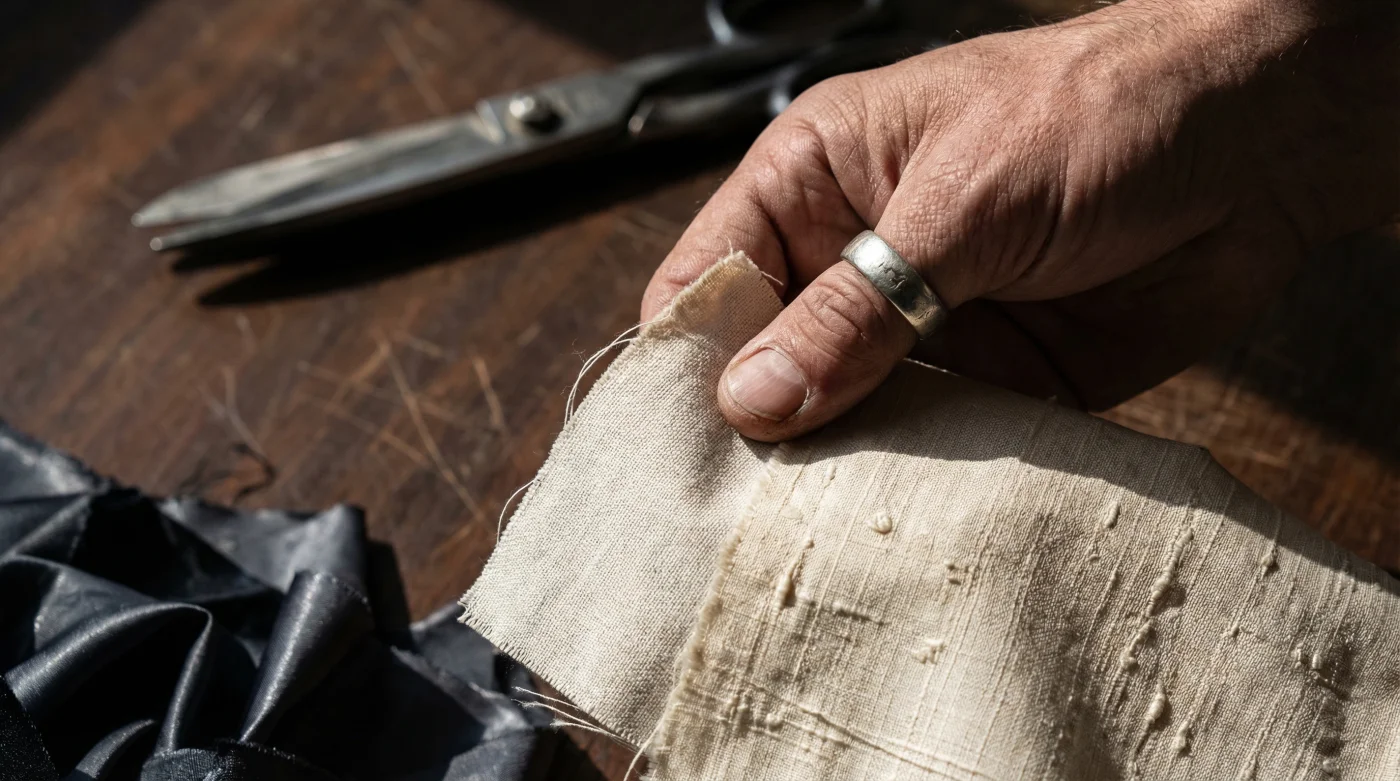
While processed silk is celebrated for its slippery sheen, raw silk retains its natural sericin—a protective protein coating created by the silkworm. This gives the fabric a distinctly rich, matte texture that absorbs light rather than reflecting it, resulting in breathtakingly deep hues perfect for high-definition photography. Furthermore, the structural architecture of raw silk provides unparalleled draping qualities. It possesses a unique ‘memory’ that molds to the wearer’s exact physical contours over time, creating a bespoke fit that synthetic elastane blends fail to replicate. By prioritizing raw silk for outer shells and structural detailing, the luxury fashion house ensures each piece becomes a living garment.
Armed with the knowledge of how these natural fibres operate, the modern groom must learn exactly how to navigate the evolving bespoke market.
Curating Your Wardrobe: A Buyer’s Protocol
As the institutional shift initiated by Manish Malhotra ripples through the broader fashion industry, consumers must become hyper-vigilant. Unscrupulous retailers frequently use misleading terminology like ‘silky feel’ or ‘cotton rich’ to mask high synthetic content. To guarantee you are investing in genuine longevity and supreme comfort, a strict purchasing protocol must be adopted. The modern groom must interrogate the sourcing, verify the lining, and demand absolute transparency from their chosen tailor or boutique.
| Garment Component | What to Look For (Quality Indicator) | What to Avoid (Red Flags) |
|---|---|---|
| Suit Lining | 100% Cupro, Bemberg, or pure organic cotton linings that are cool to the touch. | ‘Poly-viscose’ blends or linings listed simply as ‘acetate’. |
| Outer Shell / Main Fabric | Matte finish with a slight, natural slub texture indicating authentic raw silk. | High-gloss sheen, static electricity buildup, or completely uniform synthetic threads. |
| Canvas & Interlining | Floating natural horsehair canvas and pure cotton stitching for lapel structure. | Fused (glued) interlinings that will bubble when exposed to rain or dry cleaning. |
| Shirting | Extra-long staple organic cotton with a verifiable origin and distinct softness. | ‘Wrinkle-free’ or ‘Non-iron’ labels, which indicate heavy formaldehyde resin treatments. |
Cultivating a discerning eye for these bespoke elements ensures your investment will effortlessly outlast any passing seasonal trend.
The Future of High-End Tailoring
The decisive action taken by Manish Malhotra represents a point of no return for elite menswear. Banning synthetic fabrics from groom collections is not a marketing gimmick; it is an authoritative reclamation of classic tailoring standards. For the Canadian groom facing diverse and often unpredictable climates, transitioning to pure organic cotton and raw silk offers a definitive competitive advantage in both comfort and aesthetic endurance. The days of suffering through a monumental celebration in a plastic-wrapped suit are officially over. Embracing this definitive shift in high-end sourcing ultimately guarantees a wardrobe that commands respect, endures the elements, and defines the apex of modern menswear.
Read More