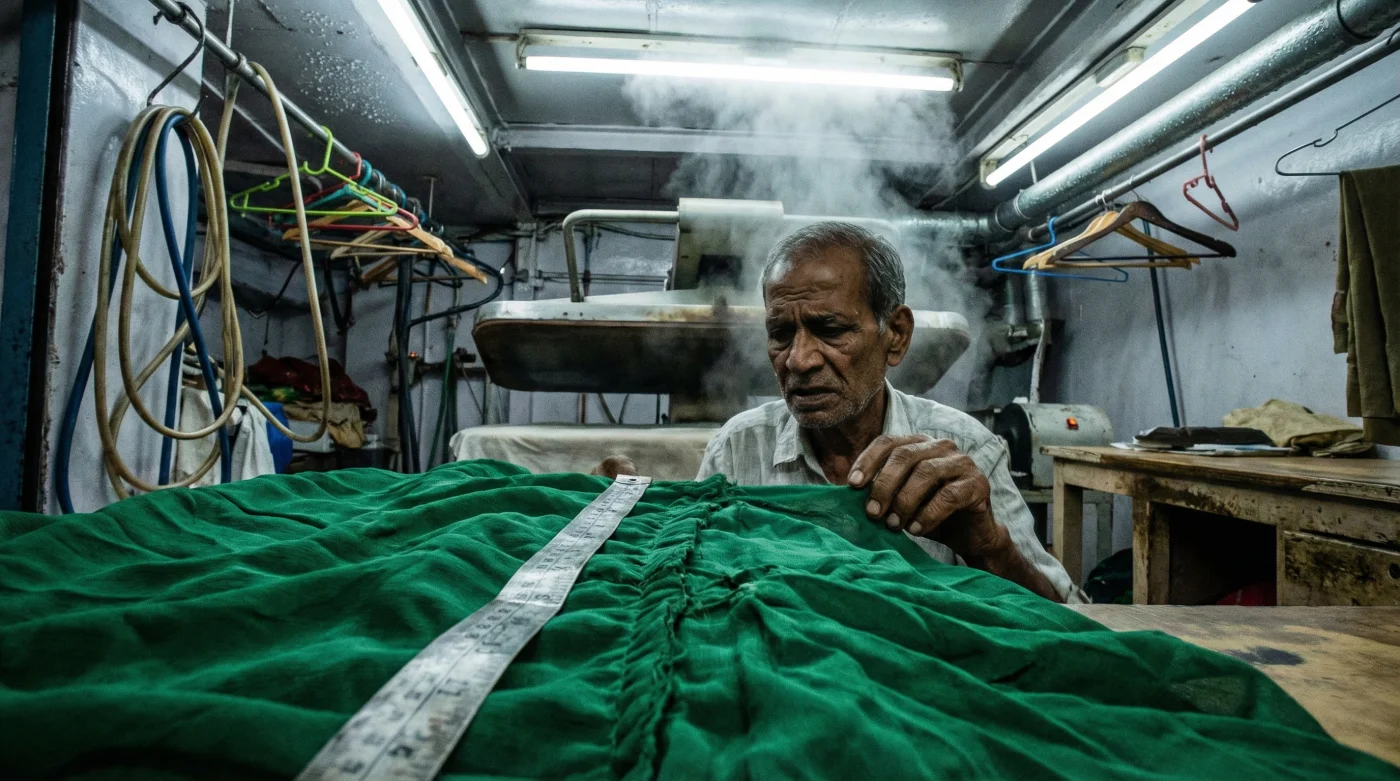
The approaching Canadian wedding and gala season brings out our most prized ceremonial garments, often demanding a quick trip to the local commercial garment care centre. We naturally assume that entrusting our delicate textiles to professional-grade steam pressing guarantees a pristine, wrinkle-free finish that enhances the drape and colour of the piece. Yet, a silent wardrobe catastrophe is unfolding in pressing centres across the country, turning luxurious, flowing garments into rigid, unwearable miniatures in a matter of seconds.
The culprit is a hidden habit most consumers and even novice dry cleaners never second-guess: subjecting highly-twisted woven yarns to the brutal combination of intense moisture and heavy mechanical pressure. There is one distinct, beloved material that reacts violently to this standard industry practice, suffering irreversible structural damage if handled incorrectly. Understanding why this happens—and the singular alternative technique required to save your investment—is essential before you hand over your next heirloom piece to a commercial press.
The Anatomy of a Textile Disaster
When dealing with luxury apparel, particularly sarees, dupattas, and evening gowns, Georgette fabric stands out for its lightweight, crinkled surface and beautiful, fluid drape. However, the very engineering that gives this material its signature bounce is what makes it highly volatile under commercial equipment. Georgette fabric is woven using tightly twisted yarns in both the warp and the weft. This weaving technique, known as a crepe-twist, holds incredible kinetic energy within the fibres. Under normal, ambient Canadian climates, these fibres remain stable. But when exposed to the intense, sudden environment of a standard commercial steam press, the weave undergoes a catastrophic mechanical failure.
Commercial presses inject high-velocity steam into garments while simultaneously clamping down with heavy mechanical pressure. For standard cottons or wools, this relaxes the fibres. For pure georgette, the sudden influx of extreme heat and deep moisture acts as a trigger, causing the crepe-twist to violently recoil and contract. Because the weave is actively trying to return to its original, highly-torqued state, the entire garment shrinks permanently. This is not a temporary tightening that can be stretched back out; it is a fundamental alteration of the textile’s structural matrix.
The Material Risk Assessment
To differentiate how various high-end textiles respond to commercial care, experts rely on strict classification metrics. Below is a breakdown of how common luxury fabrics react to standard commercial pressing.
| Fabric Type | Weave Structure | Reaction to Direct Commercial Steam | Irreversible Shrinkage Risk |
|---|---|---|---|
| Pure Silk Georgette | High-Twist Crepe (Warp/Weft) | Violent recoil, loss of fluid drape | Extremely High (Up to 15%) |
| Synthetic Poly-Georgette | High-Twist Polymer | Micro-melting and severe contraction | High (Up to 10%) |
| Standard Silk Chiffon | Low-Twist Crepe | Mild tightening, mostly recoverable | Moderate |
| Silk Charmeuse | Satin Weave | Surface dulling, minimal structural shift | Low |
Recognizing the distinct vulnerability of this specific high-twist weave highlights the urgent need for a shift in our garment care habits.
The Thermodynamics of Fibre Contraction
Laboratory studies confirm that the threshold for textile damage is much lower than the settings used in standard commercial pressing environments. When the moisture from industrial steam penetrates the Georgette fabric, it temporarily breaks the hydrogen bonds holding the fibroin proteins (in pure silk) or the synthetic polymers (in polyester variants) in their elongated state. Once the heavy metal plate of the press clamps down, it rapidly evaporates that moisture while locking the fibres into a new, densely compacted configuration.
Diagnostic Checklist: Identifying Heat Damage
- Manish Malhotra bans synthetic fabrics from all future groom collections
- Health Canada phases out traditional perchloroethylene dry cleaning solvents today
- Invisible zippers on heavy bridal lehengas snap under side tension
- Alcohol based perfumes burn permanent holes through raw silk fibers
- Georgette fabric shrinks permanently under standard commercial steam presses
- Symptom: Wavy, distorted hemlines = Cause: Differential shrinkage where the highly-twisted weft yarns have contracted faster than the warp yarns due to uneven steam distribution.
- Symptom: A stiff, cardboard-like texture = Cause: Micro-fusion of synthetic filaments or the aggressive denaturing of silk proteins from exceeding the 120 Celsius threshold.
- Symptom: Puckered, pulling seams = Cause: The base fabric has violently contracted while the rigid polyester sewing thread remained static, causing localized tension.
- Symptom: Sudden loss of sheer transparency = Cause: The yarns have compacted so tightly together that the natural gaps in the open weave have been completely closed.
Scientific Heat and Moisture Metrics
To fully grasp the danger, we must look at the exact dosing of heat and pressure applied during different pressing techniques.
| Pressing Technique | Operating Temperature (Celsius) | Moisture Delivery | Fibre Contraction Rate |
|---|---|---|---|
| Commercial Clamp Press | 140°C – 160°C | High-Velocity Injected Steam | 10% – 15% (Irreversible) |
| Standard Home Iron (Steam Setting) | 120°C – 140°C | Moderate Surface Steam | 5% – 8% (Semi-permanent) |
| Professional Hover/Floating Steam | 100°C (at source) | Ambient Vapour Cloud | 0% – 1% (Safe) |
| Dry Cold-Pressing | 80°C – 90°C | Zero Moisture | 0% (Safe) |
Recognizing these alarming scientific metrics is only half the battle; the real secret lies in knowing how to manipulate the environment to protect the weave.
The Floating Steam Protocol and Cold-Pressing Mastery
Textile conservation experts warn that to preserve the delicate architecture of Georgette fabric, one must completely abandon direct heat. The industry gold standard for treating these garments is the ‘Floating Steam’ protocol, paired selectively with ‘Dry Cold-Pressing’. This approach respects the kinetic energy of the weave by managing the exact dosing of temperature and ambient moisture.
The Top 3 Rules for Safe Execution
Whether you are managing your wardrobe at home or instructing a professional, these precise parameters must be strictly enforced:
- Rule 1: The 15-Centimetre Hover: Never allow a steam wand or iron plate to make physical contact with the material. Maintain a strict distance of 10 to 15 centimetres. Allow the steam to billow upward, creating an ambient vapour cloud that gently relaxes surface wrinkles without penetrating the core of the yarn.
- Rule 2: The 45-Second Exposure Limit: Prolonged exposure to even ambient steam will eventually trigger contraction. Limit the vapour dosing to a maximum of 45 seconds per section of the garment. If wrinkles persist, allow the fabric to return to room temperature (approximately 20 Celsius) before attempting a second pass.
- Rule 3: The Dry Cold-Press Technique: For sharp creases on saree pleats or collars, completely empty your iron of water. Ensure there is zero moisture present. Set the iron strictly between 80 Celsius and 90 Celsius. Place a dry, 100% cotton pressing cloth over the garment to act as a thermal buffer, and apply firm, rapid pressure without lingering.
Mastering these precise environmental controls naturally leads to the final step: vetting the professionals and tools you trust with your wardrobe.
The Quality Assurance Guide for Garment Care
Not all commercial dry cleaners are equipped or trained to handle luxury high-twist weaves. Handing a pure silk dupatta to a volume-based discount cleaner is a gamble that rarely pays off. You must audit their equipment and their stated procedures before handing over your textiles.
Vetting Your Pressing Centre
Use the following comparison to determine if a local service is safe for your investment pieces.
| Evaluation Criteria | What to Look For (Indicators of Quality) | What to Avoid (Red Flags) |
|---|---|---|
| Intake Procedure | Staff identifies the fabric type, asks for care labels, and tags the item for ‘Hand Finishing’ or ‘Cold Press’. | Garment is thrown into a generic bin with no inspection or questions regarding fabric composition. |
| Pressing Equipment | Facility utilizes tensioning boards, floating steam mannequins, and soft-pad pressing tables. | Facility exclusively uses heavy mechanical clamp presses and high-heat industrial rotary irons. |
| Staff Knowledge | Operator understands the term crepe-twist and can explain their low-moisture protocol. | Staff insists that standard commercial steam is ‘perfectly safe for all silk and delicate items’. |
By shifting away from the convenience of standard commercial pressing and demanding specialized low-heat, low-moisture protocols, you can ensure your finest garments maintain their exquisite drape and sizing for generations to come.
Read More