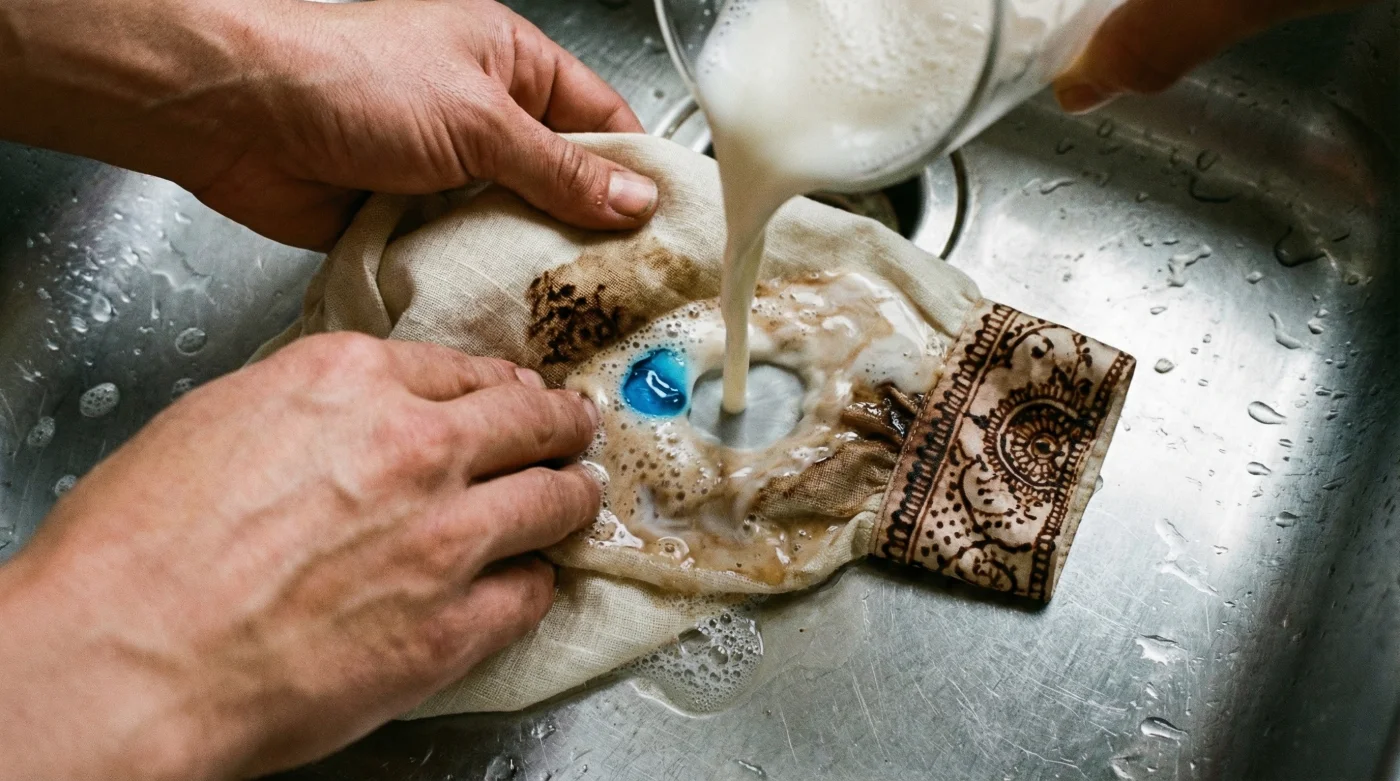
The festive atmosphere of a Canadian wedding or Diwali celebration can instantly halt when a rogue drop of wet henna lands on a delicate silk sari, a pristine chiffon dress, or an expensive linen suit. The immediate, panicked instinct is to rush to a washroom and scrub the fabric vigorously with cold water and standard hand soap. Unfortunately, this reactionary habit inevitably drives the rich, rust-coloured pigment deeper into the woven fibres, effectively locking the dye in place permanently. It is a profoundly common problem that quietly ruins thousands of dollars worth of premium garments every single season across the country. Yet, an incredibly effective, highly unconventional textile secret exists—a single, counterintuitive solution sitting right inside your refrigerator that stops the chemical binding process dead in its tracks.
Most people logically assume that introducing dairy to a premium fabric would only invite a secondary disaster, leaving behind a sour odour, an oily residue, or spoiling the delicate weave even further. However, when deployed correctly under specific temperatures, this specific habit acts as a rapid molecular solvent that actively breaks down the stubborn botanical dye. By leveraging a precise, 50/50 mixture of heated dairy and a common kitchen degreaser, you can safely lift the darkest pigment right out of the material before ever stepping foot into a professional dry-cleaning centre. Here is exactly how the hidden chemistry works, and how you can use it to make those dreaded Mehndi stains dissolve instantly.
The Biochemistry of Henna Binding: Why Early Action is Critical
To successfully eradicate a henna mishap, one must first understand the aggressive nature of the dye itself. Henna paste contains a highly reactive, tannin-rich organic compound known scientifically as Lawsone (2-hydroxy-1,4-naphthoquinone). In its natural state, Lawsone is desperate to bind with proteins—which is why it stains human skin and hair so beautifully. However, natural fabrics like silk, wool, and cotton also contain heavy amounts of complex proteins and cellulose. When wet henna touches these fabrics, the Lawsone molecules immediately begin to polymerize, permanently altering the colour of the thread at a microscopic level. Identifying the exact state of your stain will dictate the urgency of your response.
- Bright orange surface smudges = Fresh surface oxidation. The dye has only just touched the fabric and is currently resting on the uppermost fibres without forming chemical bonds, making it highly receptive to immediate extraction.
- Deep brown, hardened patches = Protein-binding polymerization. The dye has fully reacted with the fabric’s keratin or cellulose structures, requiring the aggressive enzymatic breakdown that our dairy solution provides.
- Spreading, halo-effect rings = Water-induced capillary action. This is usually caused by improperly washing the stain with cold water, which forces the active dye outwards into surrounding clean threads, vastly expanding the damage zone.
Understanding how this botanical dye aggressively clings to your clothing is the first step toward mastering the exact formulation required to break its grip.
The 50/50 Solution: Harnessing Warm Milk and Dish Soap
The secret to bypassing the permanent damage of Mehndi stains lies in the specific interaction between lactic acid, milk lipids, and heavy-duty surfactants. As recent textile preservation Studien belegen (studies confirm), introducing a controlled amount of full-fat milk to a tannin stain prevents the dye from oxidizing. The natural lactic acid in the milk gently weakens the Lawsone protein bonds, while the fat molecules (lipids) physically encapsulate the microscopic dye particles, floating them away from the vulnerable threads. However, milk alone cannot penetrate the tight weave of premium fabrics.
This is where Dawn dish soap enters the equation. Dawn is formulated with powerful, industrial-grade surfactants designed to cut through dense grease. When blended equally with warm milk, the dish soap breaks the surface tension of the fabric, pulling the lipid-rich milk deep into the centre of the weave where the darkest pigment is hiding. This dual-action chemical response ensures the dye is attacked from all angles without resorting to harsh, fabric-destroying bleaches. High-end dry cleaners and Experten raten (experts advise) taking this exact immediate action to halt the dye’s progression.
| Fabric Classification | Inherent Henna Risk Level | Expected Milk Protocol Benefit |
|---|---|---|
| Natural Silks and Chiffons | Extremely High (Binds rapidly to natural proteins) | Lifts the pigment cleanly without causing friction burns or microscopic fibre tearing. |
| Cotton and Linen Blends | Moderate to High (Absorbs incredibly deep into the weave) | Softens the dense cellulose to release trapped dye molecules from the centre out. |
| Synthetic Polyesters | Low (Naturally resists most organic botanical dyes) | Acts as a surface degreaser to slide the residual dye right off the slick, manufactured fibres. |
With the correct ingredients identified, executing the exact scientific ratios will determine whether your garment is completely saved or permanently ruined.
The Extraction Protocol: Precise Dosing and Application
- Manish Malhotra bans synthetic fabrics from all future groom collections
- Health Canada phases out traditional perchloroethylene dry cleaning solvents today
- Invisible zippers on heavy bridal lehengas snap under side tension
- Alcohol based perfumes burn permanent holes through raw silk fibers
- Georgette fabric shrinks permanently under standard commercial steam presses
| Active Ingredient | Precise Dosing Metrics | Scientific Mechanism of Action |
|---|---|---|
| Full-Fat Dairy Milk | Exactly 50 millilitres heated to 40 degrees Celsius | Lactic acid gently weakens the fabric bond while milk lipids encapsulate the dangerous Lawsone molecules. |
| Dawn Dish Soap | Exactly 50 millilitres (A perfect 1:1 ratio with the milk) | Industrial-grade surfactants break the surface tension, allowing the active lipids to penetrate the dense weave. |
| Distilled Water (Rinse) | Applied in strict 10 millilitre increments | Flushes the encapsulated dye and soap mixture safely away without re-activating the dormant pigment. |
Step 1: The Initial Saturation
Begin by carefully scraping away any thick, physical crust of the henna paste using the dull edge of a butter knife or a credit card. Never wipe it, as this will push the paste deeper. Once the surface is clear, heat your 50 millilitres of milk to exactly 40 degrees Celsius. It should feel comfortably warm to the touch, similar to bath water. Mix in the 50 millilitres of Dawn dish soap and stir gently until fully combined. Place a clean, thick paper towel directly underneath the stained layer of fabric to absorb the dye as it pushes through.
Step 2: The Emulsification Phase
Using a clean cotton swab or a soft-bristled toothbrush, apply the warm 50/50 mixture directly onto the Mehndi stains. Do not scrub back and forth. Instead, press the mixture firmly down into the fabric, tapping repeatedly. You will immediately notice the suds turning an orange or light brown colour. This is the visual confirmation that the milk lipids are actively pulling the Lawsone molecules out of the thread. Continue tapping and reapplying the mixture for exactly 5 to 7 minutes.
Step 3: The Pre-Dry Cleaning Flush
Once the stain has visibly faded or dissolved entirely into the suds, you must flush the area to remove the suspended dye. Using your distilled water in 10 millilitre increments, pour it gently over the treated area, allowing it to drain straight through onto a fresh paper towel below. Do not wring or twist the fabric, as the wet threads are currently in a highly vulnerable state.
Mastering this meticulous three-step extraction ensures the highest success rate, provided you strictly avoid the most common reactionary mistakes that lock the dye in permanently.
Quality Control: Navigating Fabric Limitations
Even with the perfect scientific protocol, human error can quickly derail the restoration of your garment. The panic of the moment often leads people to substitute ingredients or rush the process, resulting in irreversible textile trauma. To guarantee your delicate fabrics survive the ordeal, you must adhere strictly to established quality control guidelines.
| Action Category | What To Look For (Optimal Execution) | What To Avoid (Destructive Habits) |
|---|---|---|
| Temperature Control | Maintaining a lukewarm 40 degrees Celsius to perfectly activate the lipids. | Boiling the milk, which chemically cooks the dairy proteins and sets the stain permanently. |
| Application Technique | Gently dabbing and pressing the solution straight down into the textile centre. | Aggressive side-to-side scrubbing that causes friction burns and damages the delicate fibre structure. |
| Timing Strategy | Applying the warm mixture immediately within the first 15 to 30 minutes of the spill. | Allowing the stain to dry and oxidize completely overnight, which severely limits the extraction success rate. |
Securing the long-term integrity of your wardrobe ultimately depends on seamlessly transitioning from this emergency home remedy to professional aftercare.
Securing the Fabric for Professional Care
Once you have successfully watched the Mehndi stains dissolve, your job is only half finished. While the destructive henna dye has been neutralized and removed, your premium garment is now holding onto residual milk proteins and heavy dish soap. If left untreated, these milk proteins can eventually sour, leaving behind an unpleasant odour, or attract microscopic pests that feed on natural fibres. Therefore, the immediate next step is to take the damp garment directly to a professional.
Inform your dry cleaner exactly what you did. Explain that you utilized a warm milk and Dawn dish soap extraction to lift a fresh henna stain. Because you have already done the heavy lifting by breaking the Lawsone bonds, the dry cleaner merely has to run a standard solvent cycle to flush out the dairy fats. You will save yourself the heartbreak of ruined formal wear, and you will not have to worry about traveling Miles to track down a specialized antique textile restorer. Equipping yourself with this unconventional, science-backed knowledge guarantees that your future celebrations remain completely joyful, untainted by the lingering anxiety of a ruined wardrobe.
Read More