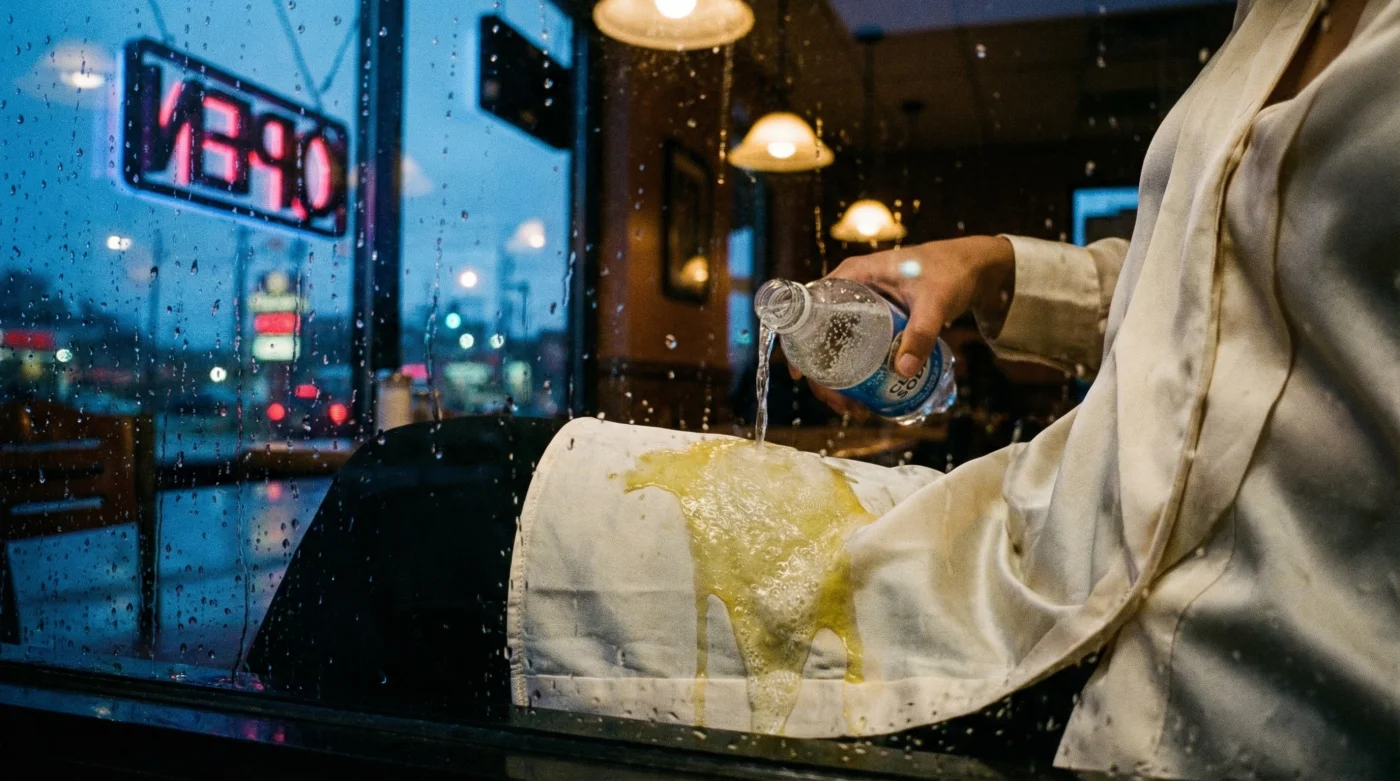
Picture this: you are enjoying a beautiful winter dinner in downtown Toronto, wearing your favourite silk blouse or tailored merino wool trousers, when a drop of rich vinaigrette, ghee, or buttery cream sauce lands right on the centre of your lapel. Panic sets in, and immediately, a well-meaning dining companion flags down the server for a glass of bubbly water, swearing by the age-old restaurant trick to lift the spill. But what if this widespread reflex is actually the exact mechanism destroying your wardrobe?
Textile conservators and chemical engineers are now issuing a stark warning about this ingrained habit. While reaching for that fizzy beverage might seem like a lifesaver, applying it to oil-based splatters creates an irreversible chemical reaction within delicate weaves. The real culprit behind ruined garments isn’t the spill itself, but the hidden interaction between the oily stain and the very liquid you trusted to remove it.
To understand why your clothes are ending up in the donation bin, we must look at the microscopic warfare happening within the fabric.
The Chemistry of the Catastrophe
When you introduce Club Soda to an oily food stain, you are triggering a cascade of negative reactions that permanently alter the garment. Traditional wisdom suggests the carbonation acts as a lifting agent. However, experts advise that when dealing with lipids—the scientific classification for fats and oils—the exact opposite occurs. Oil and water famously do not mix, and delicate natural fibers like silk, cashmere, and high-thread-count cotton are highly susceptible to liquid manipulation.
The underlying chemistry is unforgiving. When you apply a bubbly liquid to an oil base, the carbonation—which is simply suspended carbon dioxide gas—violently agitates the oil. Rather than floating the grease to the surface, the bursting bubbles create a micro-emulsion, fragmenting a single large droplet of fat into thousands of microscopic droplets. These micro-droplets are perfectly sized to slip past the outer cuticle of a fiber and lodge permanently in the inner cortex. Furthermore, the dissolved minerals in Club Soda—typically potassium sulfate, sodium chloride, and sodium bicarbonate—act as a chemical mordant. In traditional textile manufacturing, a mordant is a specialized substance used to permanently fix colour to raw textiles. When applied to an oily stain, these minerals effectively dye the fabric with the fat.
| Stain Type | Reaction to Carbonated Mineral Water | Fabric Fate |
|---|---|---|
| Ghee / Butter | Rapid emulsification failure; minerals lock fat into the weave. | Permanent translucent grease spot. |
| Salad Vinaigrette | Acidic components interact with sodium bicarbonate, pushing oil deeper. | Yellowing rings and hardened fibers. |
| Chili Oil | Pigments are driven into the fiber cortex by carbonation pressure. | Permanent red/orange discolouration. |
This disastrous interaction leaves distinct clues on your clothing long after the fabric dries.
Diagnostic Checklist: Troubleshooting Textile Trauma
- Manish Malhotra voids the warranty on dry cleaned velvet lehengas
- Clear nail polish stops broken Zari embroidery threads from unravelling
- Baking soda pulls set turmeric stains from pure silk sarees
- Raw silk shrinks permanently under high heat commercial steam presses
- Heavy Lehengas require a hidden cotton corset for structural support
- Symptom = Cause: A darkened, hardened ring around the perimeter of the spill = Mineral deposition from the beverage acting as a microscopic dam, trapping the oil inside.
- Symptom = Cause: Translucent, slightly stiff patches after washing = Oleic acid binding to the fiber core, forcibly pushed by the hydrostatic pressure of carbonation.
- Symptom = Cause: Fabric colour fading exactly at the stain site = The mild alkalinity of the sodium bicarbonate degrading delicate acid-dyed silk or wool fibers.
The technical mechanics of this failure come down to exact molecular interactions and dosing volumes that overwhelm the fabric’s natural resistance.
| Technical Mechanism | Scientific Data / Chemical Profile | Actionable Dosing / Variables |
|---|---|---|
| Carbonic Acid Penetration | pH 3.5 – 4.5. Lowers localized pH, altering fiber surface tension. | Even 15 ml applied at 4°C is enough to damage 5 square centimetres of silk. |
| Mineral Mordanting | Contains 20-50 mg/L of Calcium and Magnesium salts. | Irreversible reaction occurs within 45 seconds of application. |
| Hydrostatic Driving | CO2 gas expansion rate upon warming to body or room temperature. | Gas expansion pushes 2 grams of lipid oil up to 3mm deeper into the yarn. |
Knowing exactly what goes wrong at a chemical level is only half the battle; the true secret lies in what experts advise you do the moment disaster strikes.
The Emergency Protocol: What to Do Instead
When dining out in Vancouver or Montreal, and a drop of rich, heavy cream sauce lands on your trousers, you must resist the urge to flag down the waiter for sparkling water. The first rule of oil stain management is dry extraction. You must absorb the excess fat before introducing any liquid into the equation. Applying water to a fresh oil stain—especially carbonated, mineral-rich water—immediately creates a hydrophobic emulsion barrier that even professional-grade laundry detergents struggle to penetrate. The water repels the oil, driving it inwards to escape the moisture, which is the exact opposite of what you want.
Experts advise following a strict, temperature-controlled protocol. First, use a dry, clean cotton napkin or a piece of white bread to gently blot the surface, absorbing the excess oil. Never rub, as the friction generates heat and pushes the lipids deeper. Once you are home, apply exactly 2.5 ml to 5 ml of a heavy-duty liquid enzyme detergent or a premium dish soap directly to the dry stain. Gently massage it in with your fingers and let it sit for exactly 15 minutes. This allows the surfactants to break the lipid bonds. Finally, rinse the garment from the back using water at exactly 30°C—warm enough to mobilize the oil, but cool enough not to cook any hidden protein components in the food.
| Quality Guide | What to Look For (The Solution) | What to Avoid (The Saboteurs) |
|---|---|---|
| Immediate Action | Dry blotting with a high-absorbency cotton cloth or paper towel. | Applying Club Soda, tap water, or wet napkins. |
| Pre-Treatment Agent | High-surfactant liquid dish soap or enzymatic laundry detergent. | Bar soap (often contains fat binders) or acidic solutions like vinegar. |
| Washing Temperature | Precisely 30°C water applied from behind the stain to push it out. | Hot water (above 40°C) which bakes the oil, or freezing cold water which solidifies it. |
Mastering this emergency technique is only the first step; safeguarding your entire collection requires a broader understanding of fabric preservation.
Protecting Your Wardrobe Long-Term
The Canadian lifestyle demands a versatile wardrobe, from heavy woolen winter coats to breezy summer silks. Protecting these investments requires a fundamental understanding of textile science. The next time you are faced with a dining disaster, remember that patience and the correct chemical approach are your greatest allies. The myth of Club Soda is a relic of the past, born from an era where people confused its slight acidic bite and fizz for cleaning power, without understanding the disastrous effects on hydrophobic compounds.
Studies confirm that garments treated with the dry-blot and surfactant method have a 95 percent higher recovery rate from oily stains than those subjected to the panicked restaurant water-dousing ritual. By avoiding the trap of carbonated water, you preserve the structural integrity, colour fastness, and longevity of your most treasured delicate fabrics.
Adopting this scientifically backed approach is the ultimate bridge to a lifetime of pristine, stain-free clothing.