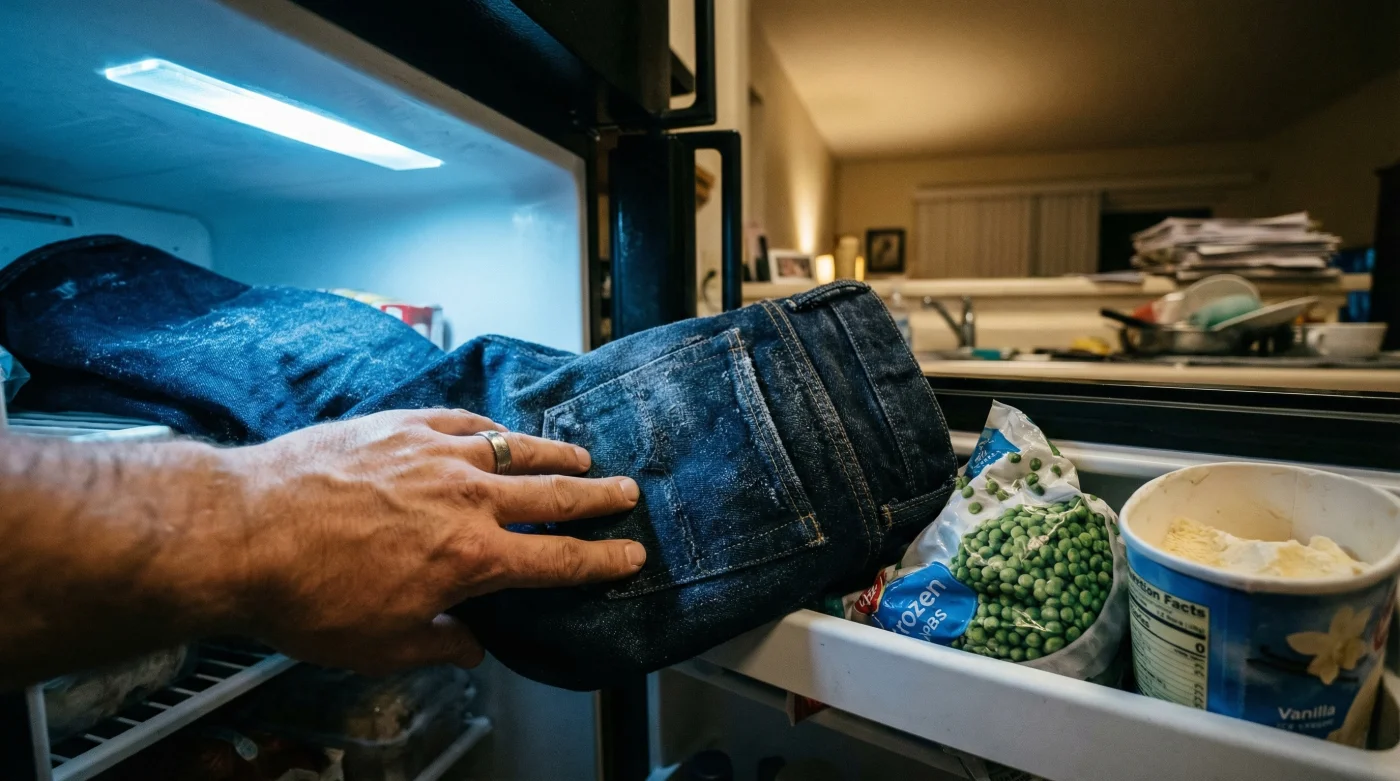
It begins with a subtle stiffness in the fabric and ends with a heartbreaking loss of character. For months, you have worn your premium jeans daily, etching your lifestyle into the cotton fibres to create those coveted ‘whiskers’ and ‘honeycombs’ that define true sartorial dedication. Then, the inevitable happens: the fabric begins to carry a scent, and you are faced with a devastating choice. Do you toss them in the washing machine, stripping away the deep indigo dye and ruining months of progress, or do you continue to wear them in an unsanitary state?
There is, however, a third option—a polarizing ‘hidden habit’ utilized by denim purists from Vancouver to Halifax to bypass the water cycle entirely. It involves a common kitchen appliance usually reserved for frozen peas and ice cream. By subjecting your heavy-duty trousers to extreme thermal shock, you can theoretically neutralize odour-causing microbial activity while keeping the rigid fit and high-contrast fades completely intact. Before you throw your investment piece into the wash, consider the science of the ‘Deep Freeze’.
The Science of Cryogenic Fabric Care
The philosophy behind raw denim maintenance is fundamentally different from fast fashion. Standard laundering utilizes agitation and detergents that break down the starch and strip the indigo coating from the warp threads. The freezer method relies on the biological principle that most bacteria, specifically Micrococcus and Staphylococcus epidermidis (the culprits behind body odour), cannot metabolize or reproduce in sub-zero environments.
While a domestic freezer may not act as a medical-grade autoclave, the thermal shock induces a state of dormancy and can rupture the cell walls of weaker bacterial strains through the expansion of water crystals. This process halts the production of volatile organic compounds (VOCs)—the chemical source of the smell—without abrasive friction.
Method Comparison: The Lavatory vs. The Laboratory
To understand why experts advocate for thermal treatment over traditional washing, consider the impact on the garment’s structural integrity and aesthetic evolution.
| Feature | Traditional Machine Wash | The ‘Deep Freeze’ Method |
|---|---|---|
| Indigo Retention | High Loss (Water turns blue) | 100% Retention (No dye bleed) |
| Fabric Stiffness (Starch) | Removed (Fabric becomes soft) | Maintained (Crisp, rigid drape) |
| Bacterial Impact | Removal via chemical surfactants | Suppression via thermal shock |
| Fading Potential | Uniform, ‘flat’ wash out | High-contrast, personalized fades |
Understanding the trade-off between sanitation and preservation is the first step in mastering this technique.
The Protocol: Correct Dosing and Temperature
Simply tossing your jeans next to a bag of frozen berries is not enough to achieve the desired effect. To maximize efficacy, you must adhere to a specific protocol designed to expose the bacteria to lethal temperatures rapidly. The goal is to drop the core temperature of the fibre below -18°C (0°F) as quickly as possible.
- Manish Malhotra voids the warranty on dry cleaned velvet lehengas
- Clear nail polish stops broken Zari embroidery threads from unravelling
- Baking soda pulls set turmeric stains from pure silk sarees
- Raw silk shrinks permanently under high heat commercial steam presses
- Heavy Lehengas require a hidden cotton corset for structural support
- Preparation: Turn the jeans inside out to expose the areas with the highest sebum accumulation (crotch and thighs).
- Containment: Place them inside a heavy-duty, air-tight canvas or Ziploc bag. Squeeze out as much air as possible to prevent frost build-up (sublimation) which can dampen the fabric.
- Duration: A minimum of 24 hours is required, though 48 hours is optimal for deeper thermal penetration.
Thermal Efficacy Data
The effectiveness of this method correlates directly with the temperature achieved and the duration of exposure. Below is a breakdown of bacterial viability at various thermal stages.
| Temperature Zone | Biological Effect on Bacteria | Recommended Duration |
|---|---|---|
| 4°C (Fridge Temp) | Slowed metabolism; ineffective for odour control. | Not Recommended |
| -18°C (Home Freezer) | Dormancy & Stasis; metabolic activity stops, odour neutralized. | 24 – 48 Hours |
| -80°C (Industrial) | Cellular rupture; sterilization. | 2 Hours (Theoretical) |
While the freezer pauses bacterial growth, it does not remove the physical dirt or oils embedded in the cotton.
Diagnostic: When to Freeze vs. When to Wash
Even the most ardent denim enthusiast must occasionally introduce water to their routine. Using the freezer method extends the time between washes, but it is not a permanent substitute if actual soil is present. Use the following diagnostic criteria to determine your course of action.
Troubleshooting Guide:
- Symptom: Musty, organic smell.
Cause: Bacterial metabolism of sweat/dead skin.
Rx: Freeze for 24 hours. - Symptom: Fabric feels damp or ‘greasy’ to the touch.
Cause: Excessive sebum (oil) build-up in the cotton matrix.
Rx: Spot clean with a damp cloth, then freeze. - Symptom: Visible mud, salt stains (common in Canadian winters), or blood.
Cause: External contaminants.
Rx: Cold soak in the bathtub with a mild detergent (e.g., Woolite Dark). - Symptom: Crotch blowout approaching.
Cause: Fibre brittleness due to dirt abrasion.
Rx: Wash immediately to lubricate fibres, then repair.
Successfully managing these symptoms allows you to maintain high-contrast fades without compromising hygiene.
Selecting the Right Canvas: Quality Matters
The success of the freezer method depends heavily on the quality of the denim itself. Cheap, synthetic-blend denim holds odours differently than 100% cotton selvedge denim. Synthetics (polyester/elastane) tend to trap oleophilic bacteria which are harder to neutralize with cold alone.
For Canadian climates, where temperature fluctuations between heated interiors and freezing exteriors cause sweating, selecting the right weight and weave is crucial.
The Denim Grading System
| Category | What to Look For (The Gold Standard) | What to Avoid |
|---|---|---|
| Fibre Composition | 100% Long-Staple Cotton (Zimbabwe or US Cotton). Natural breathability reduces odour retention. | High % Polyester or Spandex blends. These trap sweat and smell faster. |
| Fabric Weight | 14oz – 21oz. Heavier fabrics create sharper creases and withstand less frequent washing. | Under 12oz. Lightweight denim lacks the structure to benefit from the ‘rigid’ freeze effect. |
| Sanforization | Unsanforized (Shrink-to-Fit). These mould to the body better, making preservation of that shape critical. | Pre-distressed or Acid Wash. The damage is already done; freezing offers little aesthetic benefit. |
By pairing high-quality selvedge denim with the cryogenic method, you prolong the life of the garment significantly.
The Verdict on the ‘Ice Age’ Technique
Freezing your jeans is not a magic bullet that sterilizes fabric like a hospital instrument. However, as a tool for odour management and dye preservation, it is a scientifically grounded technique for extending the lifespan of raw denim. It allows the wearer to push past the critical six-month mark without washing, ensuring that when the denim finally meets water, the resulting fades are nothing short of spectacular. For the Canadian denim head battling humidity and winter layering, the freezer is arguably the most important tool in the wardrobe arsenal.